

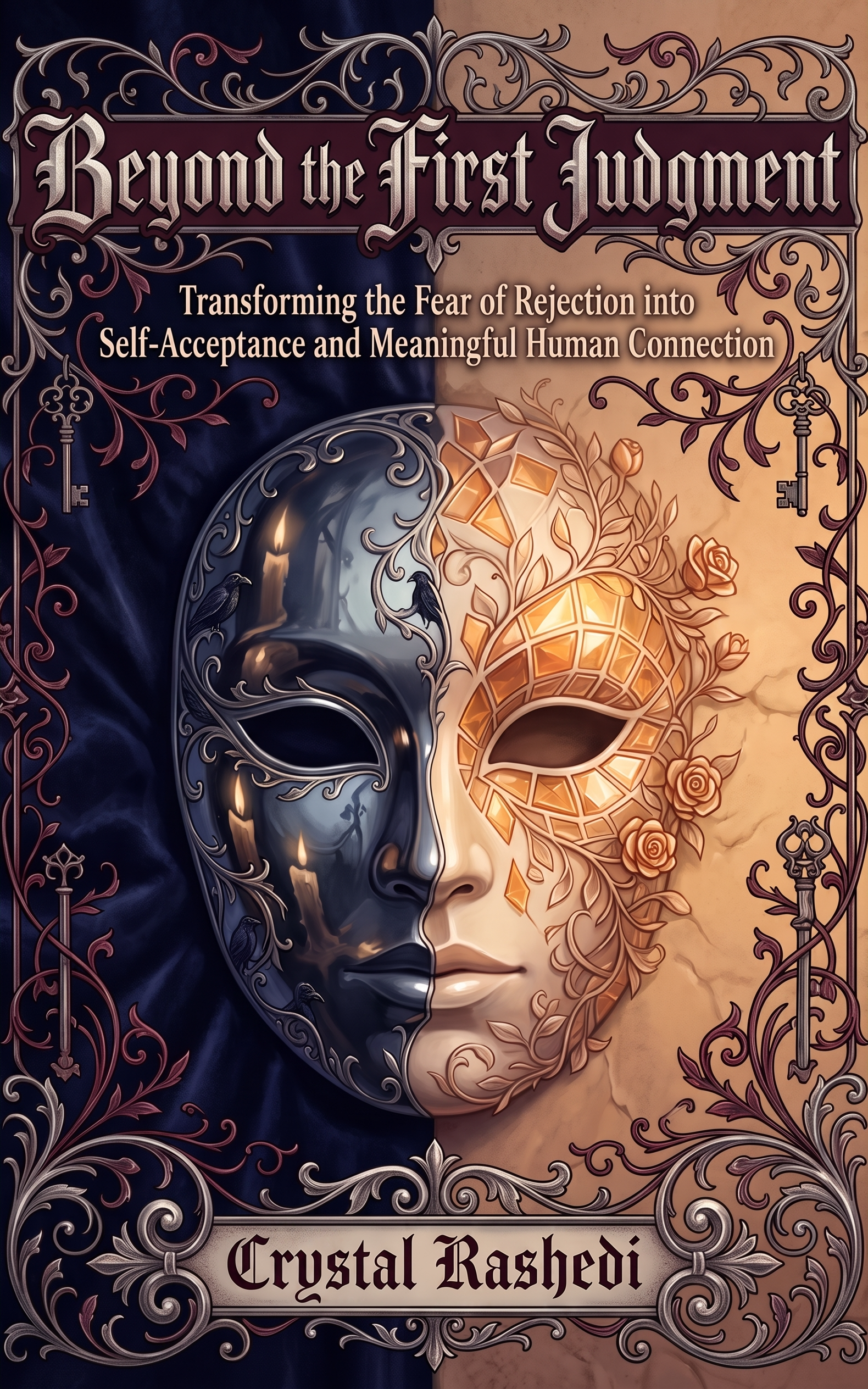
Beyond the First Judgment
Transforming the Fear of Rejection into Self-Acceptance and Meaningful Human Connection
by Crystal Rashedi
How much of your life have you spent trapped in the terror of what other people think? For years, Timothy Gomez lived paralyzed by social anxiety and isolation, constantly bracing for the harsh opinions of strangers and loved ones alike. Every awkward glance felt like an indictment; every silence felt like rejection. But when isolation threatened to consume him completely, Timothy made a radical decision: to confront the psychological roots of judgment head-on. Alongside a diverse community grappling with their own defensive shields—from biting sarcasm to deep-seated agoraphobia—Timothy uncovers a transformative truth. The hostility, criticism, and snap judgments we fear most from others are rarely about us at all; they are the externalized projections of unresolved inner turmoil. Beyond the First Judgment takes readers on an unforgettable journey through vulnerability, cognitive rewiring, and emotional courage. By learning to distinguish between instinctive brain reactions and conscious choices, Timothy discovers that solitude does not have to mean loneliness—and that genuine self-acceptance is the ultimate shield against the world's noise. Raw, compassionate, and deeply insightful, this book offers a profound blueprint for anyone ready to silence fear, reclaim inner peace, and build authentic connections.
- Non-Fiction
- Self-Help
- Psychology
- Memoir
The Voices in the Supermarket
The fluorescent lights in aisle four buzzed with an unbearable hum. I stood glued to the linoleum floor between rows of canned black beans and jars of pasta sauce, my fingers digging into the handle of a metal shopping basket until my knuckles turned chalk white. I was forty-three years old, but right then, I felt like a terrified kid caught doing something wrong. My graphic tee was wrinkled, the collar of my flannel shirt was turned inward, and my scuffed sneakers suddenly looked like an open confession of total personal failure.
A few yards away, a cashier with dark curls glanced up from the register belt. She leaned over toward a bagger and whispered something, her eyebrows lifting slightly before letting out a sharp puff of air. My brain slammed on the emergency brake. Look at him, I imagined her saying. Look at this nervous wreck loitering by the marinara like he forgot how to be a human being. A middle-aged guy pushing a cart bumped past my shoulder without looking at me, his mouth set in a tight, grim line. To my hyper-vigilant mind, that tiny brush was not an accident. It was a deliberate statement of pure contempt. The familiar panic hit my chest like a cold fist, squeezing the oxygen right out of my lungs while my shirt grew damp against my back.
This was the daily nightmare. It was the same relentless mental bullshit that had kept me trapped in my dim apartment for weeks at a stretch, scrolling aimlessly on my phone, staring at water stains on the ceiling, and convincing myself that stepping outside meant walking straight into a firing squad of public mockery. Every sideways smirk, every cleared throat, every neutral stare from a total stranger felt like an indictment against my existence. It made me want to drop the basket right there, run out the automatic double doors, sprint three blocks home, and bolt the deadbolt shut behind me.
I dropped the can of beans back onto the shelf. The clatter echoed louder than I wanted, but instead of sprinting back into isolation, I caught my breath and remembered a flyer I had folded into my back pocket three days earlier. It was a wrinkled piece of blue paper advertising an open peer circle at the community center annex down on Fourth Street. The words on the flyer had promised no clinical nonsense, just honest talk about anxiety and mental balance. I walked out of the store with empty hands, but I forced my feet toward Fourth Street instead of turning toward my quiet apartment.
The community center annex was housed in an old municipal basement. A radiator clanked steadily in the corner, throwing out dry heat against concrete walls painted pale yellow. About a dozen people sat on metal folding chairs arranged in a wide, uneven oval. In the center of the room sat Jason Reed. He wore a simple faded henley and denim jeans, his broad shoulders relaxed, with lines around his hazel eyes that suggested he laughed often despite the gray in his buzz cut. When I slipped through the door and took a seat near the back, Jason did not interrogate me or make a spectacle out of my late arrival. He simply gave me a calm, welcoming nod and continued talking.
"Let us talk about what actually happens when you walk into a room and feel instantly attacked," Jason said, his voice measured and warm. He held up a hand, tracing an imaginary line in the air. "Our brains were built for basic survival long before we invented grocery stores, social etiquette, or polite small talk. Tens of thousands of years ago, if you walked into a clearing and failed to register an immediate threat, you died. The nervous system learned to make split-second evaluations in less than a hundred milliseconds. That is not malice. That is simple biology."
I leaned forward, resting my elbows on my knees, my notebook balanced loosely in my lap. I listened closely as Jason paced the small circle of linoleum.
"Here is the trap," Jason continued, looking around the room. "We assume that because our brains deliver an instant snap judgment, that judgment must represent the absolute truth. We see someone frown in our direction, and our primitive alarm system screams that they hate us. But the truth is far simpler. That cashier who barely looked at you? She is probably stressed about rent, or her feet hurt after six hours on concrete. The guy who shoved past your shoulder in aisle four? He might be dealing with a messy divorce, or grieving a parent, or merely wondering if he forgot milk. People walk around carrying heavy loads of private exhaustion, and they project their internal turmoil onto whoever happens to be standing in front of them."
A quiet murmur moved through the circle. The idea hit me directly in the ribs. For years, I had treated every stranger's grumpy posture as a personal critique designed to point out my flaws. It had never occurred to me that I was simply catching the fallout of somebody else's bad morning.
"Snap judgments are automatic cognitive reflexes," Jason added, pausing to meet the eyes of several people in the room. "They are primitive shortcuts. They are not accurate verdicts about your worth as a person. The real mistake happens when you buy into that first reaction and treat it like hard evidence. When you assume everyone is judging you, you are usually just reading your own self-doubt off of their tired faces."
Jason opened the floor, and for several minutes, the room stayed quiet save for the clatter of the corner radiator. My heart began to pound against my ribs again, but this time it was not panic. It was the strange, terrifying itch of wanting to speak the truth out loud. My hands shook slightly as I raised my arm.
"I almost didn't make it here tonight," I said, my voice scratching the quiet room before finding its rhythm. "Forty minutes ago, I was standing in aisle four at the market, completely paralyzed. A cashier looked in my direction, whispered to a coworker, and my entire body locked up. I was convinced they were mocking my dirty sneakers and how uncomfortable I looked. I almost dropped everything and ran home to hide in the dark."
I stopped, exhaling a ragged breath, half expecting someone to laugh. But nobody did. Across the circle, a woman with sharp blonde hair tied in a practical ponytail was watching me with narrow, attentive eyes. Further down the row, a broad-shouldered man in a faded denim jacket tapped his thumbs together and nodded with quiet understanding. Jason gave me an encouraging smile from across the floor.
"It feels like walking around without skin sometimes," I admitted, rubbing the back of my neck. "You convince yourself that everyone is tracking your mistakes, keeping score of how awkward you are. It exhausts you until staying home alone seems like the only safe option left."
"Thank you for putting that into words, Timothy," Jason said gently. "What you experienced in that aisle was not a revelation of your shortcomings. It was a misfiring defense mechanism trying to keep you safe from perceived danger. The moment you name it, you take away its power to run your life."
When the session ended an hour later, the cold night air outside felt clean against my face. The hum of street traffic on Fourth Street was steady and unhurried. For the first time in years, the city around me did not feel like a hostile room waiting to ridicule my existence. People walked past on the sidewalk, wrapped in their coats, hurried and quiet, lost in their own thoughts and carrying their own hidden burdens. They were not watching me, and I did not need to keep watching them.
The Armor of Sarcasm
The morning rush at the downtown coffee shop was loud, hot, and smelled of scorched espresso beans. Steam hissed from the big chrome machine behind the counter while a dozen people shifted impatiently on the hardwood floor, checking their smart watches and ignoring everyone around them. I stood near the back of the queue with my hands jammed into m…