

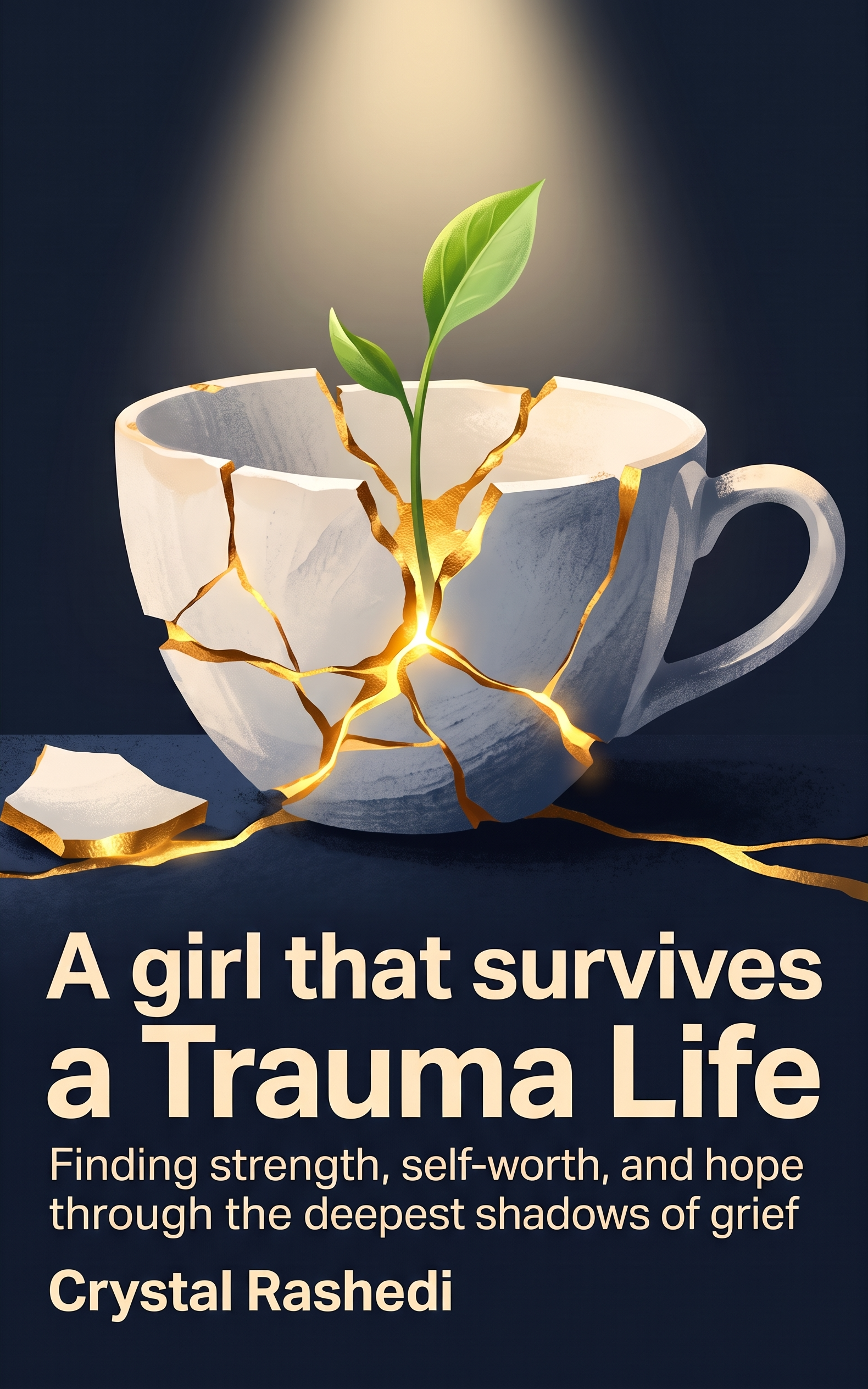
A girl that survives a Trauma Life
Finding strength, self-worth, and hope after enduring profound grief and childhood adversity
by Crystal Rashedi
Trauma changes you, but it doesn't have to define your future. Growing up in an environment where safety was a luxury, Crystal learned early on that survival demanded fierce inner resolve. Yet nothing could prepare her for the profound heartbreak of losing three children—a shattering grief that threatened to consume everything she had worked so hard to build. Instead of letting the darkness claim her, Crystal chose to confront the pain. Navigating demanding professional spaces while carrying invisible scars, she discovered an essential truth: even when it feels like nobody is standing with you, you still have yourself. In A Girl That Survives a Trauma Life, Crystal Rashedi delivers a raw, deeply empowering memoir of resilience, self-discovery, and unconditional hope. Blending poignant personal reflections with inspiring hard-won wisdom, this book reminds every reader who has ever felt broken that they are never truly alone—and that healing begins when we learn to believe in our own power.
The Shadows in My First Home
The human mind is a master of preservation. Long before we have the vocabulary to describe our fears, our bodies understand when the world around us is unsafe. For a young child, the home is supposed to be a sanctuary, a protective dome where the outside world cannot intrude. But when the threat lives inside those very walls, the home changes from a fortress into a maze. You learn to navigate it with your breath held, watching the shadows, waiting for the air to shift.
I remember the heavy silence of my childhood living room. It was not the peaceful quiet of a family resting after a long day. It was a thick, suffocating stillness, the kind that gathers in the air right before a summer storm breaks. In that house, silence was never golden; it was a warning. It meant the adults were nursing their grievances, letting their anger simmer just beneath the surface. During those long hours, even the floorboards seemed to hold their breath, as if any sudden creak would release the chaos we all knew was waiting to explode.
My refuge during those years was the space beneath the kitchen table. It was a modest wooden table with four thick legs, covered by a faded tablecloth that hung down just far enough to shield me from view. I would crawl under there with my knees pulled tightly to my chest, pressed against the cold linoleum floor. From my hiding spot, the world was reduced to feet and ankles. I became a silent observer of the lower half of my family. I learned to read their moods by the way they walked. Fast, heavy steps meant someone was angry; slow, dragging heels signaled exhaustion or depression; a sudden stop meant I needed to stay absolutely still.
One specific night remains etched in my mind with terrifying clarity. It started over something incredibly small, a misplaced set of keys or a dish left in the sink. The details of the argument faded long ago, but the emotional terror remains fresh. The yelling started suddenly, a sharp explosion of voices that shattered the fragile silence of the evening. From my spot under the table, I watched my parents’ feet pacing back and forth across the kitchen. The movements were erratic, aggressive, and fast. I squeezed my eyes shut, wrapping my arms around my legs, trying to make myself as small as a speck of dust. In that moment, the illusion of safety vanished entirely. I realized that my home was not a place of comfort. It was a battleground, and I was a civilian caught in the crossfire, learning how to survive.
The Echoes of the Storm
Living in a constant state of unpredictability changes the way a child’s brain develops. After those loud, explosive nights, I did not simply return to being a normal kid the next morning. The fight-or-flight response does not have an easy off switch. Instead, I lived in a state of chronic high alert, a condition that psychologists call hypervigilance. My nervous system was permanently dialed up to ten, scanning the environment for any sign of danger.
The physical toll of this state was exhausting. My heart would race at the slightest unexpected noise. A slammed car door outside, a dropped spoon in the kitchen, or a sudden raise in someone’s voice would send a jolt of adrenaline straight through my chest. I lived with a perpetual tightness in my shoulders and a stomach that always felt knotted. Peace was a foreign concept to me. I did not know what true relaxation felt like; I only knew the temporary relief that came when a conflict ended. For a child like me, peace was not a state of being. It was simply the quiet space between two arguments.
To survive in this environment, I became an expert at making myself invisible. I learned how to walk without making a sound, stepping on the outer edges of the floorboards where they were less likely to creak. I spoke in a quiet, even tone, never wanting to draw attention to myself. If I did not make any demands, if I did not ask for things, and if I stayed out of the way, I might avoid becoming the target of the household anger. I became a ghost in my own home, a child who was physically present but emotionally hidden, always watching, always waiting.
This habit of disappearing is a common survival strategy for children trapped in chaotic homes. We learn to blend into the wallpaper because standing out feels dangerous. We trade our voice, our needs, and our desires for a fragile sense of safety. The tragedy of this trade is that we carry these habits into adulthood, wondering why we find it so difficult to speak up for ourselves, why we feel like we are taking up too much space in the world, and why we are constantly waiting for the other shoe to drop.
A Window to the Outside
When your immediate surroundings are filled with tension, you have to find a way to escape, even if it is only in your mind. My escape came in the form of a small, worn book I found in the school library. It was a simple story about a young girl who lived in a cabin in the deep, quiet woods. She spent her days exploring the forest, gathering wild berries, and listening to the wind in the trees. There were no raised voices in her world, no unpredictable tempers, and no need to hide under tables.
That book was the first tangible evidence I had that another way of living existed. Up until that point, my home was my entire universe, and I assumed that every family lived in the same state of quiet terror. Reading about the girl in the woods cracked open a door in my mind. It showed me that peace was real, that there were places in the world where you could breathe deeply without fear. I would hide the book under my mattress at night, pulling it out with a small flashlight to read the pages over and over until the words were memorized.
The book became my secret mental sanctuary. When the shouting started downstairs, I would close my eyes and transport myself to that quiet cabin in the woods. I could smell the pine needles, feel the cool breeze, and hear the gentle rustle of the leaves. This was not just daydreaming; it was a survival mechanism that kept my spirit intact. It was the first spark of hope that I could one day build a life of my own design, far away from the chaos of my childhood.
Every survivor of early trauma has their own version of that little book. It might be a teacher who showed them kindness, a hobby that brought them joy, or a dream of a distant place. These small windows to the outside world are crucial. They remind us that our current reality is not the only reality. They plant a seed of desire for something better, a seed that eventually grows into the strength we need to leave the past behind and build a new future.
The Blueprint of Survival
Childhood trauma is not something that simply happens and ends. It leaves behind a blueprint, a set of deeply ingrained beliefs about how the world works and how we must behave to stay safe. When you grow up in an unpredictable environment, you learn several critical lessons that shape your personality and your future interactions:
- The world is inherently dangerous: You learn that safety is temporary and that danger can appear at any moment without warning. This leads to a constant need to control your surroundings to prevent disaster.
- People are unpredictable: You learn to read people’s micro-expressions, body language, and tone of voice with extreme accuracy. You become a human barometer, constantly checking the emotional weather of the room.
- Your needs are secondary: You learn that expressing your feelings, desires, or complaints can cause conflict or neglect. To keep the peace, you bury your own needs and focus entirely on keeping others happy.
- You are responsible for the peace: Children often blame themselves for the chaos around them. You may grow up believing that if you can just be perfect enough, quiet enough, or helpful enough, the anger will stop.
While these lessons are highly effective for keeping a child safe in a dysfunctional home, they become major obstacles in adult life. The hypervigilance that protected you as a child turns into chronic anxiety as an adult. The ability to read people’s moods becomes people-pleasing and a complete lack of personal boundaries. The habit of hiding your needs leads to deep resentment and a feeling of being invisible in your relationships and your career.
It is important to look at these survival skills with compassion. They are not weaknesses; they are signs of your incredible strength and adaptability. You did what you had to do to survive a situation that was far too big and heavy for a child to carry. The goal of healing is not to judge these habits, but to recognize that they are no longer necessary. You are no longer that helpless child under the kitchen table. You are an adult with the power to choose your environment, protect your peace, and speak your truth.
Understanding the Adult Echoes
To understand how these childhood patterns affect us today, it helps to look at how they show up in real-world scenarios. Consider the story of Sarah, a highly successful project manager at a fast-paced advertising agency. By all external measures, Sarah was thriving. She was organized, detail-oriented, and possessed an uncanny ability to anticipate her clients' needs before they even spoke them. Her bosses praised her responsiveness, and her team relied on her to keep projects running smoothly.
But behind closed doors, Sarah was drowning in anxiety. Every email from her director sent her heart racing. If a meeting ran late or a coworker looked slightly frustrated, Sarah would spend hours obsessing over what she might have done wrong. She worked late nights, took on extra work without complaining, and never said no to a request, even when she was exhausted. She lived in a constant state of fear that she would make a mistake and lose her job.
During a coaching session, we began to trace the roots of her work anxiety. Sarah did not have a bad relationship with her current boss, nor was her job actually in jeopardy. Instead, her professional behavior was being driven by her childhood survival strategies. Sarah grew up with an unpredictable, highly critical father who would fly into rages over minor mistakes. As a little girl, Sarah learned that her safety depended on her ability to anticipate his moods, keep him happy, and be absolutely perfect.
When Sarah entered the corporate world, her brain mapped her boss onto her father. The high-stress office environment triggered the exact same survival instincts she used as a child. She was still trying to keep the unpredictable parent happy, still trying to avoid a rage that was no longer coming. Once Sarah realized that her work anxiety was actually a childhood echo, she was able to start separating her past from her present. She began to see that her boss was not her father, that she was allowed to make mistakes, and that she had the power to set boundaries at work without losing her livelihood.
Healing Reflection and Practice
Healing begins with awareness. We cannot change the patterns of our lives until we see them clearly and understand where they came from. To help you connect with your own history and begin the process of untangling your past from your present, I invite you to participate in a reflective exercise. This exercise is designed to help you identify your childhood safety patterns and see how they are still active in your life today.
Take a quiet moment, find a piece of paper, and try the following activity:
- Draw your childhood home: Sketch a simple map of the house or apartment where you lived as a child. Do not worry about artistic quality; a basic floor plan is perfect. Include the main rooms, doors, and windows.
- Mark the zones of safety: Using a green pen or pencil, mark the areas where you felt the most secure, quiet, and protected. This might be your bedroom, a closet, a spot under a table, or even a tree in the backyard.
- Mark the zones of tension: Using a red pen or pencil, mark the areas where the conflict usually happened, where you felt the most anxious, or where you had to be on high alert. This is often the kitchen, the living room, or near the front door.
- Reflect on the map: Look at the contrast between the green and red areas. Where did you spend most of your time? How did you get from a red zone to a green zone without being noticed? Write down any memories or physical sensations that come up as you look at your map.
Once you have completed your map, take some time to answer these reflection questions in a journal or on a separate sheet of paper. Be honest with yourself, and allow whatever emotions surface to flow without judgment:
- What is your earliest memory of feeling like you had to take care of yourself or protect yourself?
- How did you protect your heart when you were little? Did you hide, did you become perfect, did you fight back, or did you try to fix everyone else's problems?
- How do those same protection strategies show up in your adult life today, especially at work or in your close relationships?
- What would a truly safe place look like and feel like for you today? How can you begin to build that space in your current life?
As you work through these questions, remember to be incredibly gentle with yourself. You are digging up old soil, and it is natural for some pain, sadness, or anger to surface. These feelings are not a sign that you are broken; they are a sign that you are finally safe enough to feel what you could not afford to feel when you were a child. The child under the table had to keep those feelings locked away to survive. The adult you are today has the strength, the space, and the compassion to let those feelings out, to listen to them, and to finally lay them to rest.The human mind is a master of preservation. Long before we have the vocabulary to describe our fears, our bodies understand when the world around us is unsafe. For a young child, the home is supposed to be a sanctuary, a protective dome where the outside world cannot intrude. But when the threat lives inside those very walls, the home changes from a fortress into a maze. You learn to navigate it with your breath held, watching the shadows, waiting for the air to shift.
I remember the heavy silence of my childhood living room. It was not the peaceful quiet of a family resting after a long day. It was a thick, suffocating stillness, the kind that gathers in the air right before a summer storm breaks. In that house, silence was never golden; it was a warning. It meant the adults were nursing their grievances, letting their anger simmer just beneath the surface. During those long hours, even the floorboards seemed to hold their breath, as if any sudden creak would release the chaos we all knew was waiting to explode.
My refuge during those years was the space beneath the kitchen table. It was a modest wooden table with four thick legs, covered by a faded tablecloth that hung down just far enough to shield me from view. I would crawl under there with my knees pulled tightly to my chest, pressed against the cold linoleum floor. From my hiding spot, the world was reduced to feet and ankles. I became a silent observer of the lower half of my family. I learned to read their moods by the way they walked. Fast, heavy steps meant someone was angry; slow, dragging heels signaled exhaustion or depression; a sudden stop meant I needed to stay absolutely still.
One specific night remains etched in my mind with terrifying clarity. It started over something incredibly small, a misplaced set of keys or a dish left in the sink. The details of the argument faded long ago, but the emotional terror remains fresh. The yelling started suddenly, a sharp explosion of voices that shattered the fragile silence of the evening. From my spot under the table, I watched my parents’ feet pacing back and forth across the kitchen. The movements were erratic, aggressive, and fast. I squeezed my eyes shut, wrapping my arms around my legs, trying to make myself as small as a speck of dust. In that moment, the illusion of safety vanished entirely. I realized that my home was not a place of comfort. It was a battleground, and I was a civilian caught in the crossfire, learning how to survive.
The Echoes of the Storm
Living in a constant state of unpredictability changes the way a child’s brain develops. After those loud, explosive nights, I did not simply return to being a normal kid the next morning. The fight-or-flight response does not have an easy off switch. Instead, I lived in a state of chronic high alert, a condition that psychologists call hypervigilance. My nervous system was permanently dialed up to ten, scanning the environment for any sign of danger.
The physical toll of this state was exhausting. My heart would race at the slightest unexpected noise. A slammed car door outside, a dropped spoon in the kitchen, or a sudden raise in someone’s voice would send a jolt of adrenaline straight through my chest. I lived with a perpetual tightness in my shoulders and a stomach that always felt knotted. Peace was a foreign concept to me. I did not know what true relaxation felt like; I only knew the temporary relief that came when a conflict ended. For a child like me, peace was not a state of being. It was simply the quiet space between two arguments.
To survive in this environment, I became an expert at making myself invisible. I learned how to walk without making a sound, stepping on the outer edges of the floorboards where they were less likely to creak. I spoke in a quiet, even tone, never wanting to draw attention to myself. If I did not make any demands, if I did not ask for things, and if I stayed out of the way, I might avoid becoming the target of the household anger. I became a ghost in my own home, a child who was physically present but emotionally hidden, always watching, always waiting.
This habit of disappearing is a common survival strategy for children trapped in chaotic homes. We learn to blend into the wallpaper because standing out feels dangerous. We trade our voice, our needs, and our desires for a fragile sense of safety. The tragedy of this trade is that we carry these habits into adulthood, wondering why we find it so difficult to speak up for ourselves, why we feel like we are taking up too much space in the world, and why we are constantly waiting for the other shoe to drop.
A Window to the Outside
When your immediate surroundings are filled with tension, you have to find a way to escape, even if it is only in your mind. My escape came in the form of a small, worn book I found in the school library. It was a simple story about a young girl who lived in a cabin in the deep, quiet woods. She spent her days exploring the forest, gathering wild berries, and listening to the wind in the trees. There were no raised voices in her world, no unpredictable tempers, and no need to hide under tables.
That book was the first tangible evidence I had that another way of living existed. Up until that point, my home was my entire universe, and I assumed that every family lived in the same state of quiet terror. Reading about the girl in the woods cracked open a door in my mind. It showed me that peace was real, that there were places in the world where you could breathe deeply without fear. I would hide the book under my mattress at night, pulling it out with a small flashlight to read the pages over and over until the words were memorized.
The book became my secret mental sanctuary. When the shouting started downstairs, I would close my eyes and transport myself to that quiet cabin in the woods. I could smell the pine needles, feel the cool breeze, and hear the gentle rustle of the leaves. This was not just daydreaming; it was a survival mechanism that kept my spirit intact. It was the first spark of hope that I could one day build a life of my own design, far away from the chaos of my childhood.
Every survivor of early trauma has their own version of that little book. It might be a teacher who showed them kindness, a hobby that brought them joy, or a dream of a distant place. These small windows to the outside world are crucial. They remind us that our current reality is not the only reality. They plant a seed of desire for something better, a seed that eventually grows into the strength we need to leave the past behind and build a new future.
The Blueprint of Survival
Childhood trauma is not something that simply happens and ends. It leaves behind a blueprint, a set of deeply ingrained beliefs about how the world works and how we must behave to stay safe. When you grow up in an unpredictable environment, you learn several critical lessons that shape your personality and your future interactions:
The world is inherently dangerous: You learn that safety is temporary and that danger can appear at any moment without warning. This leads to a constant need to control your surroundings to prevent disaster.
People are unpredictable: Yoÿu learn to read people’s micro-expressions, body language, and tone of voice with extreme accuracy. You become a human barometer, constantly checking the emotional weather of the room.
Your needs are secondary: You learn that expressing your feelings, desires, or complaints can cause conflict or neglect. To keep the peace, you bury your own needs and focus entirely on keeping others happy.
You are responsible for the peace: Children often blame themselves for the chaos around them. You may grow up believing that if you can just be perfect enough, quiet enough, or helpful enough, the anger will stop.
While these lessons are highly effective for keeping a child safe in a dysfunctional home, they become major obstacles in adult life. The hypervigilance that protected you as a child turns into chronic anxiety as an adult. The ability to read people’s moods becomes people-pleasing and a complete lack of personal boundaries. The habit of hiding your needs leads to deep resentment and a feeling of being invisible in your relationships and your career.
It is important to look at these survival skills with compassion. They are not weaknesses; they are signs of your incredible strength and adaptability. You did what you had to do to survive a situation that was far too big and heavy for a child to carry. The goal of healing is not to judge these habits, but to recognize that they are no longer necessary. You are no longer that helpless child under the kitchen table. You are an adult with the power to choose your environment, protect your peace, and speak your truth.
Understanding the Adult Echoes
To understand how these childhood patterns affect us today, it helps to look at how they show up in real-world scenarios. Consider the story of Sarah, a highly successful project manager at a fast-paced advertising agency. By all external measures, Sarah was thriving. She was organized, detail-oriented, and possessed an uncanny ability to anticipate her clients' needs before they even spoke them. Her bosses praised her responsiveness, and her team relied on her to keep projects running smoothly.
But behind closed doors, Sarah was drowning in anxiety. Every email from her director sent her heart racing. If a meeting ran late or a coworker looked slightly frustrated, Sarah would spend hours obsessing over what she might have done wrong. She worked late nights, took on extra work without complaining, and never said no to a request, even when she was exhausted. She lived in a constant state of fear that she would make a mistake and lose her job.
During a coaching session, we began to trace the roots of her work anxiety. Sarah did not have a bad relationship with her current boss, nor was her job actually in jeopardy. Instead, her professional behavior was being driven by her childhood survival strategies. Sarah grew up with an unpredictable, highly critical father who would fly into rages over minor mistakes. As a little girl, Sarah learned that her safety depended on her ability to anticipate his moods, keep him happy, and be absolutely perfect.
When Sarah entered the corporate world, her brain mapped her boss onto her father. The high-stress office environment triggered the exact same survival instincts she used as a child. She was still trying to keep the unpredictable parent happy, still trying to avoid a rage that was no longer coming. Once Sarah realized that her work anxiety was actually a childhood echo, she was able to start separating her past from her present. She began to see that her boss was not her father, that she was allowed to make mistakes, and that she had the power to set boundaries at work without losing her livelihood.
Healing Reflection and Practice
Healing begins with awareness. We cannot change the patterns of our lives until we see them clearly and understand where they came from. To help you connect with your own history and begin the process of untangling your past from your present, I invite you to participate in a reflective exercise. This exercise is designed to help you identify your childhood safety patterns and see how they are still active in your life today.
Take a quiet moment, find a piece of paper, and try the following activity:
Draw your childhood home: Sketch a simple map of the house or apartment where you lived as a child. Do not worry about artistic quality; a basic floor plan is perfect. Include the main rooms, doors, and windows.
Mark the zones of safety: Using a green pen or pencil, mark the areas where you felt the most secure, quiet, and protected. This might be your bedroom, a closet, a spot under a table, or even a tree in the backyard.
Mark the zones of tension: Using a red pen or pencil, mark the areas where the conflict usually happened, where you felt the most anxious, or where you had to be on high alert. This is often the kitchen, the living room, or near the front door.
Reflect on the map: Look at the contrast between the green and red areas. Where did you spend most of your time? How did you get from a red zone to a green zone without being noticed? Write down any memories or physical sensations that come up as you look at your map.
Once you have completed your map, take some time to answer these reflection questions in a journal or on a separate sheet of paper. Be honest with yourself, and allow whatever emotions surface to flow without judgment:
What is your earliest memory of feeling like you had to take care of yourself or protect yourself?
How did you protect your heart when you were little? Did you hide, did you become perfect, did you fight back, or did you try to fix everyone else's problems?
How do those same protection strategies show up in your adult life today, especially at work or in your close relationships?
What would a truly safe place look like and feel like for you today? How can you begin to build that space in your current life?
As you work through these questions, remember to be incredibly gentle with yourself. You are digging up old soil, and it is natural for some pain, sadness, or anger to surface. These feelings are not a sign that you are broken; they are a sign that you are finally safe enough to feel what you could not afford to feel when you were a child. The child under the table had to keep those feelings locked away to survive. The adult you are today has the strength, the space, and the compassion to let those feelings out, to listen to them, and to finally lay them to rest.
Learning to Walk on Eggshells
The brass doorknob was always cold, no matter how hot the afternoon had been outside. Turning that knob meant crossing an invisible border between the neighborhood sidewalk and an emotional minefield. Before I even pushed the front door open, my small body went through an entire diagnostic routine. I would pause on the welcome mat, listen through t…