

Courage Legends in Masterpieces
Discovering Strength, Rebellion, and Resilience Across Timeless Masterpieces
by BigCat (InGallery.art)
Art was never meant to hang silent on a wall. From the Renaissance to Modernism, from the depths of faith to the fury of politics, from the madness of creators to the resilience of ordinary people—these 100 masterpieces all tell us the same story, echoed across a thousand years: How humans choose courage in the face of despair, temptation, loneliness, and fear. We come from InGallery.art. We believe art is not simply an investment or decoration. It's a mirror—one that reflects the deepest truths we hold about ourselves. This book is our invitation to you. As you turn each page, you're not just looking at a painting. You're discovering answers to a question that has defined human civilization: What does courage actually look like? It might be a steady gaze that refuses to look away. It might be a voice crying out without hesitation. It might be thousands standing shoulder to shoulder. It might be the madness of breaking the rules. It might be moving forward even when hope has faded. It might be rising again after falling. In the 100 works ahead, you'll witness courage in every form it can take. Each painting holds a story. Each story holds a mirror back to you. Now begin this journey—one that crosses time, geography, and the human soul itself.
- Historical Non-Fiction
- Self-Help
- Art History
- Cultural & Social History
- Resilience & Grit
- Mindset & Motivation
沉默的勇气 - 直面而不逃避
True courage does not always shout. We often associate bravery with the clash of steel, the roar of an army, or the defiant speech delivered before a hostile crowd. Yet across centuries of artistic expression, painters and sculptors have captured a different kind of strength, one that happens entirely in stillness. This is the courage of the interior life. It belongs to those who recognize that an inevitable suffering, loss, or transition has arrived, and who choose to meet that reality without running away, without bargaining, and without losing their moral center.
When you cannot change an external outcome, the only territory left to govern is your own spirit. The masterworks examined in this chapter do not depict triumphant conquerors or easy victories. Instead, they present men and women suspended in moments of extreme vulnerability, betrayal, grief, and physical agony. Through their quiet composure, these figures demonstrate that enduring a trial with dignity requires as much resolve as charging into battle.
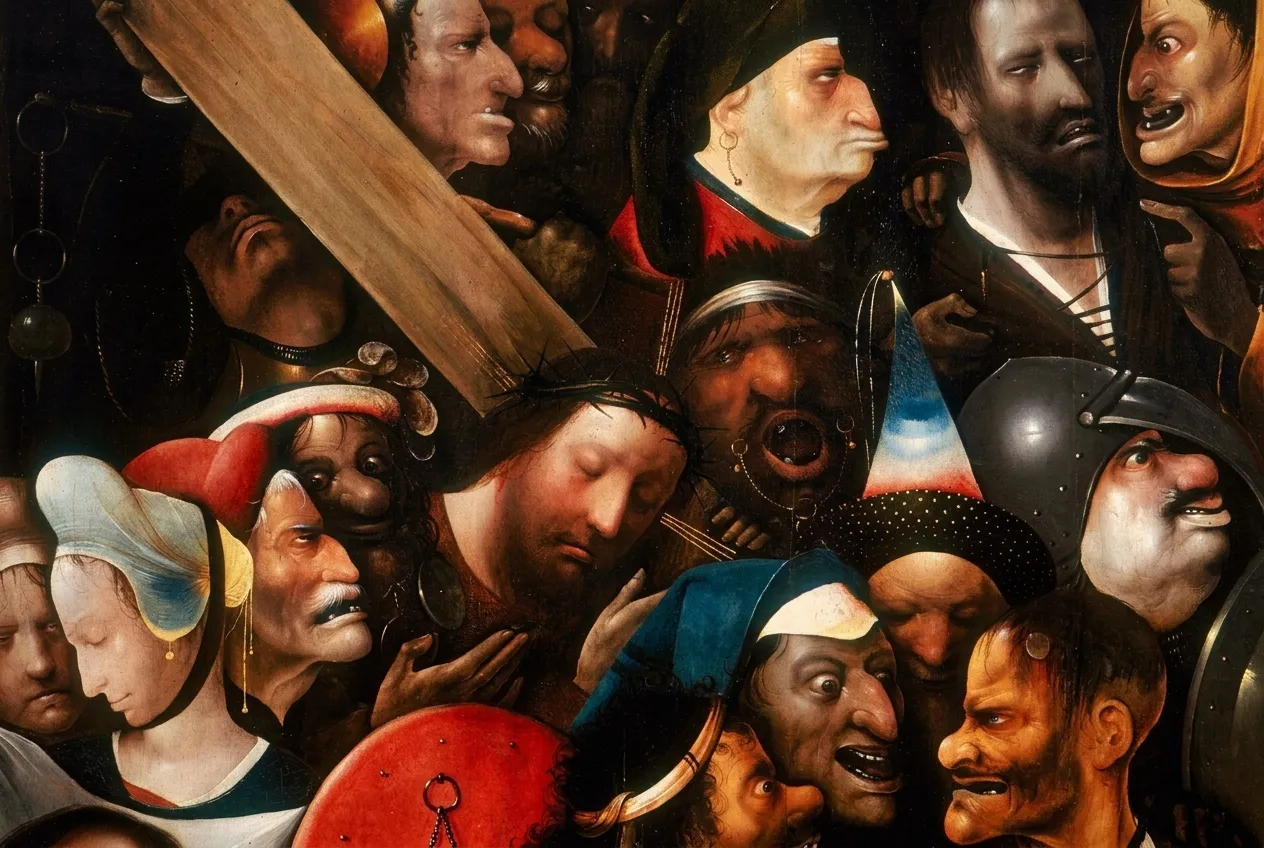
1. The Arrest of Christ (The Kiss of Judas) — Caravaggio (1602)
In the pitch-black garden of Gethsemane, chaos erupts. Armored soldiers press forward with heavy metal plates and polished helmets, their faces obscured by the shadows of their helmets. A single lantern held aloft cuts through the night, casting hard, dramatic light across the scene. Judas leans in, his face tense and eager, planting the fatal kiss of betrayal. To the left, a disciple flees in terror, his mouth open in an unheeded scream, his cloak trailing behind him. Yet right at the center of this violent kinetic storm stands Jesus.
Caravaggio portrays him not as an untouchable divine spirit, but as a flesh-and-blood man who has already settled the question within himself. His hands are clasped loosely together in front of his waist. His head tilts slightly downward, his eyes heavy with sorrow but devoid of panic. He does not pull back from the Judas kiss, nor does he reach out to strike the approaching guards. There is no physical resistance, yet his presence dominates the entire canvas.
This is the silent courage of acceptance. Christ knows precisely what this arrest means: the trials, the mockery, the scourging, and the cross. He has spent the hours before this moment wrestling with dread in the dark, but now that the hour has struck, his internal debate is over. His stillness is not passivity. Passive surrender happens when a person collapses under superior force; conscious acceptance occurs when a person chooses to endure a catastrophe because running away would destroy who they are.
Consider how difficult it is to remain still when everything around you screams for flight or counterattack. When betrayal comes, our instinct is to rage, to defend our reputation, or to strike out at the betrayer. Caravaggio reminds us that a higher strength exists: the ability to look directly into the face of treachery, recognize the road ahead, and step forward without losing our composure.
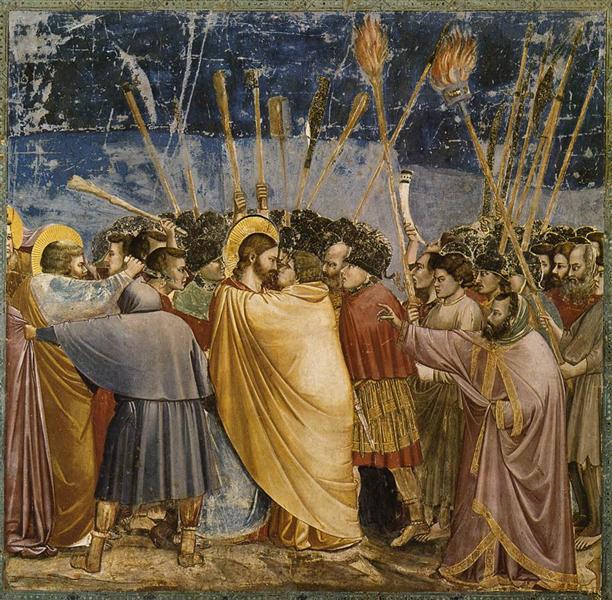
2. The Tribute Money — Masaccio (1424–1428)
On the walls of the Brancacci Chapel in Florence, Masaccio revolutionized painting by introducing realistic spatial depth and weight to the human figure. In The Tribute Money, he gathers three distinct moments into a single narrative landscape. In the center, a Roman tax collector blocks the path of Jesus and his disciples, demanding payment. The disciples are agitated, looking at one another with confusion and defensive postures. They have no money, and the demand appears impossible to meet.
Jesus remains remarkably calm. Without raising his voice or disputing the authority of the collector, he points toward the Sea of Galilee on the far left. He directs Peter to go to the water, cast a line, and look inside the mouth of the first fish he catches, where he will find a coin. On the left edge of the fresco, Peter kneels alone on the riverbank, pulling the coin from the creature's mouth. On the right, Peter hands the coin directly to the collector, settling the debt with quiet dignity.
The silent courage shown here belongs to Peter. The command he receives defies everyday logic. Fishermen know that coins do not belong inside the mouths of fish, and practical men do not solve financial confrontations through absurd gestures. Yet Peter suspends his doubts. His courage does not come from intellectual certainty, but from trust. He walks away from the argumentative crowd, kneels in the mud, and does the work.
Life frequently confronts us with demands that seem unjust or insoluble through standard logic. In such moments, the loud reaction is cynicism, argument, or panic. The quiet reaction is to trust our core principles, perform the task right before us, and discover that solutions often emerge from the most unexpected places. It takes immense internal discipline to act on faith when reason offers no guarantees.
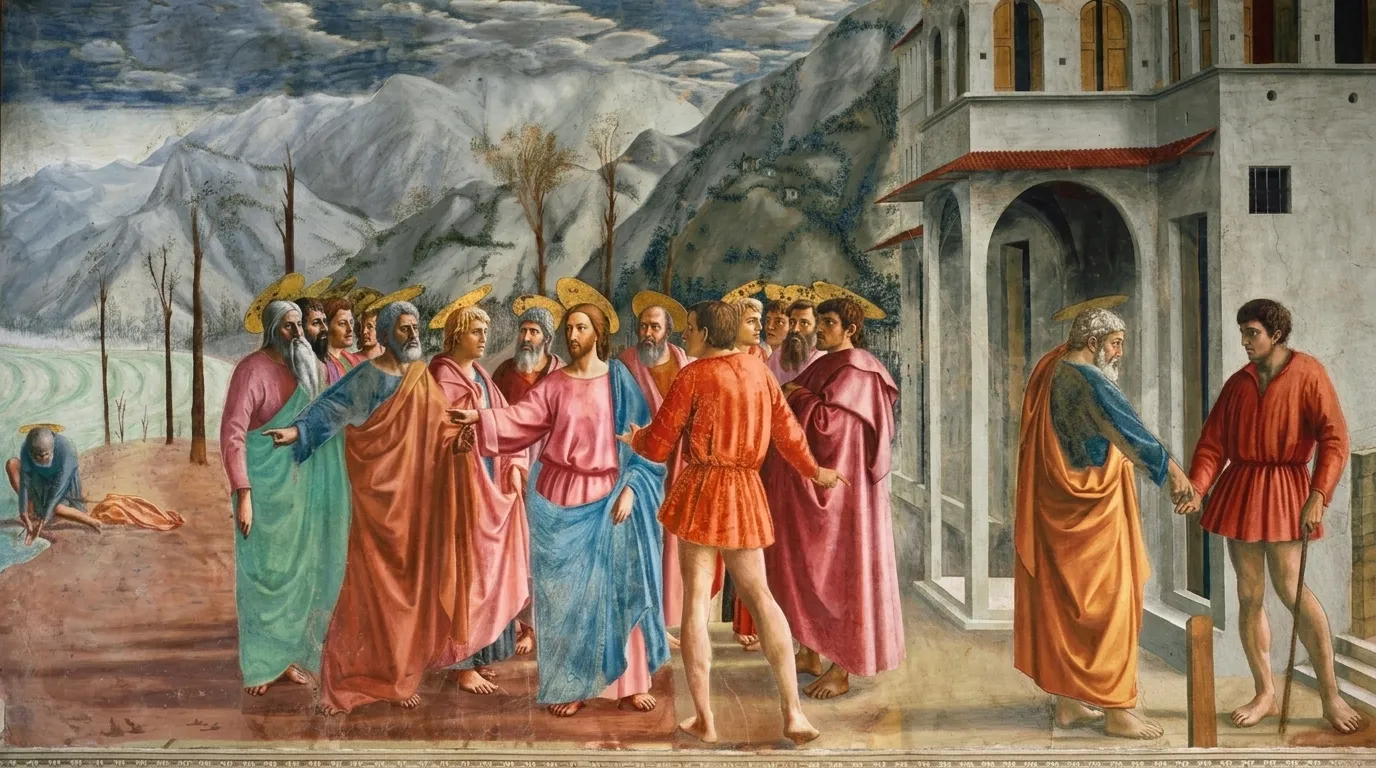
3. The Carrying of the Cross — Hieronymus Bosch (c. 1510–1516)
Hieronymus Bosch offers one of the most disturbing visions of human malice ever painted. The canvas is choked with grotesque, exaggerated faces that press tightly against one another. There is no sky, no landscape, no open air to breathe. Every corner is filled with sneering mouths, bloodshot eyes, hooked noses, and twisted expressions of mockery and cruelty. These figures represent the lowest instincts of the mob — ignorance, sadistic pleasure in another person's pain, and blind conformity to violence.
In the middle of this suffocating darkness, Christ carries the heavy wooden beam of the cross. His eyes are closed. His face is serene, smooth, and utterly still. He does not look at his tormentors, nor does he engage with their insults. He retreats into an untouchable sanctuary within his own soul. Next to him, the thief who repents shows a similar inward look, while the unrepentant thief snarls back at the crowd, mirroring the ugly energy of his captors.
Bosch presents us with the courage to remain clean amid moral corruption. When we find ourselves surrounded by cynicism, hostility, or cruelty, the easiest path is to adopt the methods of our opponents — to scream back, to sneer, to match hatred with hatred. But the moment you return malice for malice, you let the mob dictate your character. Christ's closed eyes are an active choice to refuse the world's poison. His quiet dignity acts as a mirror that exposes the ugliness around him without allowing that ugliness to enter him.
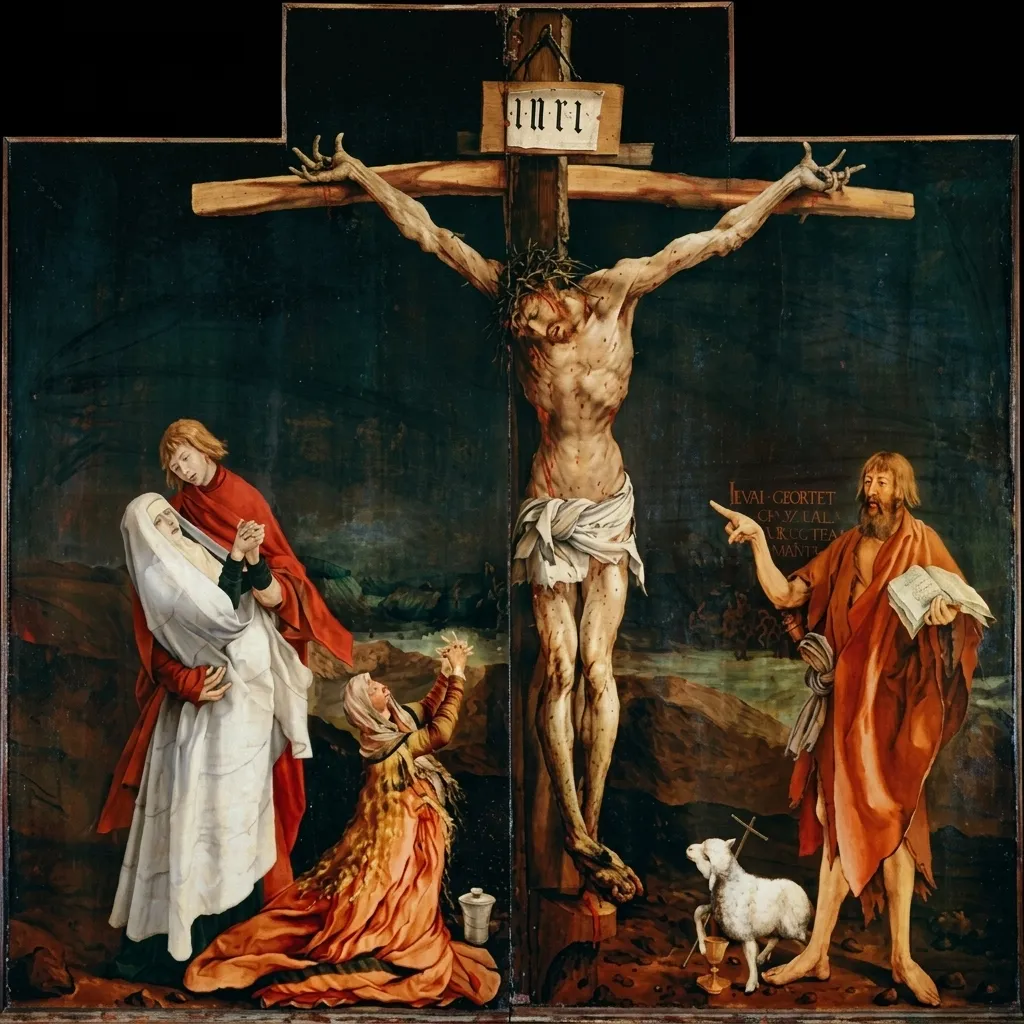
4. The Crucifixion — Matthias Grünewald (c. 1512–1516)
Painted for a hospital monastery in Isenheim where monks treated victims of the plague and painful skin diseases, Grünewald's crucifixion refuses every impulse toward decorative beauty. The body of Christ is covered in gray-green pallor, torn by thorns, and studded with festering splinters. His hands are splayed open, his fingers twisted into rigid claws of agony. His ribcage strains against taut skin, and his feet are pinned together by an enormous iron spike. The sky behind him is pitch-black, stripped of all comfort.
Below the cross, Mary Magdalene weeps uncontrollably, and John the Baptist points an elongated finger toward the dying man. There is no sentimentality here. Pain is depicted as visceral, raw, and total. Yet despite the graphic physical horror, the work breathes a solemn, heavy peace. Christ's head has dropped to his chest. His final breath has left him, not in a scream of defeat, but in the absolute completion of a chosen burden.
Grünewald articulates the courage of ultimate endurance. Some trials cannot be softened, romanticized, or reasoned away; they must be borne in their full, brutal weight. The patients at Isenheim looked at this painting and recognized that their own agony was mirrored in this figure. When physical or emotional suffering reaches its highest intensity, courage stops looking like action and becomes the simple, massive ability to hold fast and refuse to break inwardly until the ordeal is finished.
5. Saint Sebastian Attended by Irene — Georges de La Tour (c. 1649)
Saint Sebastian was a Roman soldier condemned to death for his Christian faith, tied to a stake and shot through with arrows. While many artists depicted him during the execution, Georges de La Tour chooses the intimate aftermath. In the dark of night, Saint Irene and her attendants come to rescue the martyr. A single candle, shaded by Irene's hand, illuminates the quiet scene with a warm, amber glow.
Sebastian sits slumped against a tree, his muscular body pale and vulnerable. A single arrow protrudes from his ribcage. Irene leans over him with exquisite gentleness, preparing to remove the shaft and dress his wounds. Sebastian does not cry out. His head rests back, his eyes half-closed, his face reflecting a deep, stoic endurance. The atmosphere is not one of frantic medical rescue, but of silent reverence and mutual respect.
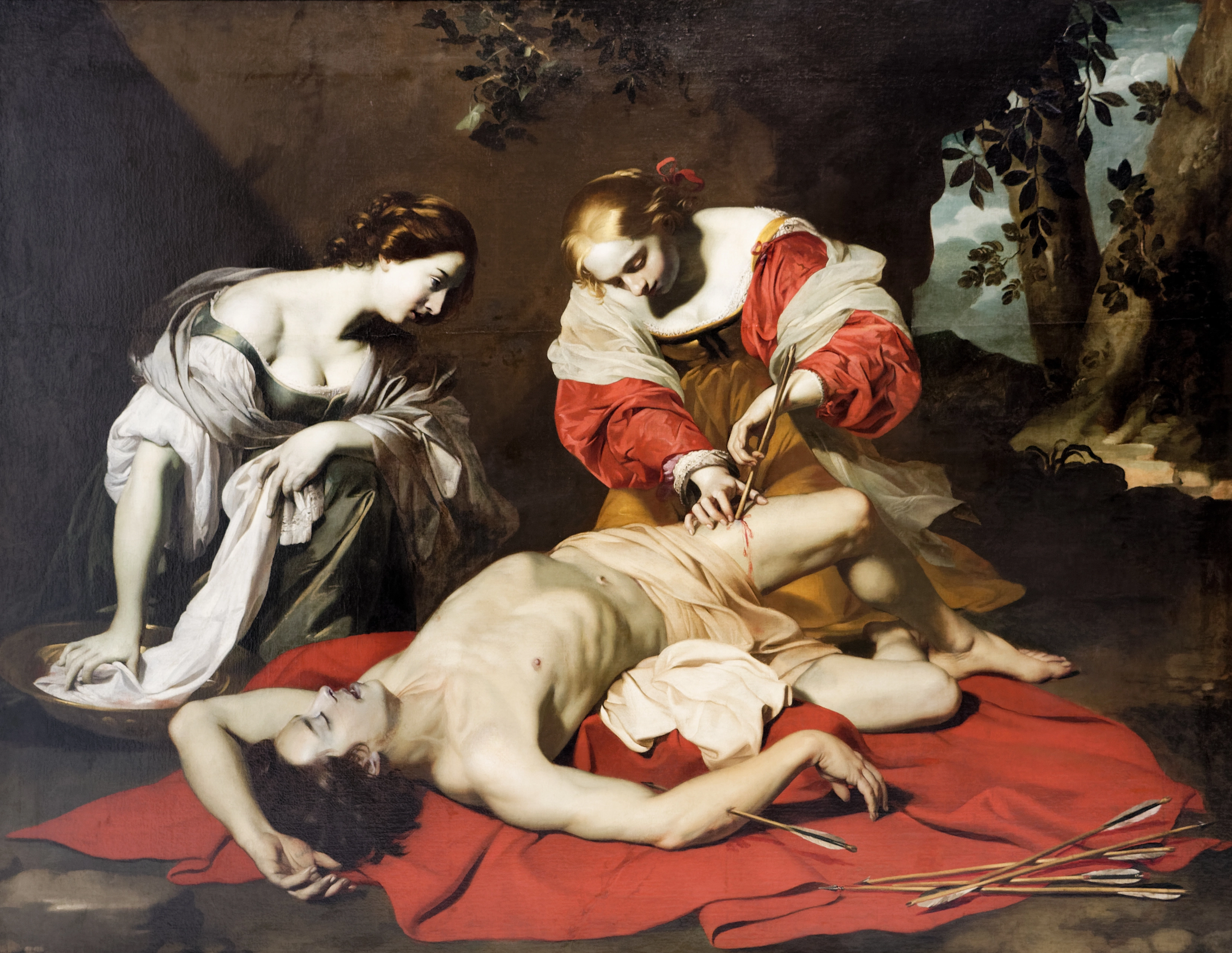
This work reveals two complementary forms of quiet bravery:
- The Courage of the Wounded: Sebastian accepts pain and physical helplessness without bitterness, maintaining his dignity even when stripped and broken.
- The Courage of the Healer: Irene risks her own life by venturing into imperial territory to care for a condemned man, offering compassion where cruelty ruled.
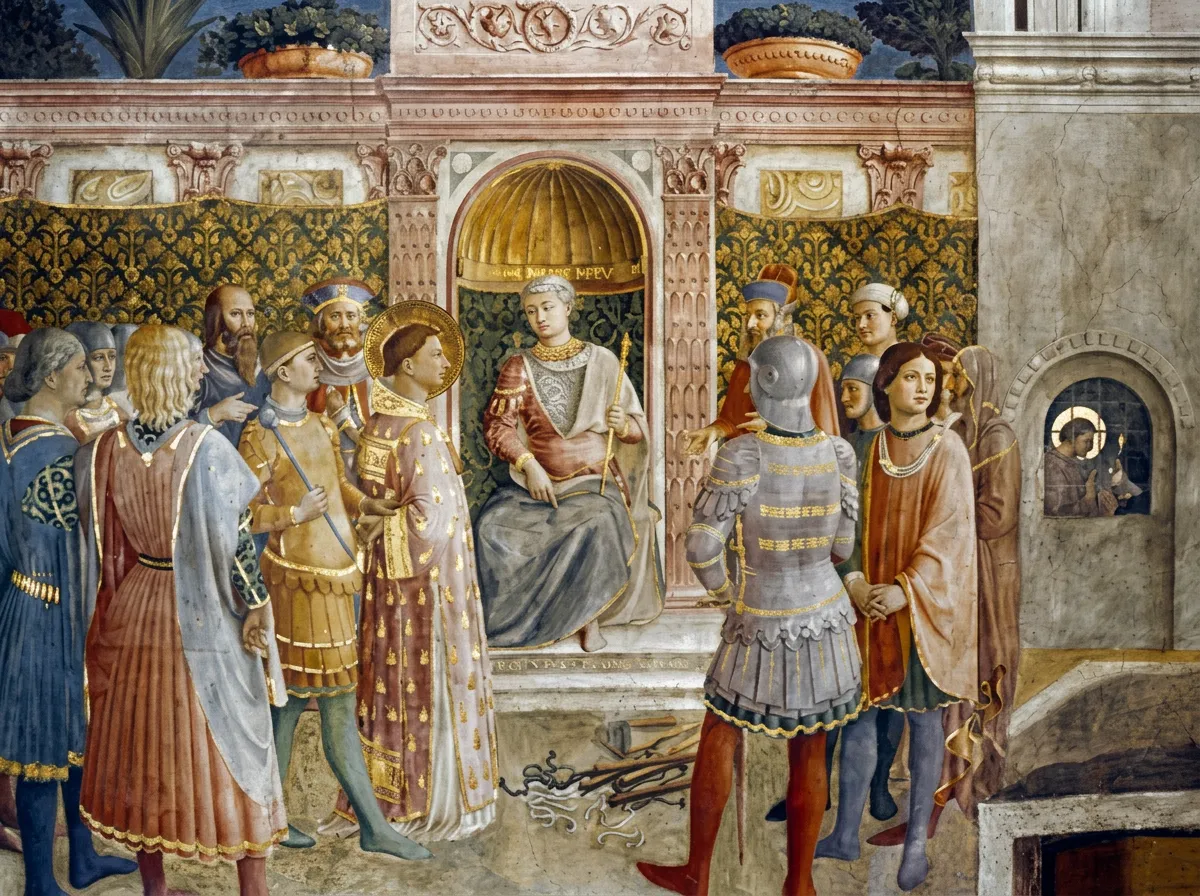
6. Saint Lawrence Before the Roman Prefect — Fra Angelico (1447–1449)
In the Niccoline Chapel of the Vatican, Fra Angelico painted the life of Saint Lawrence, a deacon of Rome who was ordered by the imperial prefect to hand over all the treasures of the church. Instead of surrendering gold, Lawrence distributed the church's wealth to the poor, the sick, and the orphaned, then brought these suffering people before the prefect, declaring: "These are the treasures of the church."
Fra Angelico captures the moment of confrontation. The Roman prefect sits elevated on an ornate throne, surrounded by armed guards holding spears and axes. The architecture is classical, imposing, and solid, projecting the full weight of imperial authority. Standing on the floor below is Lawrence, dressed in the simple red robe of a deacon. He looks directly at the ruler. His face is serene, his spine straight, his hands open.
Lawrence exhibits the courage to speak truth to power without anger. He does not wave weapons or incite a riot. He simply refuses to compromise his moral duty. When confronted by an oppressive system that measures value in coins and conquered land, he counters with the value of human dignity. His strength lies in his clarity: he knows what he stands for, he understands the fatal consequences of his stance, and he delivers his truth with absolute calm.
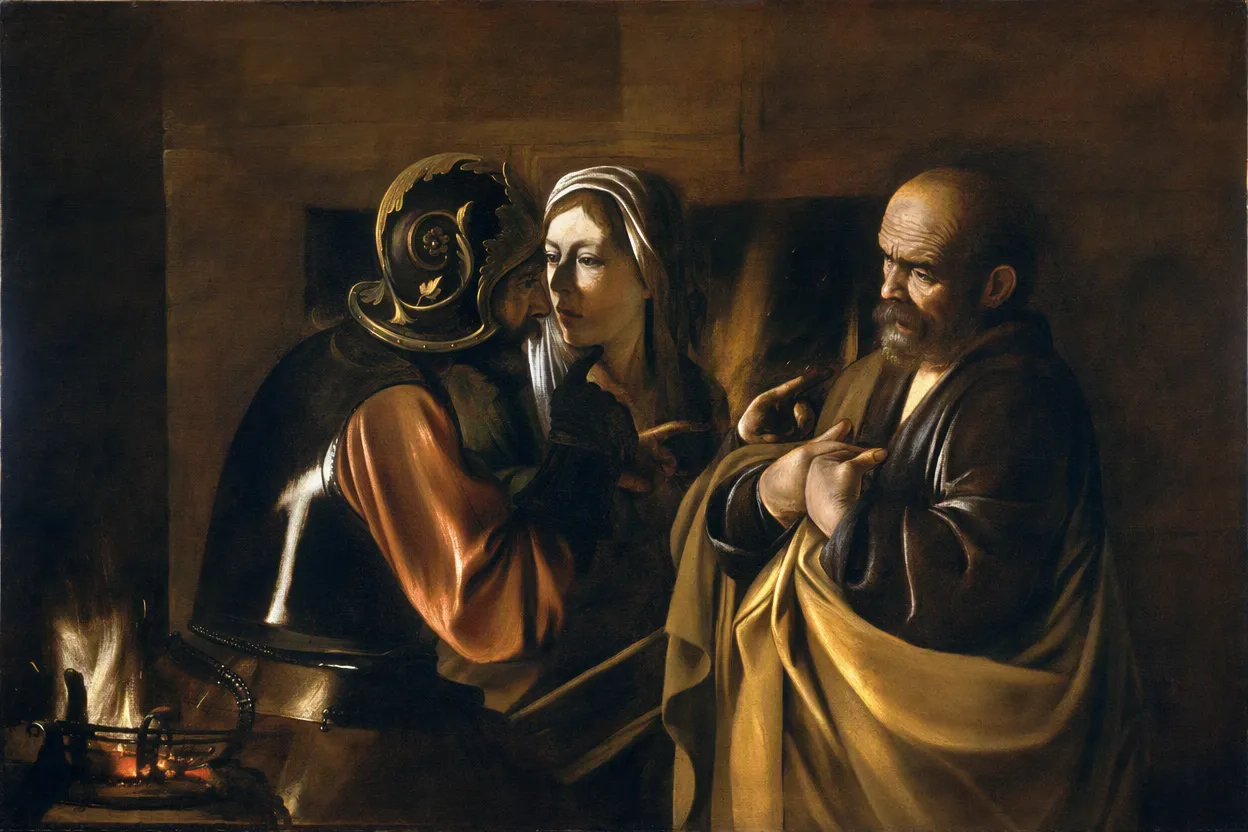
7. The Denial of Saint Peter — Caravaggio (1610)
One of Caravaggio's final works, painted in a loose, dark style, captures an unvarnished moment of human failure. After Jesus is arrested, Peter waits in a courtyard. A woman points an accusatory finger at him, identifying him as a follower of the prisoner, while a Roman soldier turns his gaze toward him with suspicion. Peter presses his hands against his chest, his shoulders hunched, his eyebrows lifted in fear and denial. He denies his master three times before the rooster crows.
At first glance, this painting depicts cowardice rather than courage. Peter breaks under pressure, prioritizing his immediate physical survival over loyalty to his teacher. Yet this narrative is inseparable from the silent courage that followed. When the rooster crowed, Peter remembered the warning, walked out into the cold morning, and wept bitter tears of self-recognition.
Facing our own moral weakness takes severe bravery. It is easy to construct excuses, blame circumstances, or harden our hearts into cynicism when we fail those we love. Peter chose none of these defenses. He looked directly at his own failure, accepted the shame of his betrayal, and spent the remainder of his life striving to live up to the standard he had briefly abandoned. True resilience is not the absence of fear or mistakes; it is the willingness to confront our darkest failures and rebuild our character from the ground up.
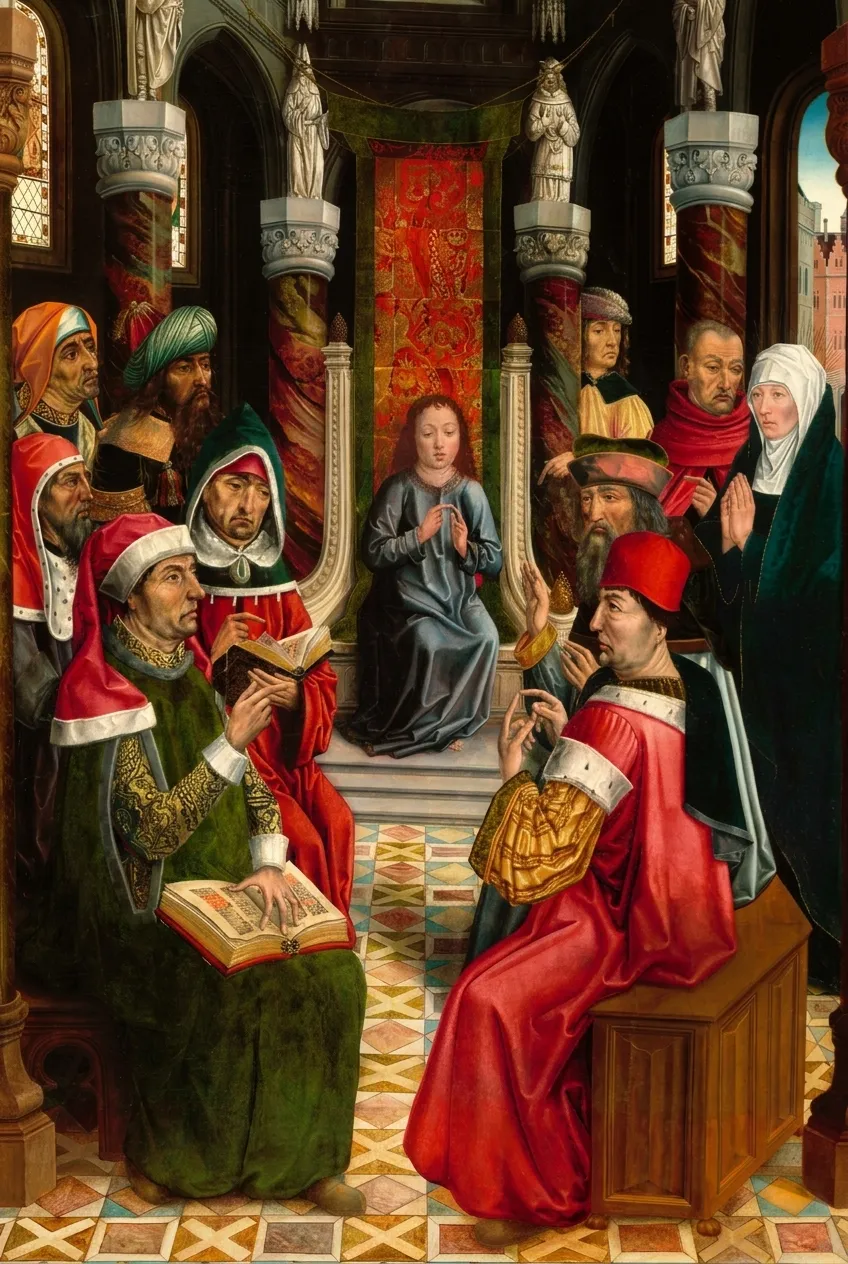
8. Christ Among the Doctors — Bartolomé Bermejo (c. 1490)
The Gospel of Luke records that at age twelve, Jesus stayed behind in Jerusalem, sitting in the temple among the most learned elders, listening to them and asking questions. Spanish master Bartolomé Bermejo stages this scene with remarkable psychological depth. Jesus sits on a modest bench, surrounded by elderly scholars dressed in rich robes, clutching heavy leather-bound volumes and pointing to scriptural passages.
The old doctors show expressions ranging from deep skepticism and squinting confusion to open frustration. Their long beards, wrinkled brows, and defensive gestures indicate how deeply their intellectual authority has been unsettled. At the center sits the young Jesus. His posture is relaxed, his expression open and attentive, his hands gesturing gently as he explains difficult truths. He does not posture as a superior; he simply speaks clearly.
Here we see the quiet courage of independent thought. Challenging entrenched orthodoxy is always hazardous, especially for the young or the outsider. The weight of tradition, institutional power, and age-old consensus creates immense pressure to conform and stay silent. Bermejo shows that wisdom does not require aggressive posturing. When you understand the truth, you do not need to shout down your opponents; you need only state what is real with clarity, patience, and unwavering resolve.
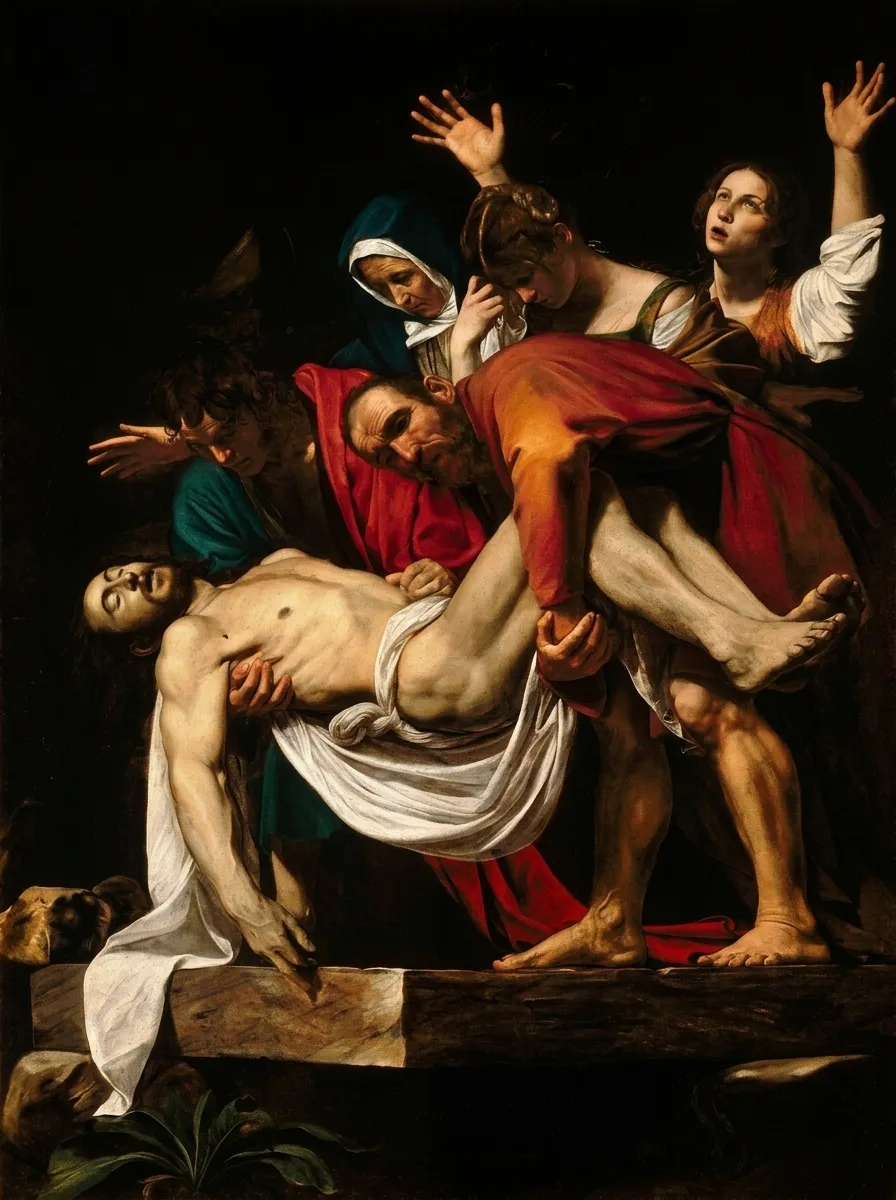
9. The Entombment of Christ — Caravaggio (1603–1604)
In this masterpiece from the Santa Maria in Vallicella, the lifeless body of Christ is lowered toward a cold, stone slab that serves as the tomb's entrance. Nicodemus, with bare feet and strained calf muscles, bears the weight of the legs, looking directly out at the viewer. Saint John supports the torso, his fingers inadvertently touching the wound in Christ's side. Behind them, three Marys express three distinct stages of grief: young Mary Magdalene weeps quietly with bowed head, the Virgin Mary stretches her arms in stoic, solemn resignation, and Mary of Cleopas raises both hands toward the dark heavens in open despair.
The central dynamic of this canvas is the sheer, physical weight of grief. Christ's arm dangles downward, his fingers brushing the stone beneath him. The scene is heavy, silent, and final. There are no angels, no golden rays of resurrection, no easy comforts. There is only the painful, heavy work of laying a beloved teacher to rest.
Caravaggio honors the courage to finish the duties of love when hope seems completely gone. When our plans collapse, when a project fails, or when someone we cherish dies, our initial impulse is to abandon the field and shut down emotionally. The figures in this painting demonstrate the quiet dignity of caretaking. They pick up the heavy weight, descend into the tomb, and perform the final services of devotion, proving that loyalty is most profound when there is nothing left to gain.
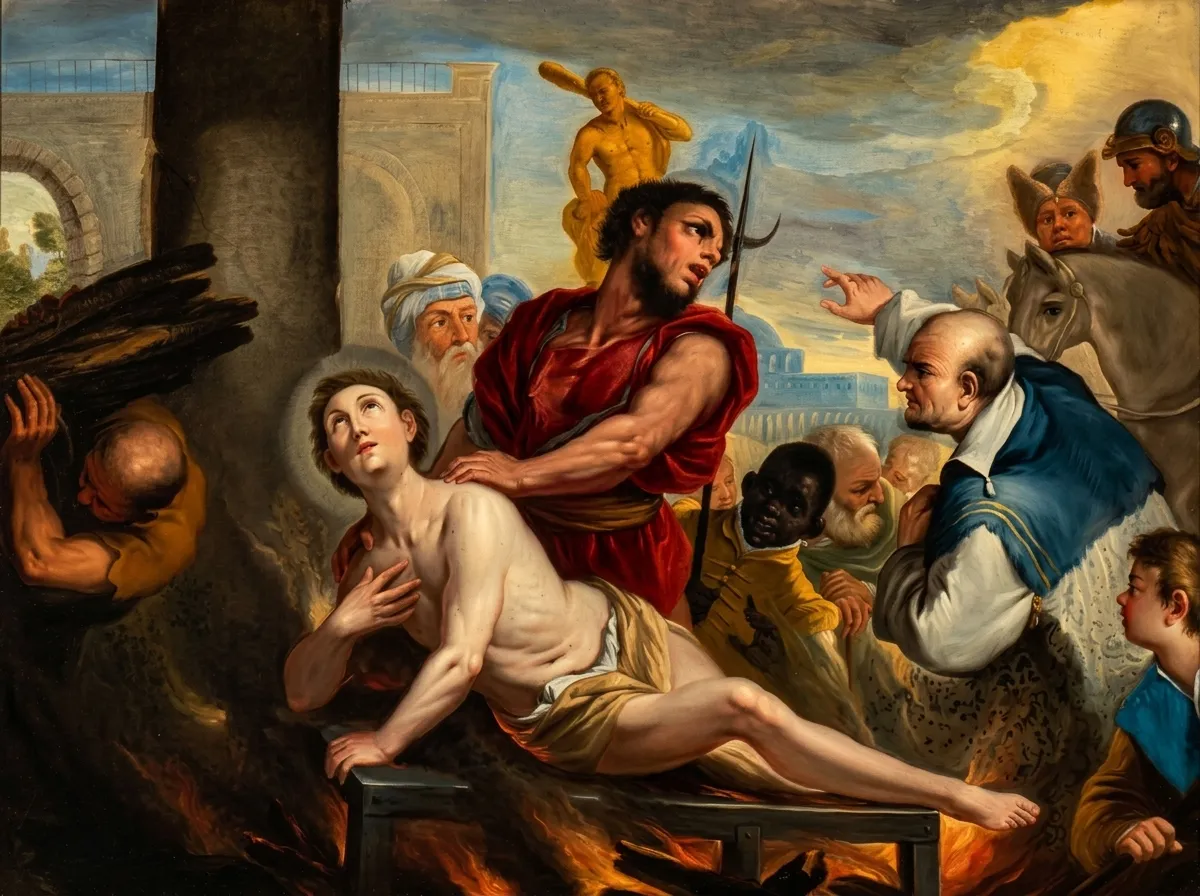
10. The Martyrdom of Saint Lawrence — Luca Giordano (c. 1700)
Luca Giordano depicts the brutal conclusion of Saint Lawrence's life. The Roman authorities, enraged by his defiance, condemned him to be burned alive on an iron gridiron over red-hot coals. The composition is charged with diagonal energy: executioners stoke the fire with pitchforks, smoke billows across the dark sky, and onlookers watch from the parapets above.
Lawrence lies across the iron bars, his body illuminated by the glow of the embers. His hands are unbound, his head is turned toward the sky, and his face shows an extraordinary stillness. According to tradition, his composure was so complete that he mocked his executioners, telling them to turn him over because he was already done on one side. Giordano paints him not as an insensible madman, but as someone whose spirit has detached itself from the physical agony inflicted on his flesh.
This work depicts the mastery of the mind over the body's terror. Pain is one of the most coercive forces in human experience; it can make people betray their deepest values, abandon their comrades, and crawl before tyrants. When a person demonstrates that their principles matter more to them than physical comfort or physical survival, they break the ultimate weapon of their oppressors. Lawrence's silence in the flames represents an absolute victory of the spirit over brute force.
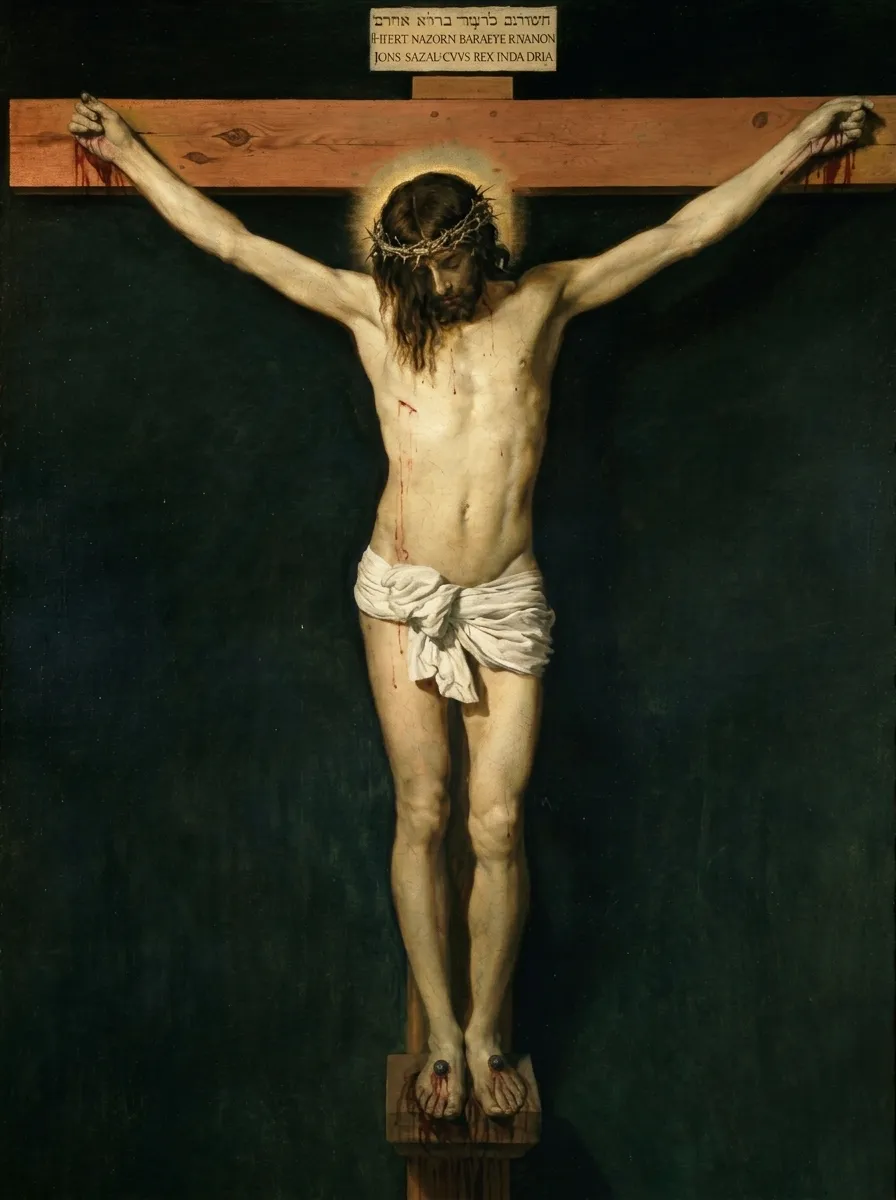
11. Christ on the Cross — Diego Velázquez (1632)
Unlike the gruesome, splinter-filled agony of Grünewald, Diego Velázquez approaches the crucifixion with austere, classical restraint. Christ hangs on a clean wooden cross against an entirely flat, dark background. There are no thieves beside him, no weeping women below, no soldiers casting lots, and no storm clouds gathering in the sky. All narrative context has been stripped away.
Christ's pale body is proportioned according to classical ideals of harmony. His head drops forward onto his chest, half of his face obscured by a long cascade of dark brown hair. A soft, pale light outlines his silhouette. There are no contorted muscles, no rivers of blood, and no theatrical grief. The work feels hushed, solemn, and intensely private.
Velázquez captures the silent courage of solitude. There are burdens in every human life that no friend, partner, or ally can share with us. We must enter those narrow passes alone. In this painting, Christ bears the weight of his purpose in complete isolation, without seeking validation from an audience. This quiet, self-contained strength teaches us that our truest battles are fought not in the public arena, but in the private chambers of our own hearts, where we decide whether to remain faithful to our purpose.
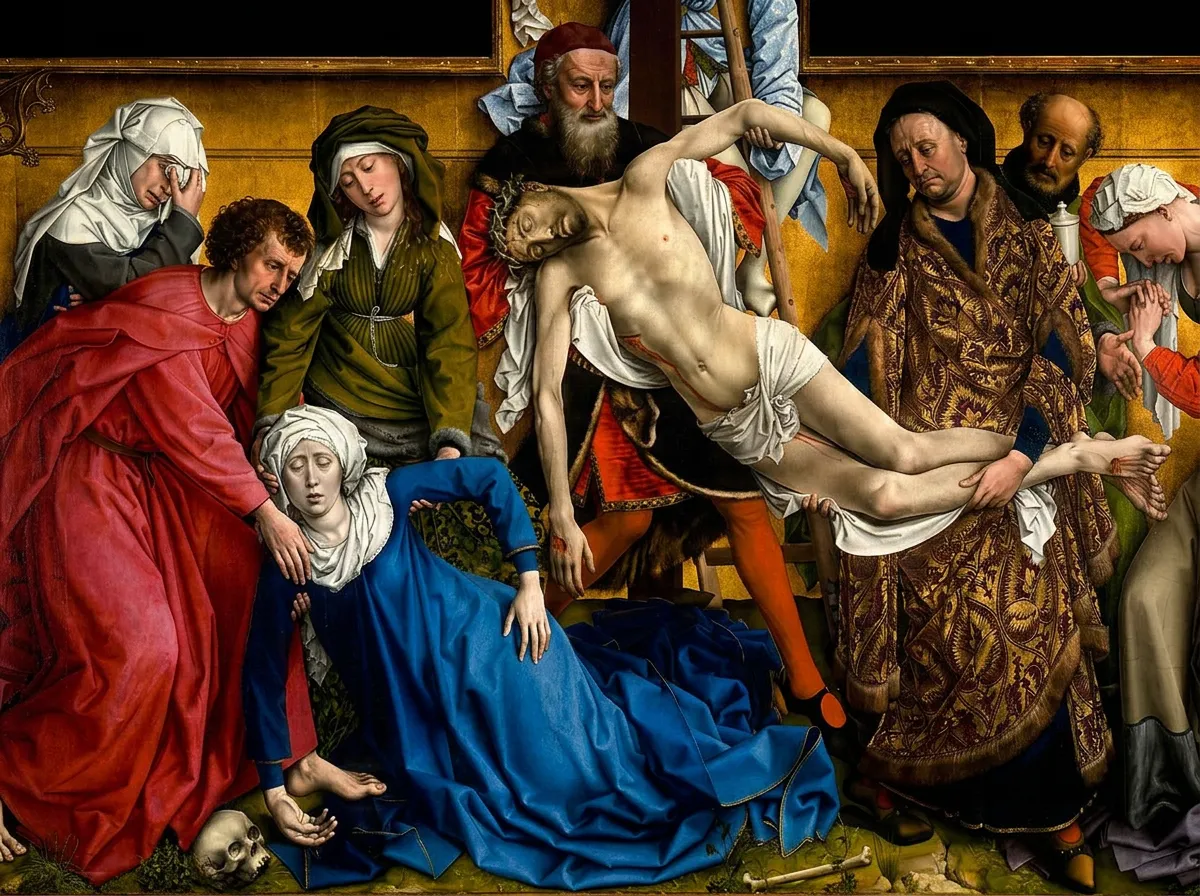
12. The Descent from the Cross — Rogier van der Weyden (c. 1435)
Van der Weyden compresses ten life-sized figures into a shallow, box-like architectural space that resembles a carved wooden shrine. The spatial compression forces the viewer into immediate, uncomfortable intimacy with their grief. As the dead Christ is carefully lowered from the cross by Joseph of Arimathea and Nicodemus, the Virgin Mary collapses to the ground in overwhelming sorrow.
What makes this painting a landmark of art history is the parallel composition between mother and son. Mary's falling body mirrors the exact curve, angle, and limp hands of Christ above her. Her grief is not separate from his sacrifice; she feels it in her own bones. Tears run down the cheeks of every attendant, rendered with optical precision — wet trails glistening on skin, red eyes, trembling lips.
Here we see the courage of shared suffering, or compassio. It takes immense bravery to stand near someone who is in profound pain and simply allow yourself to feel it with them. When others suffer, our instinct is to offer shallow platitudes, look away, or create emotional distance to protect ourselves. Van der Weyden's mourners do not look away. They step directly into the grief, hold the body, and let their hearts break, demonstrating that compassion is an active act of strength.
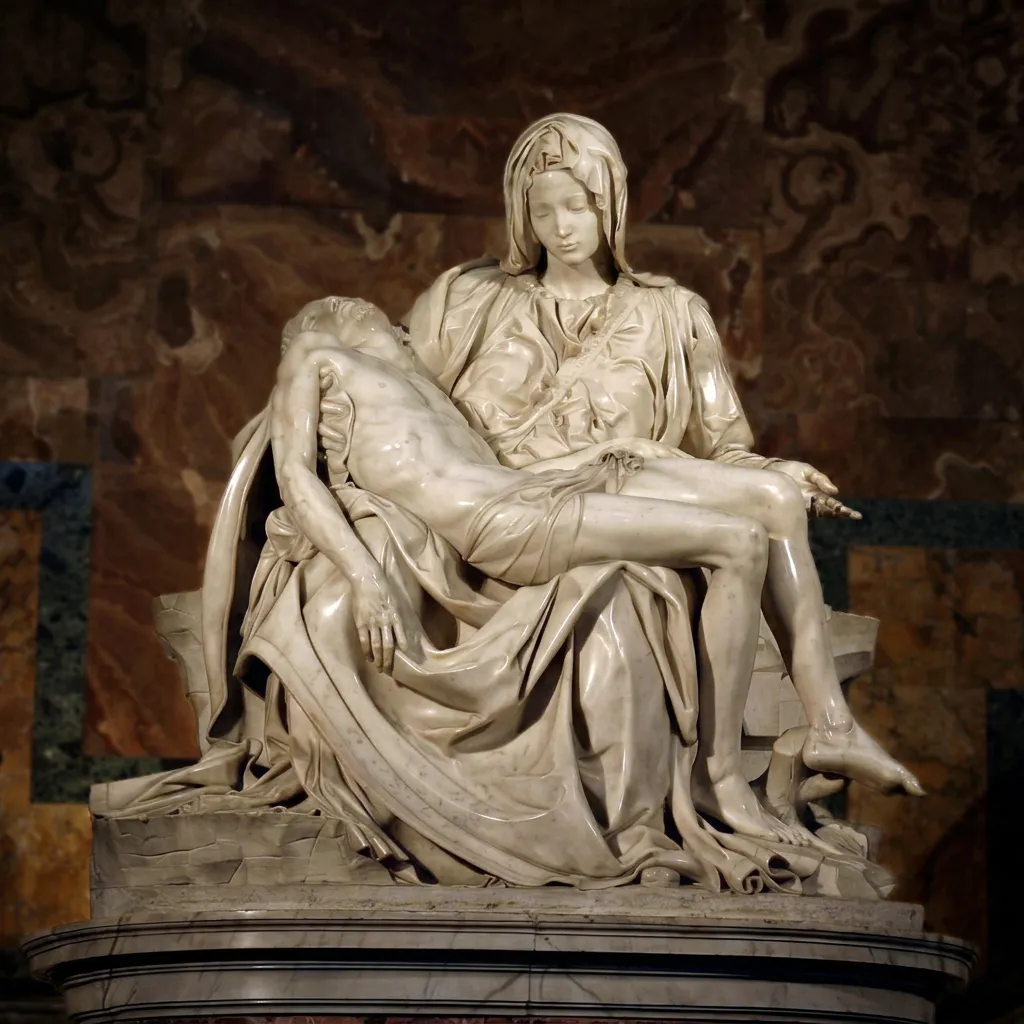
13. Pietà — Michelangelo (1498–1499)
Carved from a single block of Carrara marble when Michelangelo was just twenty-four years old, the Pietà in Saint Peter's Basilica remains the definitive sculptural statement on grief and acceptance. The Virgin Mary sits on a rock, holding the lifeless body of her adult son across her lap. Her drapery flows in deep, rhythmic folds, providing a broad base for the composition, while Christ's body rests in her arms with anatomical weight and grace.
The most striking element of the sculpture is Mary's face. Michelangelo chose to depict her as remarkably young, her features smooth, undisturbed by screaming or disfiguring tears. She looks down at her son with a lowered gaze. Her left hand is turned upward and open, an ancient gesture of questioning and submission. She does not clutch him to her chest in panic, nor does she turn away in horror. She presents him to the world with quiet, sorrowful reverence.
Michelangelo shows that true strength does not require an outward display of fury. When critics questioned why he made the mother appear so youthful and calm, Michelangelo explained that a pure, virtuous soul maintains a timeless peace that the storms of this world cannot easily destroy. Mary's open hand represents the courage to release what we love most when the time comes, accepting life's heaviest losses without collapsing into despair.
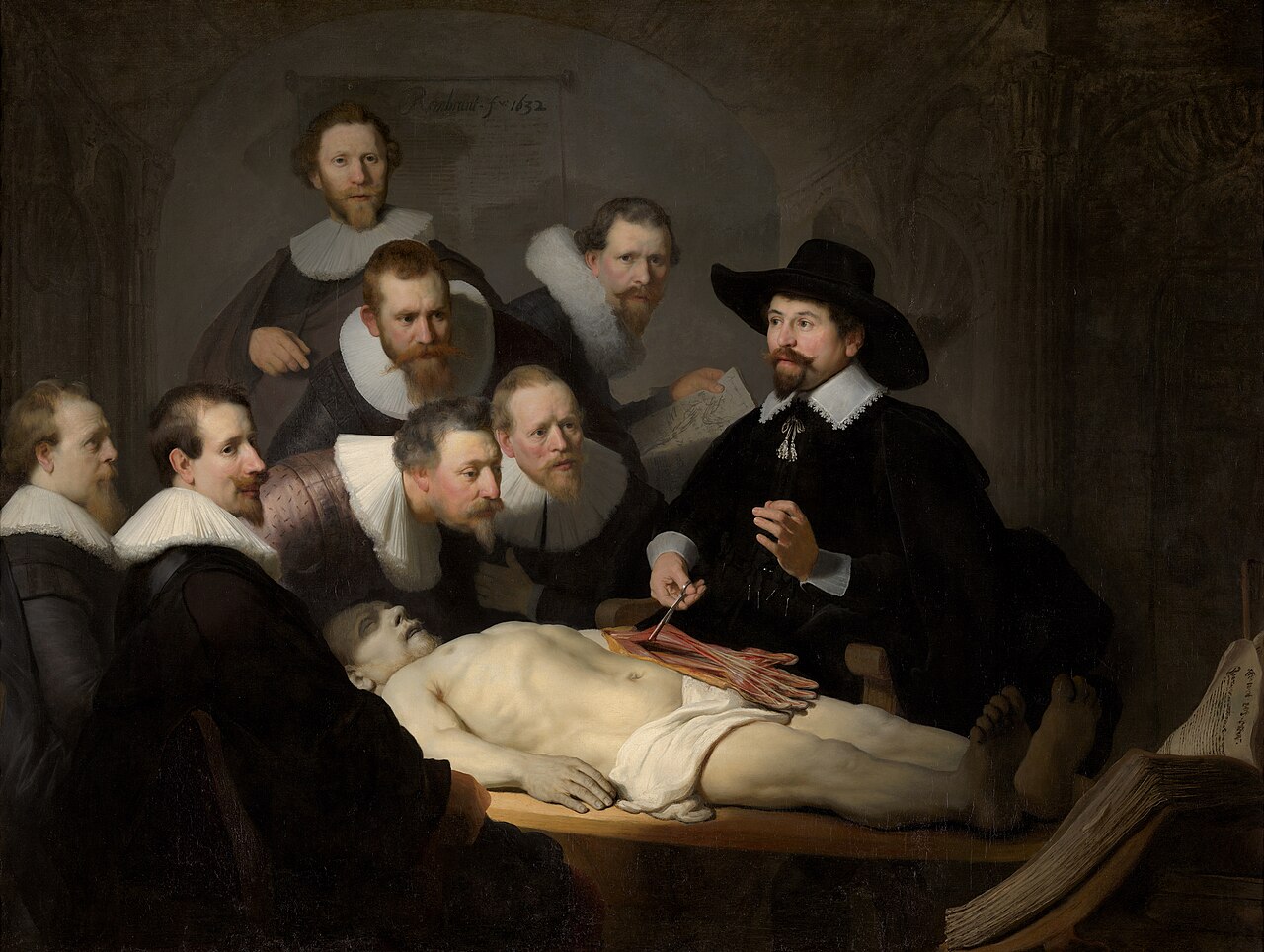
14. The Anatomy Lesson of Dr. Nicolaes Tulp — Rembrandt (1632)
In a seventeenth-century Amsterdam dissection hall, Dr. Nicolaes Tulp, the city anatomist, demonstrates the muscular structure of a human arm to members of the Surgeons' Guild. The cadaver on the table belongs to Aris Kindt, an executed thief. Rembrandt illuminates the scene with cool, rational light that falls across the pale corpse and the expressive, attentive faces of the doctors gathering around it.
The doctors lean forward at various angles. Some look at the dissected tendons exposed by Dr. Tulp's forceps; others look up at the anatomy textbook open at the foot of the table; one looks directly at the viewer. None turn away in disgust. There is no horror, only intense, disciplined curiosity. The body of the deceased man, having met a tragic end, now serves as an instrument of understanding that will help these men heal the living.
Rembrandt captures the stoic courage of intellectual inquiry. Progress requires us to look directly at the realities of our mortality, our fragility, and our internal mechanics. Most people prefer illusions; they do not wish to examine the anatomy of a failure, the mechanics of a disease, or the hard realities of death. The surgeon's courage lies in maintaining a steady hand and a calm mind in the presence of mortality, seeking truth where others see only decay.
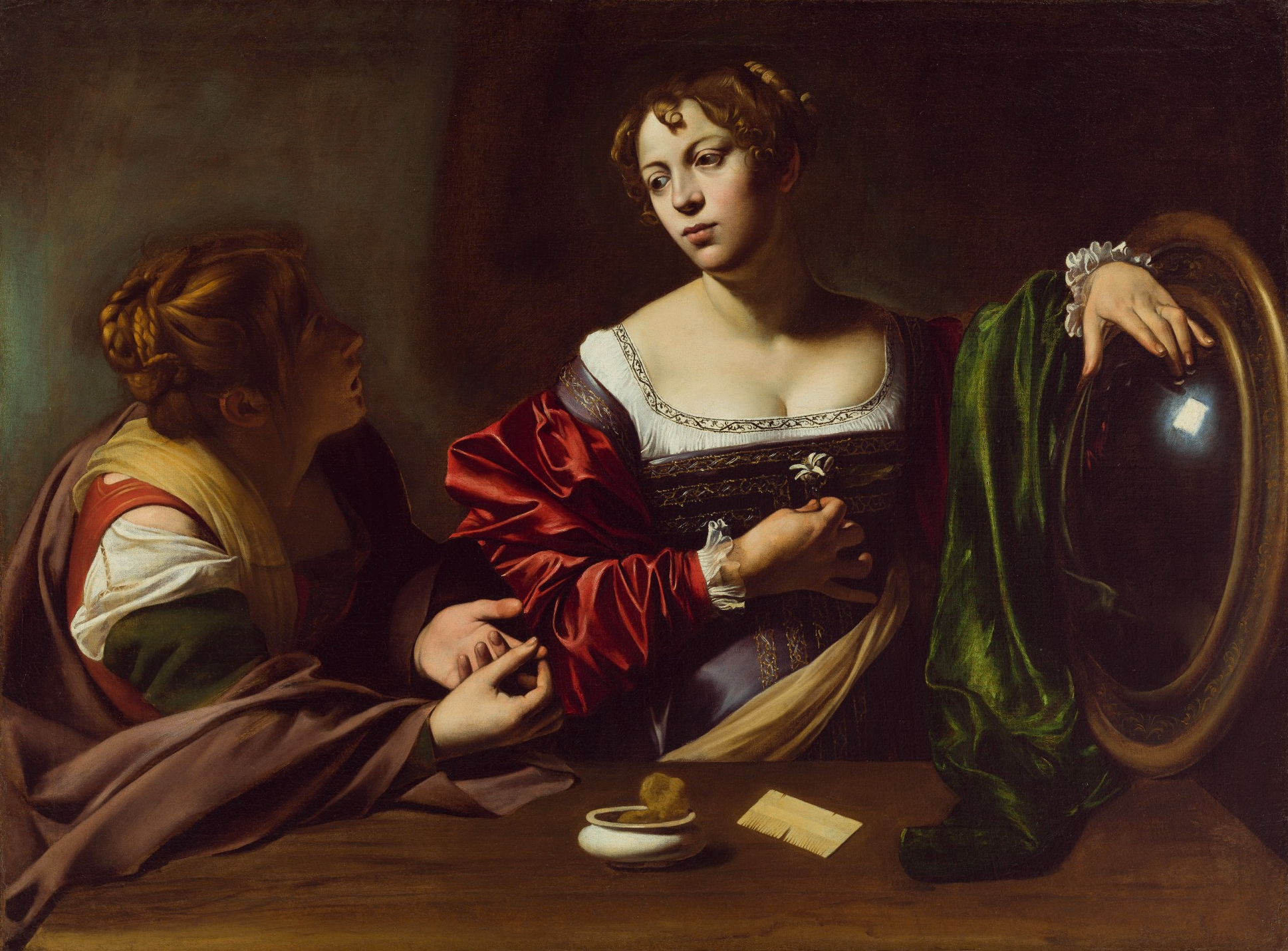
15. Martha and Mary Magdalene — Caravaggio (c. 1598)
In a dark interior, two sisters engage in an urgent, intimate conversation. Martha leans forward from the shadows, counting points on her fingers as she speaks with urgent concern. Mary Magdalene sits in the light, resting one hand on a luxurious convex mirror — the symbol of her former vanity and worldly wealth — while holding a delicate orange blossom in the other. Her luxurious gown and styled hair speak to her past, but her posture reveals that an internal shift has begun.
Mary's face is caught between two worlds. Her head tilts slightly, her lips are parted, and her dark eyes are reflective, looking past her sister into an unseen distance. She is not arguing back, nor is she laughing off her sister's counsel. She is experiencing the heavy, uncomfortable realization that her previous way of living was shallow and incomplete. The light falling across her blouse mirrors the illumination taking place within her conscience.
This painting portrays the quiet courage of self-examination. Confronting an external enemy is simple compared to looking in the mirror and admitting that our habits, ambitions, or behaviors have been wrong. That admission demands that we dismantle the identity we built, surrender our comfortable illusions, and face the uncertainty of living by a higher standard. Mary's stillness is the moment of moral turning, where real change always begins.
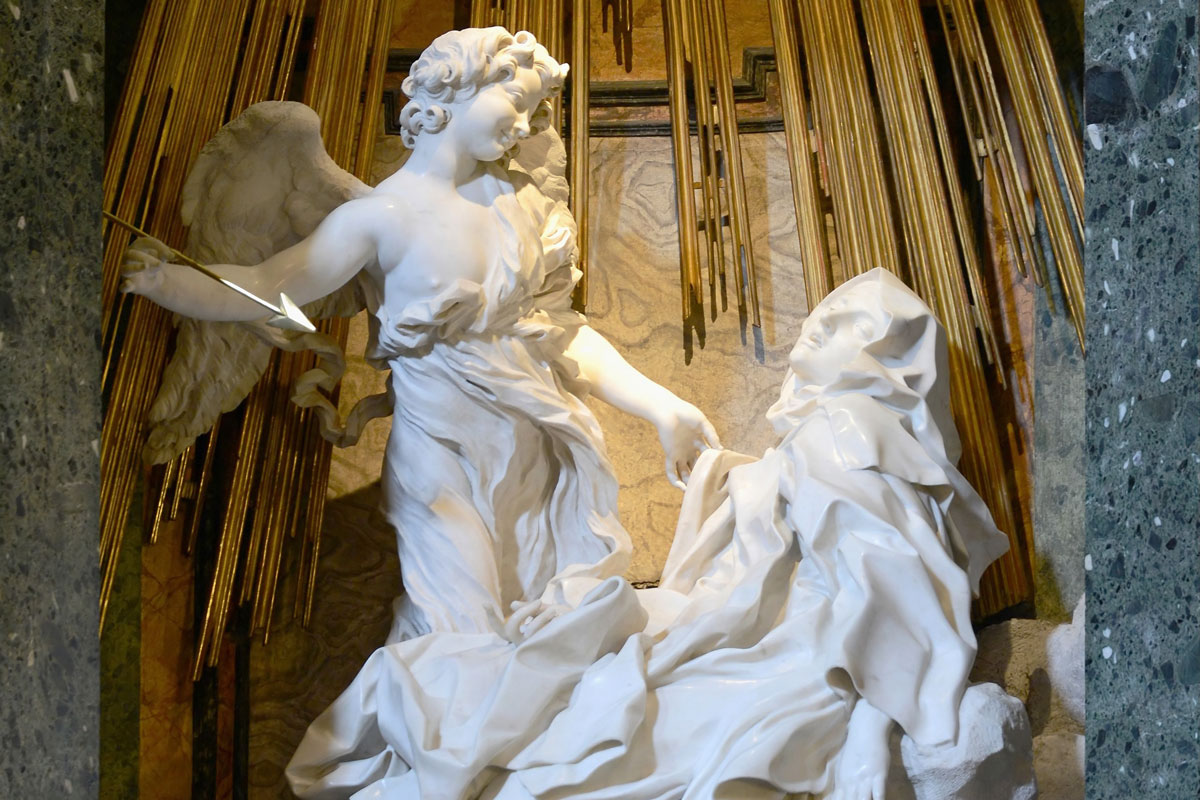
16. The Ecstasy of Saint Teresa — Gian Lorenzo Bernini (1647–1652)
In the Cornaro Chapel in Rome, Bernini realized the dramatic capabilities of baroque sculpture in colored marble, gilded bronze, and theatrical lighting. The central group shows the Spanish mystic Teresa of Ávila floating on a cloud. A smiling angel holds a golden arrow pointed at her heart, preparing to pierce her with divine love. Teresa's head tilts back, her eyes are closed, her lips parted in a sigh, and her heavy monastic habit churns in turbulent, cascading folds.
Teresa's physical posture suggests total surrender. Her hands and bare feet hang limp, suspended in midair. She has surrendered all muscular tension, all resistance, and all self-control. The experience she undergoes is described in her autobiography as an intense blend of spiritual sweetness and physical agony — a pain so sharp that it made her moan, yet so delicious that she could not wish it to end.
Bernini articulates the courage of total spiritual openness. Human beings naturally build psychological defenses to protect themselves from being overwhelmed by experiences that transcend their control. We prefer manageable routines and safe boundaries. To surrender those defenses — to allow yourself to be completely overtaken by an experience greater than your ego, whether that is profound love, deep grief, or spiritual awakening — requires immense bravery. Teresa shows us the power of letting go of control.
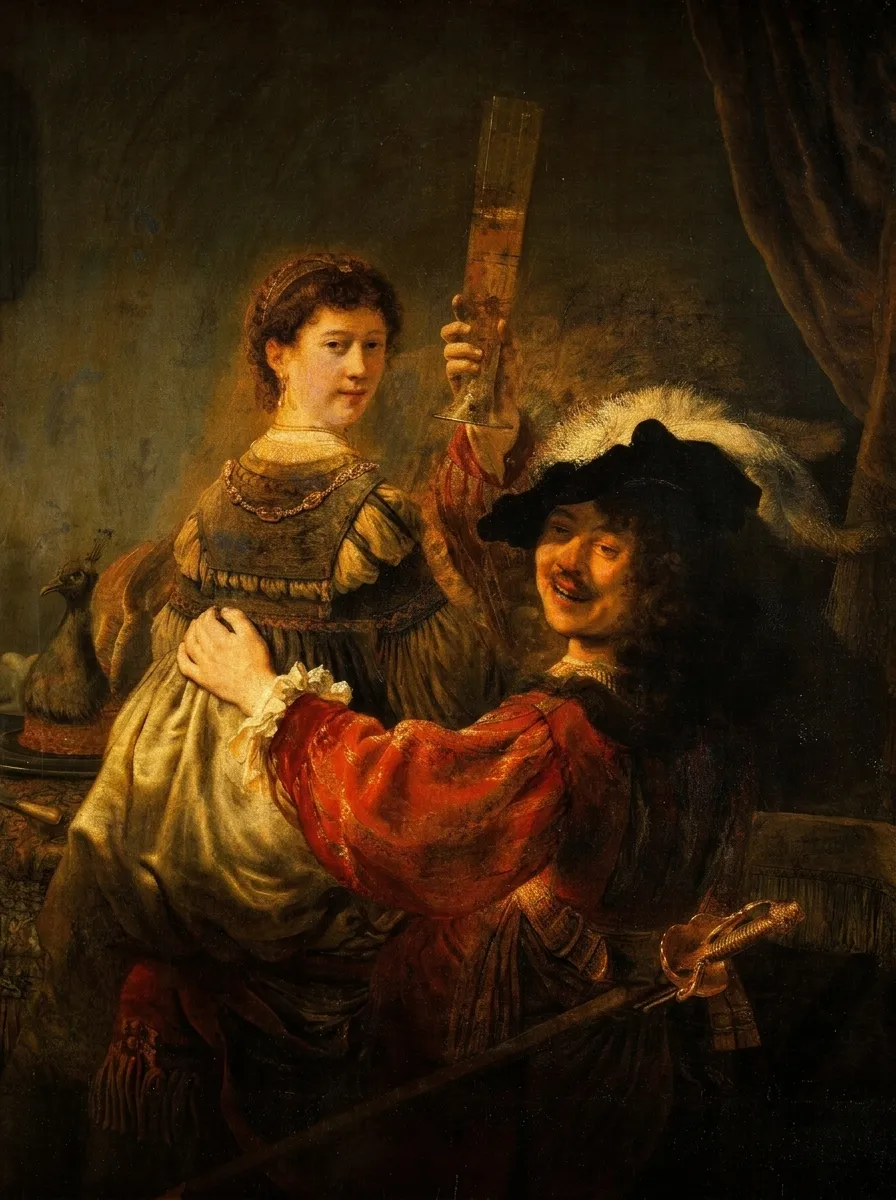
17. The Prodigal Son in the Brothel (Self-Portrait with Saskia) — Rembrandt (c. 1635)
Rembrandt paints himself in the role of the prodigal son from the biblical parable, sitting in a tavern with his young wife Saskia on his lap. He wears an extravagant costume with a feathered hat, a sword at his side, and a reckless grin across his face. He turns toward the viewer, raising a tall glass of beer in a boastful, drunken toast. On the wall behind them, a slate board records the tavern bill, keeping score of the debt he is running up.
This painting appears to celebrate shallow indulgence, but Rembrandt's choice to paint himself as the prodigal son carries a severe undercurrent of self-awareness. By depicting his own youthful arrogance and vanity with such brutal honesty, Rembrandt confronts the darker sides of his personality. He knows how this parable ends: the money runs out, the false friends vanish, famine strikes, and the son ends up starving in a pig pen before gathering the humility to walk back home.
The silent courage in this work is the artist's refusal to flatter himself. Most people commission portraits to make themselves look wiser, wealthier, and more dignified than they truly are. Rembrandt paints his own capacity for foolishness, excess, and pride. To document your own flaws for public view requires an honest, unsparing mind. It is the necessary starting point for any real journey of maturity and redemption.
The Anatomy of Silent Courage
When we review these seventeen works together, we see that silent courage is not a single reaction, but a disciplined posture toward life. It takes distinct forms depending on the nature of the trial:
| Dimension | Primary Dynamic | Key Masterpiece |
|---|---|---|
| Conscious Acceptance | Meeting inevitable pain without panic or retreat | The Arrest of Christ — Caravaggio |
| Moral Integrity | Remaining clean and calm in the presence of malice | The Carrying of the Cross — Bosch |
| Radical Honesty | Confronting personal failure and self-indulgence | The Denial of Saint Peter — Caravaggio |
| Loving Duty | Caring for others when hope seems entirely lost | The Entombment of Christ — Caravaggio |
| Tranquil Truth | Speaking principles clearly to entrenched power | Saint Lawrence Before the Prefect — Fra Angelico |
External circumstances will often sit entirely outside your control. You will face unexpected betrayals, physical ailments, the loss of those you care for, and the quiet failures of your own resolve. When those storms break, the shout of anger or the impulse to flee will present themselves as the only options.
These masterpieces show that a third path exists. You can plant your feet on the ground, breathe slowly, and look directly at what is before you. You can accept the weight of the moment without surrendering your dignity. In that quiet, unwavering posture lies a strength that no external force can take from you.
战士的勇气 - 冲锋与行动
Action changes the nature of fear. When danger appears, the human impulse splits along two basic lines: collapse inward to endure the blow, or step forward to meet it. If the first chapter showed how men and women preserve their souls through quiet endurance, this chapter turns toward outward force. Here we look at figures who refuse to wait. They …