

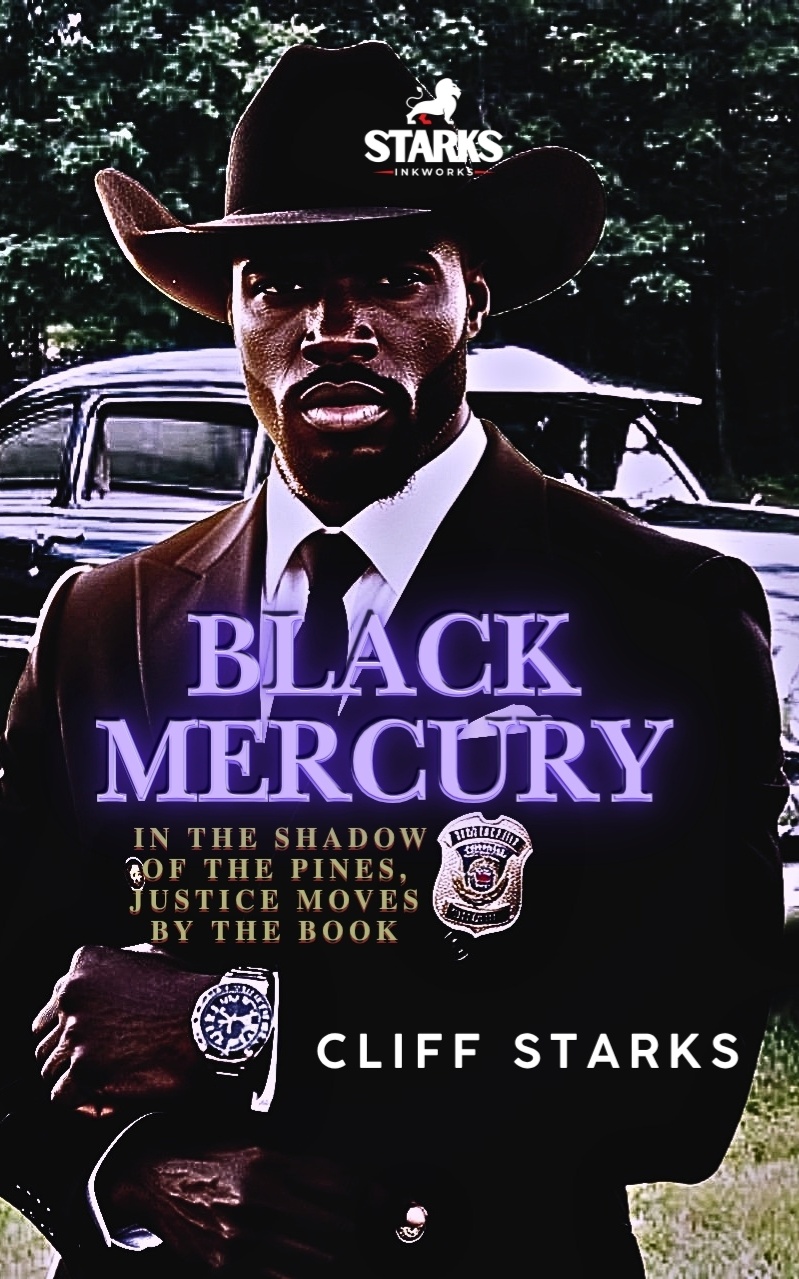
Black Mercury
In the shadow of the pines, justice moves by the book
by Cliff Starks
Alabama border, 1954. Deep in the suffocating pine hollows, the ruthless Maddox syndicate runs an illicit moonshine empire through sheer violence and fear. Local law won't cross them, and the mountain brush swallows anyone foolish enough to try. Enter Mr. Booker. Armed with a sharp tie, a supercharged 1949 Mercury, and unyielding federal discipline, the meticulous revenue agent has arrived to dismantle the syndicate piece by piece. Booker does not negotiate, and he does not bend the rules. But when a woodland raid erupts into gunfire and a raging inferno, the surviving Maddox brothers launch a desperate, deadly flight through treacherous dirt back roads. Tearing across midnight switchbacks and rotting timber bridges, Booker engages in a relentless high-speed pursuit where one wrong turn means certain death. In the deep South, outlaws rule the night—but the revenue man brings the law. From Cliff Starks comes an explosive historical crime thriller packed with razor-sharp tension, gritty action, and the unstoppable force of justice.
- Crime Fiction
- Thriller
- Historical Fiction
- Action Thriller
- Crime Thriller
- Cat & Mouse
The Federal Warrant
The heat came up off the blacktop in waves before eight in the morning, and by the time Mr. Booker crossed the county line the temperature gauge on the Mercury's dash had already climbed past what most men would call comfortable. He did not roll down the window. He did not loosen his tie. The black car ran smooth beneath him, the supercharger humming low and steady like something alive, and he kept both hands on the wheel at ten and two the way the manual said a man should drive when he carried federal papers on the seat beside him.
Pine trees crowded the road on both sides, tall and close, the kind of timber that swallowed sound and light in equal measure. Mr. Booker had read the county surveys before he left Montgomery. He knew the elevation, the creek crossings, the three logging roads that cut back into the hollows where no county map bothered to draw a line. He knew the names Clay Maddox, and the two brothers who rode with him, and he knew the federal warrants folded in the leather case on the passenger seat carried the weight of law behind every syllable of those names.
The courthouse sat on the square in the middle of town, brick and white columns gone gray with age, and Mr. Booker parked the Mercury square in front of it, nose out, the way a man parks who expects to leave in a hurry. He carried the case inside and found the Sheriff's office at the end of a hallway that smelled of tobacco and old paper.
The Sheriff was a heavyset man behind a desk too small for him, and he looked up when Mr. Booker's shadow crossed the doorway and did not get up right away.
"Help you?" the Sheriff said, though his tone suggested he already suspected the answer would not please him.
"Mr. Booker. Federal revenue agent." He set the case on the desk and opened it, laid the warrants out in a neat row. "I'm required by statute to log my jurisdiction with the local authority before executing enforcement in the field. Section 26, subchapter F, of the Internal Revenue Code."
The Sheriff looked at the papers the way a man looks at a snake he has not decided whether to kill or step around. He did not touch them.
"You're here for the Maddox boys."
"I am."
"Then you already made a mistake just by driving into this county." The Sheriff leaned back, and the chair groaned under him. "You know what they do to revenue men out here? They don't run. They don't hide their whiskey and wait for you to leave. They shoot. Clay Maddox has put two men in the ground that I know of, and there's likely more nobody's ever found, because the pines out past Cotton Hollow don't give nothing back once it's gone under."
"I'm aware of the department's prior attempts in this territory."
"Then you're aware every last one of them ended with a man carried out on a truck bed, or not carried out at all." The Sheriff sat forward now, elbows on the desk. "I got two deputies. One's got a bad hip and the other's twenty-two years old and scared of his own shadow. I ain't sending either one of them into that brush after Clay Maddox, and I sure as hell ain't going myself. You want my advice, you'll turn that fancy car around and tell Montgomery the Maddox place burned down on its own."
Mr. Booker gathered the warrants and returned them to the case without hurry. "Title 26 of the United States Code makes the unlicensed production and distribution of distilled spirits a federal offense, Sheriff. It does not require the concurrence of local law enforcement to be enforced. I came to inform you as a courtesy. I did not come to ask permission."
The Sheriff studied him a long moment, the way a man studies weather he does not trust. "You're gonna make enemies out there, Mr. Booker. The kind that don't forget."
"That has been my experience in every county I've worked."
He left the Sheriff sitting behind his too-small desk and did not look back at the window as he crossed the square. The morning had grown hotter, and the courthouse bell tower threw a short black shadow across the sidewalk that did nothing to cool it.
The diner sat two doors down, a narrow building with a hand-painted sign and a screen door that stuck. Mr. Booker took a booth by the window, ordered black coffee he did not drink, and spread a county road map across the table, the paper soft and worn at the folds from previous use. He traced the logging roads with one finger, marking in pencil the trading posts he'd flagged from the shipping manifests back in Montgomery. Cotton Hollow General. Simms Feed and Supply. A crossroads store with no name at all, just a coordinate on the survey.
The waitress refilled a cup at the next table and glanced at his map without meaning to, then looked away fast when she saw what it was.
Mr. Booker did not look up. He was reading manifests now, copies he'd requisitioned from two counties over, freight records showing sugar by the ton and copper sheeting by the roll moving into stores no bigger than a woodshed, month after month, more sugar than any bakery in the state could account for. Hundreds of gallons a week, by his own arithmetic, moving out of these hollows into three states, and not one arrest on the county books in six years. Not one name in the docket. Not one indictment.
He folded the map along its original creases and set it beside the manifests, squared the corners the way he squared everything, and looked out through the screen door at the tree line beyond the last row of buildings, dark and unbroken, running back into hills that did not appear on any map he owned.
He left two dimes on the table for coffee he had not finished, picked up his case, and walked back out into the heat toward the Mercury. The road to Cotton Hollow ran west out of town, narrowing fast once the pavement gave out, and he meant to be on it before noon.
Sugar and Copper
The general store at Old Mill Road had not sold a can of anything in years, not by the look of it. The porch boards had gone soft and gray, and the tin roof had rusted through in patches that let the afternoon light fall in coins across the floor inside. A single word, SIMMS, remained legible on the false front, the rest of the paint long since sur…