

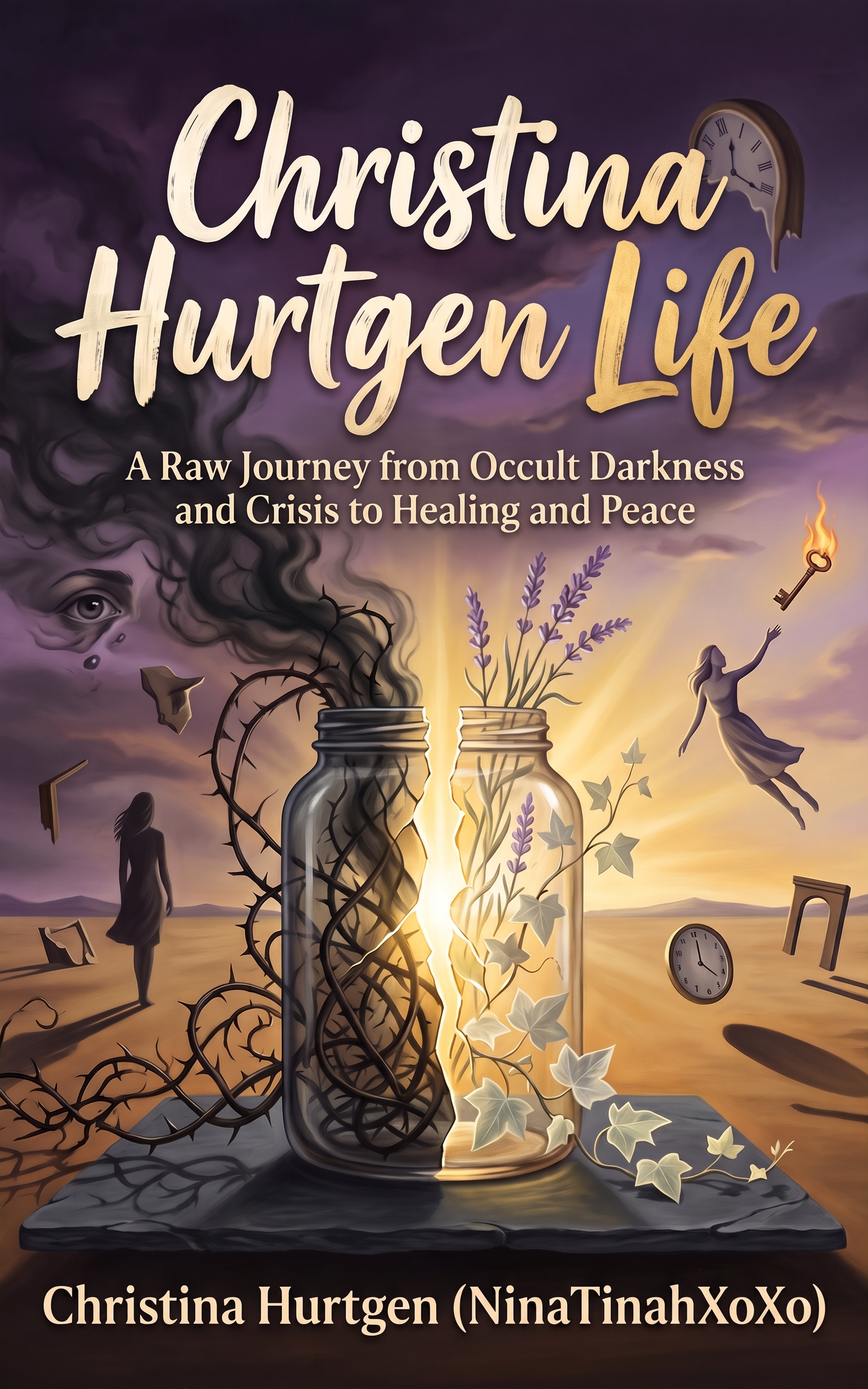
Christina Hurtgen Life
A Raw Journey from Occult Darkness and Crisis to Healing and Peace
by Christina Hurtgen (NinaTinahXoXo)
What happens when the spiritual search for healing leads into the deepest darkness? Following the heartbreaking loss of her grandmother and a turbulent childhood marked by family dysfunction, Christina Hurtgen sought solace in substance use, Wicca, energy healing, and the occult. But her deliberate pursuit of clairaudience and opening her third eye unlocked terrifying consequences: relentless auditory voices, profound spiritual torment, and a complete unraveling of her daily life. Desperate for relief, Christina entered a residential faith mission, embarking on intense fasting, prayers, and deliverance efforts. Yet within rigid walls, she confronted new battles—strict dogma, unanswered questions, and the struggle to reconcile her identity as an LGBTQ woman in crisis. Caught between supernatural fear and dogmatic disillusionment, she had to forge her own path forward. Christina Hurtgen Life is an unflinching, candid memoir of spiritual warfare, addiction recovery, and emotional survival. By sharing her rawest trials, Christina offers a powerful beacon of hope for anyone striving to reclaim their voice, set healthy boundaries, and discover grounded peace after the storm.
- Biography
- Religion & Spirituality
- Spiritual Memoir
- Overcoming Adversity
- New Age & Spirituality
- Christianity
Shadows in the Hallway: Childhood Turmoil and Early Fear
The sounds started long before the bedroom door ever swung open. It was the heavy thud of a boot against baseboard, the sharp rattle of a cabinet door slammed hard in the kitchen, and then the shouting that rose like a sudden summer storm. In our house, nighttime was never a quiet refuge. Nighttime was when the atmosphere turned thick, volatile, and dangerous. I would lie underneath my blankets, pulling the rough cotton up past my chin until only my eyes and the bridge of my nose were exposed to the cold room. My whole body would stiffen into a single, aching muscle. I tried not to breathe loudly, convinced that even the tiny sound of air passing through my nostrils might draw the violence straight down the hallway and into my bedroom.
Every child knows what it is like to be afraid of the dark, but my fear was not about imaginary monsters lurking in the closet. My fear was about the very real people walking across the linoleum flooring just outside my room. When the shouting reached that certain pitch—shrill, ragged, and full of raw fury—the sound of skin hitting skin would inevitably follow. A dull, sickening slap. A muffled cry. The sound of a body hitting the wall hard enough to make the framed pictures in my own room vibrate against the drywall. In those moments, I stayed completely paralyzed. My hands gripped the edges of the sheet with white knuckles. I wanted to run out there and throw myself between them. I wanted to scream at the top of my lungs to make them stop, but terror pinned me flat against the mattress. I felt tiny, helpless, and utterly alone in the middle of a war zone I could neither understand nor escape.
The Atmosphere of Nighttime Dread
Living in that environment meant you were always waiting for the next explosion. Even during the day, when the house was temporarily calm and the sun was shining through the front windows, there was this lingering tension hanging over every room. You walked on eggshells, measuring every word and watching the adults' facial expressions to see what kind of mood would dictate the evening. When the sun began to go down, a familiar knot twisted inside my stomach. Dusk did not bring rest or cozy bedtime routines; it brought an overwhelming sense of dread. Bedtime meant being left alone in the dark with my thoughts while the living room turned into a battlefield.
Because my nervous system was constantly in a state of high alert, sleep became my enemy. Whenever I did manage to drift off, my mind twisted the waking chaos into terrible nightmares. I suffered from frequent night terrors that left me waking up drenched in cold sweat, gasping for air, and unable to make a sound. Worse than the dreams were the episodes of sleep paralysis that began happening when I was very young. I would wake up in the middle of the night, fully conscious of my bedroom, but completely unable to move a finger or turn my head. The room felt freezing cold, and the air felt heavy, like wet wool pressing down against my chest.
During these episodes, I started sensing dark presences watching me from the corners of the room. I would stare toward the doorway, where the faint glow from the hallway cast long, distorted shadows across the carpet. Right at the foot of my bed, or hovering just beside my pillow, I could feel an oppressive, shadowy figure standing in the darkness. It had no distinct face, but the malice radiating from it was palpable. I would struggle with every ounce of my will to break the paralysis, trying to kick my legs or force a scream out of my throat, but nothing would move. It felt as though something unseen was feeding on the terror generated in that house, hovering over me while violence played out just on the other side of my bedroom wall.
Looking back, it is hard to separate where the psychological trauma of domestic abuse ended and where spiritual oppression began. When a home is filled with violence, anger, and physical pain, the environment becomes poisoned. That constant state of fear opened doors inside my mind at a very early age. I became hyper-aware of everything around me, sensitive to shifts in energy, and terrified of unseen forces that seemed to lurk just behind the physical reality of our home.
Crying Out into the Dark
As a child, when my mom used to get beat up, I believed in God and prayed for help. I had learned about God the way many children do—through simple stories and the natural instinct to cry out to a higher power when everything around you is falling apart. I truly believed that somewhere above our broken ceiling, there was an almighty Father who loved us, who saw what was happening in our living room, and who had the power to rescue us. In those terrible nights, while the shouting echoed down the hall, I would press my small hands together under the covers and pray with everything I had inside me.
"Please, God, make it stop," I would whisper into the pillow, tears burning my cheeks. "Please protect my mom. Don't let him hurt her. Please just make him fall asleep. Please send an angel to stand at our door and keep us safe."
I prayed those exact words over and over, repeating them like a desperate rhythm to drown out the sounds of violence. I bargained with God. I promised I would be the best kid in the world, that I would never complain, that I would do all my chores without asking, if only He would make our home peaceful. I waited, holding my breath, hoping that after every prayer I would hear sudden silence in the next room—that God would step in and bring an immediate end to the madness. But the answers never came the way I begged for them. The shouting continued. The impacts continued. My mother's muffled sobs carried through the thin walls, followed by the heavy pacing of an angry man stomping across the house.
Year after year, the routine repeated itself. The faces and the exact details sometimes shifted, but the fundamental fear remained identical. Each time the violence flared up, I went through the same cycle of desperate prayer, intense hope, and crushing disappointment. Slowly, a bitter realization began to take root in my young heart. I started to feel that my childhood prayers were merely bouncing off the ceiling panels and falling back into an empty, silent room. I wondered why a powerful God, if He truly loved me and loved my mother, would allow her to be beaten while I cried myself to sleep. Why wasn't anyone stepping in? Why didn't an angel show up to push the darkness away?
That feeling of abandonment marked the beginning of a profound spiritual shift. Somewhere along the way, amidst the broken promises and the repetitive trauma, I lost all my faith. I concluded that if God was real, He was distant, uncaring, or entirely powerless to fix the mess in my living room. That loss of faith left a gaping wound in my soul. I was still deeply aware of the spiritual realm—I could feel the heavy, oppressive shadows in my bedroom every single night—but I no longer believed the God of the Bible cared enough to defend me. That realization broke something fundamental inside my childhood innocence.
Building Walls and Finding Resilience
When you realize that no external savior is coming through the front door to fix your life, you learn to adapt. Even as a small child, an internal survival mechanism took over. I realized that if I wanted to survive the chaos of our household, I had to develop my own armor. I had to become strong, observant, and completely self-reliant.
I began studying the patterns of the adults around me with intense focus. I learned to read the subtle signs that predicted an impending explosion:
- The specific cadence of footsteps coming up the front walkway, which told me whether someone was walking steadily or stumbling from alcohol.
- The tone of voice in casual conversation, listening for the sharp edge of irritability that signaled a fight was brewing.
- The clinking of glasses in the kitchen and how frequently the refrigerator door opened throughout the afternoon.
- The sudden shifts in room temperature and silence that seemed to precede an outburst of rage.
Recognizing these patterns gave me a tiny illusion of control. If I could predict when the violence was coming, I could prepare myself mentally. I could make sure I was already tucked away in my room, hidden out of sight, minimizing the chances of becoming a target myself. I created small zones of comfort within my immediate surroundings. I hoarded small items that brought me peace—a favorite blanket, a worn stuffed animal, a particular book that I could stare at under the glow of a flashlight. I turned my bed into an impenetrable fortress in my mind, telling myself that as long as I stayed within the perimeter of my mattress, nothing could truly destroy me.
This hyper-vigilance kept me alive and alert, but it came at a tremendous psychological cost. My brain was wired to stay in an endless loop of fight-or-flight. I never truly relaxed. Even when the house was quiet, my ears strained to catch the faintest whisper or creek of the floorboards. I learned to suppress my outward emotions, keeping a neutral face during the day so no one could see how terrified and wounded I felt underneath. I became an expert at hiding my vulnerability, convinced that showing weakness or shedding tears would only invite more pain.
The Seeds of an Esoteric Search
Looking back across all these years, I can see clearly how the deep instability of my early childhood laid the groundwork for everything that followed. Trauma does not simply disappear when a fight ends; it carves deep trenches into a child's psyche, creating emotional voids that demand to be filled. I grew up with two massive, unhealed wounds: a desperate craving for safety and control, and a bitter disillusionment with traditional faith.
Because I had abandoned belief in God, but remained painfully aware of the dark presences that had terrified me during my childhood night terrors, I was left spiritually adrift. I knew there was a spiritual world. I had felt its cold fingers during sleep paralysis, and I had witnessed the demonic rage that seemed to take over the adults in my home. But because I believed God had ignored my cries for help, I began to look elsewhere for protection. I wanted a spiritual system where I could hold the power in my own hands, where I did not have to beg an unseen deity who might ignore me, but where I could perform specific actions to guarantee my own defense.
This desperate need for personal power and energetic protection is what later made esoteric paths, New Age spirituality, and Wicca look so appealing to me as a teenager. When I eventually discovered books on magic, energy manipulation, and rituals, they did not seem strange or frightening. To my wounded mind, they looked like practical solutions. They promised that through my own will, my own focus, and my own rituals, I could create energetic shields, cast away negative entities, and control my environment. I thought I was finding a way to ensure I would never be that helpless little girl paralyzed under the blankets ever again.
What I failed to see at the time was that the enemy had been orchestrating this spiritual trap from the very beginning. By allowing trauma to sever my connection to God, the adversary prepared the soil of my heart for deception. The very practices I thought would give me control were designed to strip away the remaining defenses I had left. But in those early years, as a young child staring into the shadows of my bedroom hallway, I only knew one thing: I was tired of being afraid, and I was willing to do whatever it took to protect myself from the darkness.
Reflecting on Early Survival
Childhood trauma has a way of shaping adult behavior in ways we rarely recognize until decades later. When a child grows up in an environment where safety is conditional and peace is constantly shattered, their survival strategies become deeply ingrained habits. We carry those coping mechanisms into our adult relationships, our careers, and our spiritual lives, often without realizing that the war we are fighting ended years ago.
To begin untangling the roots of fear and understanding how early adversity shapes spiritual vulnerability, consider working through the following exercise:
- Identify Earliest Memories of Fear: Take a piece of paper and write down the three earliest memories you have where you felt completely unsafe or overwhelmed by fear. Note the physical sensations you felt in your body during those moments.
- Examine Your Childhood Coping Mechanisms: Beside each memory, write down what you did to survive or cope with that fear. Did you hide? Did you dissociate? Did you become overly agreeable to keep the peace? Did you seek control over small details of your environment?
- Trace the Persistence of Strategies: Reflect on how those exact childhood coping mechanisms still show up in your life today. Ask yourself if you still use emotional withdrawal, hyper-vigilance, or a need for absolute control whenever you feel threatened.
Understanding these patterns is a vital step toward personal healing. When we recognize why we built our internal walls, we can finally evaluate whether those defenses are truly protecting us, or if they are simply keeping us trapped inside the very fears we have spent our entire lives trying to escape.
Losing Sandy: Grief, Cancer, and the First Crack
When Sandy died, the only piece of solid ground I had stood on was ripped right out from under me. In a childhood defined by screaming matches, slammed doors, and broken promises, my grandmother Sandy had been my single safe harbor. She was the one person whose love never came with strings attached, conditions, or sudden explosions of temper. When …