
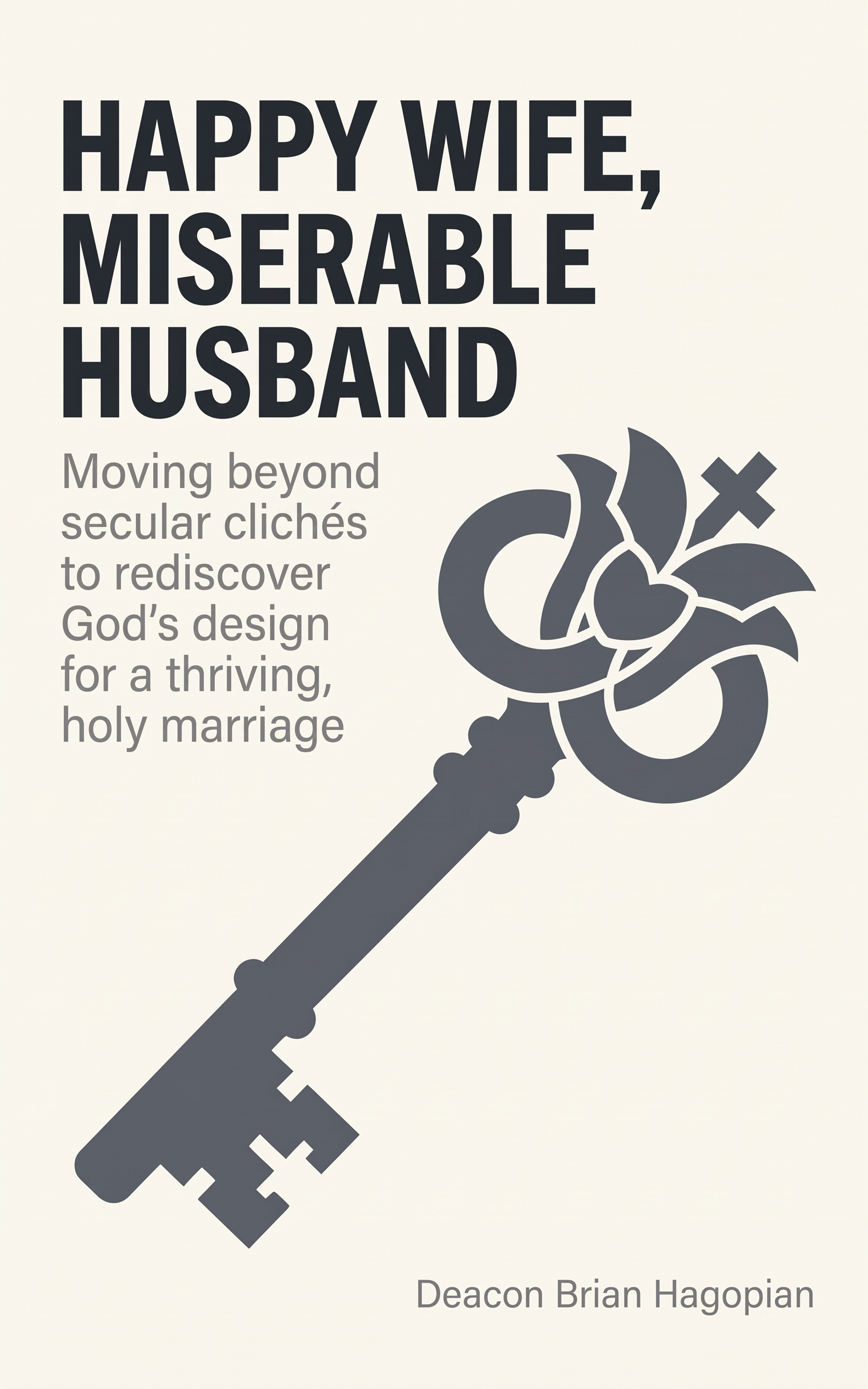
Happy Wife, Miserable Husband
Moving beyond secular clichés to rediscover God's design for a thriving, holy marriage
by Brian Hagopian
The phrase "Happy Wife, Happy Life" has become the unspoken commandment of modern marriage. But for many Christian men, this pursuit of peace at any price has led to a life of quiet desperation, isolation, and spiritual depletion. In Happy Wife, Miserable Husband, Deacon Brian Hagopian pulls back the curtain on the cultural myth that demands husbands sacrifice their identity and God-given roles at the altar of marital convenience. When a man’s primary goal is merely to appease, he risks losing the very soul of his marriage. This isn't just about frustration; it's about a fundamental misalignment with the Creator's blueprint. Through a deep dive into the Biblical Blueprint, this book contrasts worldly expectations with the sacred covenant of marriage. You will learn the difference between holy sacrifice and codependent people-pleasing, and discover how to transition from a passive bystander to a spiritual leader who leads with grace and authority. It is time to stop surviving and start thriving by establishing healthy, biblical boundaries that protect both your soul and your spouse. Discover how to love your wife deeply while remaining right in the eyes of God. It’s time to move from human performance to divine grace and reclaim the joy intended for your home.
- Religion & Spirituality
- Christianity
- Spiritual Growth
The High Cost of Keeping the Peace
Let me ask you a question.
Have you anytime in the past couple of months looked around your own house, sighed under your breath, and whispered, "I just want some peace and quiet"?
I know you have. Oh, don't look away now. I see you. I know that look. It is the look of a man who has mastered the art of walking on eggshells in his own living room. It is the look of a husband who has turned the absolute surrender of his own identity into a daily spiritual discipline. You have convinced yourself that if you can just make it through the evening without a sigh, a glare, or a door slamming, then you have done your job as a Christian husband. You have bought into the grandest lie modern culture has ever sold to men: the idea that a husband’s primary, God-given purpose in life is to keep his wife completely satisfied, perfectly comfortable, and perpetually happy.
We have a saying for this in our culture, don't we? It is repeated at bachelor parties, carved onto decorative wooden plaques in home goods stores, and passed down from well-meaning fathers to their sons like it is some kind of holy scripture. You know the words: "Happy wife, happy life."
But let me be your interpreter today. Let me take that English phrase that we all throw around so casually and translate it into what it actually means in the spirit. When we live by the creed of "happy wife, happy life," what we are really saying is this: "Lord, I am too tired to lead. I am too scared of conflict to stand up for what is right. I would rather let my household drift into spiritual decay than face an uncomfortable conversation at the dinner table. So, I will just give up. I will say yes to everything. I will bend, I will break, and I will stay quiet, all so I can have a temporary, fragile truce that I mistake for peace."
It is like trying to build a fortress out of wet cardboard. It is a miserable way to live, and it is an even worse way to run a Christian marriage. Yet thousands of good, church-going men are doing it every single day. They are sitting in the pews every Sunday with a plastic smile on their faces, while inside, their spirits are shriveling up. They have traded their God-given authority for a quiet life, only to find that the quietness they bought is actually the silence of a graveyard.
The Story of Average Joe
Let me introduce you to a guy I like to call Average Joe. Joe is a good man. He loves his wife, Sarah, and he loves his kids. He works forty-five hours a week at a decent job, pays his taxes, helps out with the youth group when they need an extra driver, and never misses a Sunday service if he can help it. If you met Joe in the church lobby, you would think he has it all together. He is friendly, he shakes hands, and he always asks how your week was—but behind that warm, practiced smile, his eyes are dead tired, and his spirit is absolutely running on fumes.
But if you follow Joe home on a Tuesday evening, you start to see a very different picture. You see a man who is constantly calculating the emotional temperature of the house before he even puts his key in the front door. He sits in his driveway for an extra three minutes, staring at the steering wheel, taking a deep breath, and mentally preparing himself for whatever mood is waiting for him on the other side of that door.
When Joe walks inside, Sarah is stressed. The kids are loud, dinner is late, and the house is a mess. Sarah looks at him and says, "Must be nice to get away from all this at an office all day."
Now, Joe has had a brutal day himself. His boss spent the afternoon breathing down his neck, his project is behind schedule, and he has a headache that is slowly pounding its way behind his left eye. He has a choice here. He can speak up, share his own burdens, and work with his wife to establish a sense of mutual support and order in the home. Or, he can use the ultimate survival tactic of the miserable husband: he can appease.
"You're right, honey," Joe says, forcing a smile. "I'm sorry. Let me take care of the kids, and I'll clean up the kitchen after dinner."
This is how it starts. It is not one massive blowout where Joe surrenders his manhood in a single, dramatic moment. It is a slow, steady erosion. A thousand tiny surrenders, a million little "yeses" when his soul is screaming "no," slowly eat away at his life.
Over the years, Joe's world begins to shrink. His hobbies, like restoring old cars, get pushed aside; he no longer spends Saturday mornings in the garage, his hands covered in grease while he coaxes life back into a rusted-out engine. But Sarah complained that the garage was too messy and that he was spending too much time away from the family. So, Joe sold the car project. He told himself it was a "holy sacrifice" for his family, but deep down, a little part of him died when that flatbed truck hauled his dream down the street.
Joe used to have friends. He had a group of guys he went hunting with every fall, men who knew him, challenged him, and held him accountable. But those trips required planning, money, and a weekend away from home. Every time the annual trip came up, the tension in the house would rise to an unbearable level. There would be sighs, passive-aggressive comments about how hard it is to be a single mother for three days, and cold shoulders that lasted for a week after he got back. Eventually, Joe decided the trip just wasn't worth the emotional tax he had to pay when he returned. He started making excuses to the guys. "Too busy with work this year," he would say. "Maybe next year." Now, those friends don't call anymore. His phone only rings when his wife needs him to pick up milk on the way home.
But the most dangerous loss of all is Joe's connection to his Creator. Joe used to have a vibrant, quiet time with God. He would wake up early, drink his coffee, read his Bible, and pray with conviction. He felt connected to the Spirit. But as the domestic demands grew and his internal misery deepened, Joe found himself spiritually exhausted. He began to feel like a hypocrite. How could he pray to a sovereign, all-powerful God when he couldn't even stand up for his own schedule in his own house? When he tried to read his Bible, the words felt dry. He began to sleep in, using sleep as an escape from the reality of his day. His prayers turned from bold declarations of faith into desperate, whispered pleas for a quiet evening. "Lord, just let her be in a good mood tonight. Lord, please don't let there be a fight."
Joe has become a hostage in his own home. He has built a prison of peace-at-all-costs, and he is the one sitting in the cell with the keys in his pocket. He thinks he is being a good, selfless, Christian husband. After all, doesn't the Bible tell us to lay down our lives for our wives? Doesn't it tell us to be patient, kind, and long-suffering?
Yes, it does. But there is a massive difference between laying down your life as a spiritual leader and laying down your spine as a spiritual coward. Joe has confused the two, and his marriage, his family, and his relationship with God are paying the price.
The Snare of the Fear of Man
Let us take a look at what the Word of God actually says about this dynamic. Open your Bible to the book of Proverbs. In Proverbs chapter twenty-nine, verse twenty-five, we find a profound spiritual truth that cuts straight to the heart of the miserable husband's dilemma:
"The fear of man lays a snare, but whoever trusts in the Lord is safe."
Now, when we read that verse in church, we usually think about peer pressure at school, or the fear of what our coworkers think of our faith, or perhaps the fear of government persecution. We think of "man" as the collective world outside our front door. But let me interpret this for you in the context of your marriage. The Hebrew word used for "man" here is adam, which refers to human beings, to flesh and blood, to any mortal person. That includes your spouse.
When you live in fear of your wife’s reaction, her mood, her disapproval, her disappointment, or her anger, you have fallen headfirst into the snare of the fear of man. You are allowing a human being to dictate your obedience, your joy, and your spiritual standing. You have elevated her voice above the voice of the Holy Spirit.
Let’s look at that word "snare" for a moment. A snare is not a trap that kills its prey instantly. It is a hidden loop of wire or rope designed to catch an animal by the leg. When the animal steps into it, the loop tightens. The more the animal struggles, the tighter the wire grips. The animal doesn't die right away; it is held captive, exposed to the elements, slowly starving, and waiting for the predator to arrive and finish the job.
That is exactly what happens to a husband who is caught in the fear of his wife's displeasure. Every time you say "yes" to something you know is wrong, or every time you stay silent when you should speak up, you are stepping deeper into that wire loop. You think you are avoiding a fight, but you are actually tightening the cord around your own spiritual neck. You are trapped in a cycle of appeasement, and your spiritual vitality is slowly starving to death.
Let’s be honest about what this looks like in daily life. It looks like a hostage situation. Have you ever noticed how the entire atmosphere of your household can change based on the mood of one person? If your wife walks into the kitchen in a bad mood, everyone in the family immediately feels the drop in barometric pressure. The kids quiet down. They stop playing. You find yourself extra helpful, jumping up to clear plates, offering to wash dishes, doing everything you can to soothe the beast. You are managing her emotions instead of leading your home.
But where in Scripture is a husband commanded to manage his wife’s emotions? Where does God say that a husband's primary role is to ensure his wife never feels sad, angry, stressed, or disappointed? It is not in there. In fact, when we look at the biblical pattern of leadership, we see that a leader must be anchored in something far more stable than the shifting emotions of another human being.
When you allow your wife's emotional state to dictate the spiritual atmosphere of your home, you have abdicated your role as the priest of your household. You have handed the steering wheel over to her feelings. And let me tell you something about feelings: they are terrible drivers. They are inconsistent, unpredictable, and easily influenced by circumstances, fatigue, hormones, and stress. If your home is steered by feelings, you will spend your entire marriage crashing into one emotional ditch after another.
God did not design marriage to be a hostage situation where the husband is constantly negotiating for his freedom with ransom payments of compliance. He designed marriage to be a covenant, built on the rock-solid foundation of His truth, where both husband and wife are accountable to Him first. When you fear God more than you fear your wife's reaction, you are finally free to love her the way Christ loves the church. But until you get that order right, you will remain trapped in the snare.
The Worldly vs. Biblical Pivot
We need to understand that there are two competing philosophies of marriage pulling at us every single day. On one side, we have the voice of the world. On the other side, we have the voice of God. These two voices are not saying the same thing in different ways. They are in direct, hostile opposition to one another.
Let’s look at the contrast between these two approaches:
- The World's Standard: The primary goal of marriage is personal happiness and self-actualization. If your spouse is not making you happy, they are failing. Therefore, a husband must do whatever it takes to keep his wife happy, comfortable, and satisfied, even if it means sacrificing his own values, his calling, and his connection to God. The ultimate metric of a good marriage is the absence of conflict.
- The Biblical Standard: The primary goal of marriage is to reflect the relationship between Christ and the Church. Marriage is a sacred covenant designed to make us holy, not just happy. A husband is called to lead his home under the authority of God, loving his wife sacrificially but always putting his obedience to Christ first. The ultimate metric of a good marriage is covenant faithfulness and spiritual fruitfulness.
The world tells you that a "good husband" is a passive, accommodating helper who never makes waves, never challenges his wife, and always defers to her wishes. We see this caricature on television all the time. Every sitcom husband is a bumbling, incompetent buffoon who is constantly getting into trouble, only to be rescued by his wise, organized, and long-suffering wife. He spends the entire episode apologizing, groveling, and trying to get back into her good graces. This is the cultural mold that has been prepared for you, and if you are not careful, you will slide right into it without even realizing it.
But when we look at the biblical pattern, we see something entirely different. We see that God has established a divine order for the family. This is not about superiority or inferiority; it is about roles, responsibilities, and authority under God. Just as Christ is the head of the church, the husband is called to be the head of the wife. But what does that leadership look like?
It does not look like tyranny. It does not look like a dictator barking orders from his armchair. That is the worldly, distorted view of authority. True biblical authority is sacrificial, loving, and visionary. It is a leadership that is willing to die for the family, but it is also a leadership that is willing to stand firm in the truth, even when that truth is unpopular or uncomfortable.
Consider the difference between a fragile truce and a solid foundation. When you appease your wife to avoid a conflict, you are purchasing a fragile truce. It is a temporary peace built on a lie. It is like sweeping dirt under a rug; eventually, the pile gets so big that you start tripping over it. The dirt is still there, rotting away, destroying the floorboards beneath, even if you can't see it on the surface.
But when you stand on biblical truth, you are building on a solid foundation. That foundation is not shaken by a bad day, a sharp comment, or an emotional storm. It is built on covenant commitments that remain steady regardless of how either of you feels on any given Tuesday. It is a peace that passes understanding because it is anchored in the presence of God, not in the absence of conflict.
Let's look at how this plays out in a practical scenario. Imagine your wife wants to make a financial decision that you know, in your heart and according to your budget, is unwise. Perhaps she wants to buy an expensive piece of furniture or take a vacation that you cannot afford without going into debt.
The worldly husband says, "Well, if I say no, she's going to be miserable for weeks. She'll give me the silent treatment, she'll complain to her friends, and the house will be a war zone. I'll just put it on the credit card and worry about the payments later. At least she'll be happy." He buys the furniture, but he also buys a mountain of stress, resentment, and financial bondage. He has kept the "peace" of the moment, but he has sabotaged the security of his family's future.
The biblical husband, however, looks at the situation through the lens of stewardship and covenant. He understands that God has held him accountable for the financial well-being of his home. He sits down with his wife, looks her in the eye, and says, "Sweetheart, I love you, and I want you to have nice things. But looking at our budget and our stewardship before God, we cannot afford this right now. Going into debt for this would be unwise, and as the leader of this home, I cannot agree to it. Let's work together to save for it, or let's find a more affordable option."
Now, is his wife going to jump up and cheer? Probably not. She might be disappointed. She might be angry. She might walk away and slam a door. But the biblical husband does not panic. He does not chase her down to apologize for doing what is right. He stays calm, stays loving, and remains anchored in his decision. He is willing to endure temporary discomfort to preserve long-term covenant integrity. Over time, as his wife sees that his decisions are motivated by love, wisdom, and a desire to honor God—not by control or selfishness—she begins to trust his leadership. She realizes that she is married to a man, not a boy, and that brings a deep, lasting security that no expensive furniture could ever provide.
The Misery Markers
How do you know if you have fallen into this trap? How can you tell if you are living as a miserable husband under the illusion of a happy marriage? We need to look at the spiritual and emotional diagnostic indicators. I call them the "Misery Markers." These are the warning lights on the dashboard of your soul, telling you that your engine is about to blow, even if the exterior of your car looks clean and polished.
Let’s examine these markers honestly. As you read through them, do not look at your wife. Do not think about how she needs to change. Look into the mirror of the Word and ask yourself if these markers are present in your own life.
Marker 1: Resentment
Resentment is the poison you drink while hoping the other person dies. It is the quiet, simmering anger that builds up when you constantly sacrifice your own needs, desires, and values to keep someone else happy, without ever receiving acknowledgement or appreciation for your sacrifice.
When you say "yes" to your wife out of fear rather than love, you are not actually making a holy sacrifice. You are making a transaction. You are thinking, "I will give up my Saturday morning, or my golf game, or my dream, and in exchange, you will be nice to me and make me feel appreciated." But when she doesn't notice your sacrifice—or worse, when she demands even more—you feel cheated. You feel used. You begin to collect mental receipts of all the things you have given up for her, and you store them in a vault in your mind, ready to bring them out during the next argument.
This resentment shows up in passive-aggressive behavior. It is the heavy sigh when she asks you to do something. It is the sarcastic comment wrapped in a joke. It is the emotional withdrawal, where you are physically present in the room but miles away in your spirit. You have become a martyr of your own making, blaming your wife for a prison that you built with your own hands.
Marker 2: Loneliness
You can be married for thirty years, sleep in the same bed every night, eat dinner together every evening, and still be the loneliest man on the planet. This is the loneliness of the husband who has hidden his true self to keep the peace. You realize that your wife doesn't actually know you; she only knows the version of you that you have curated to keep her happy.
You cannot have true intimacy without honesty. If you are constantly wearing a mask of compliance, hiding your fears, your doubts, your desires, and your convictions because you are afraid of her reaction, then she cannot love the real you. She is loving a shadow, a puppet that you are controlling. And you are left sitting in the dark, wondering if anyone would actually care about the man behind the curtain.
This loneliness drives men to seek escapes. Some men escape into work, staying late at the office because it is the only place where they feel competent and respected. Some escape into pornography, seeking a cheap, counterfeit intimacy that requires no vulnerability and carries no risk of rejection. Others escape into sports, hobbies, or video games, creating a virtual world where they can feel like conquerors because they feel like losers in their own homes.
Marker 3: Spiritual Deafness
This is the most dangerous marker of all. When you consistently prioritize your wife's approval over God's command, your spiritual ears begin to grow dull. You lose the ability to hear the whisper of the Holy Spirit because you are so focused on the loud, demanding voice of your circumstances.
Think about it. How can you hear the Spirit's promptings to lead, to correct, or to step out in faith when your entire life is designed around avoiding discomfort? The Holy Spirit is a comforter, yes, but He is also a disruptor. He will call you to do hard things. He will call you to speak up when it is difficult, to lay down your life for the truth, and to walk through the fire. If your primary goal in life is to keep things smooth, quiet, and easy, you will find yourself constantly resisting the Holy Spirit.
You will start to rationalize your passivity. You will call your cowardice "patience." You will call your lack of leadership "meekness." You will twist the scriptures to justify your desire to avoid conflict. But your spirit knows the truth. Your spirit knows that you have turned your back on your calling, and that internal division will eat away at your faith until you are left with nothing but a dry, lifeless form of religion.
The Fallacy of the "Holy Sacrifice"
Now, let's address the defense mechanism that almost every miserable husband uses when he is confronted with his passivity. He will look at me and say, "But preacher, doesn't Ephesians chapter five tell me to love my wife as Christ loved the church and gave Himself up for her? Aren't I supposed to sacrifice myself for her?"
Yes, you are. But let us look at that passage with open eyes and a clear mind. Let us interpret English to English, and Scripture to Scripture.
Did Christ give Himself up for the church so that the church could do whatever it wanted? Did He die on the cross so that the church could set the agenda, dictate the rules, and ignore His commands? Absolutely not. Christ gave Himself up for the church to sanctify her, to cleanse her, and to present her to Himself in splendor, without spot or wrinkle. His sacrifice was directed toward her holiness, not her immediate comfort. His sacrifice was motivated by His devotion to the Father’s will, not by a fear of the church’s disapproval.
When Christ sacrificed Himself, He did not lose His identity, His authority, or His mission. He fulfilled them. His sacrifice was an act of supreme spiritual leadership, not spiritual surrender.
But when you, as a husband, say "yes" to your wife’s demands at the expense of your own peace, your connection to God, and your stewardship of your home, you are not sacrificing like Christ. You are sacrificing to her. You have made her your idol, and you are laying your manhood, your calling, and your relationship with God on her altar, hoping she will look down on you with favor.
Let’s be clear about what true sacrifice looks like. True sacrifice is active, not passive. It is a conscious, loving decision to give up something good for something better. It is choosing to spend your Saturday morning coaching your son's baseball team instead of playing golf, because you know your son needs his father's presence. It is choosing to hold your tongue when you are insulted, not because you are afraid of a fight, but because you want to honor Christ with your words. It is choosing to work hard to provide for your family, even when you would rather rest, because you love them.
But passivity is not sacrifice. Passivity is the lazy man's way out. It is letting things drift because you don't want to do the hard work of steering. It is staying silent because you are too cowardly to speak. It is letting your wife make the hard decisions so that if things go wrong, you can blame her instead of taking responsibility.
Let's look at the first marriage in history to see how this passivity plays out. In the garden of Eden, God gave a clear command to Adam: do not eat of the tree of the knowledge of good and evil. He held Adam responsible for keeping that command. But when the serpent tempted Eve, where was Adam? The Scripture tells us he was right there with her. He was standing there, watching the conversation happen, watching his wife reach out her hand for the fruit, and he did absolutely nothing.
Why did Adam stay silent? Why didn't he step in, protect his wife from the deceiver, and remind her of God's command? Perhaps he didn't want to make a scene. Perhaps he was curious himself. Perhaps he wanted to keep the "peace" of the moment. He let his wife take the lead, she ate, she handed some to him, and he ate too.
And what was the result of Adam's passivity? Did it lead to a happy life? Did it lead to a peaceful home? No. It led to the fall of humanity, the entry of sin into the world, and the destruction of the perfect relationship they had with God and with each other. And when God came walking in the garden in the cool of the day, who did He call out for? He didn't call for Eve. He called for Adam. He said, "Adam, where are you?"
God held the man accountable for the failure of the home, even though the woman was the one who was deceived first. He will do the same to you. When you stand before the judgment seat of Christ, you will not be able to point to your wife and say, "Well, she wanted to do it, and I just wanted to keep her happy." God will look at you and say, "I did not call her to lead your home. I called you. Where were you?"
The Case of Mark
To help you see how this plays out in the modern world, let me tell you the story of a real man named Mark. Mark was a member of a Bible church I know well. He was a solid guy, a contractor who worked hard with his hands and had a deep love for the scriptures. When Mark first got married to his wife, Jessica, he was actively involved in a men’s Bible study that met every Tuesday night. This wasn't just a social club for Mark; it was his lifeline. The men in that group prayed for him, challenged him to be a better man, and kept him grounded in his faith.
But after a few months of marriage, Jessica began to complain about Tuesday nights. She would say things like, "I've been working all day, and I'm lonely on Tuesdays. Why do you have to go out with the guys when you could be home with me? Don't you love me more than them?"
Mark felt a pang of guilt. He wanted to be a good husband, and he certainly didn't want Jessica to feel neglected. So, he decided to compromise. He told himself that he was making a "holy sacrifice" for his wife. He started attending the study every other week. But that didn't satisfy Jessica. The tension on the Tuesdays he did go was still palpable. She would be quiet, distant, and emotional when he got home. Eventually, Mark made the decision to stop going altogether.
"I can study the Bible at home," he told the group leader. "My wife needs me right now. It's just a season."
But it wasn't just a season. It was the beginning of a spiritual decline. Without the accountability and encouragement of those men, Mark's personal devotional life began to slip. He spent his Tuesday nights sitting on the couch next to Jessica, watching reality television shows that he had no interest in, just to keep her company. He was physically present, but his spirit was starving.
As Mark’s spiritual fire faded, his resentment grew. He began to look at Jessica not as his partner, but as his warden. Every time she asked him to do something around the house, he felt a surge of irritation. He started making biting, sarcastic comments under his breath. He became passive-aggressive, doing chores poorly so she wouldn't ask him again. The intimacy in their marriage dried up, replaced by a cold, business-like transaction of daily survival.
Jessica, on the other hand, didn't feel loved by his sacrifice. She felt his withdrawal. She could sense his resentment, even if he didn't voice it. She became more insecure, more demanding, and more critical, trying to force an emotional connection from a man who had checked out. They were caught in a vicious cycle of appeasement and resentment, all because Mark had sacrificed his spiritual lifeline on the altar of temporary domestic peace.
It wasn't until Mark hit rock bottom—feeling completely empty, depressed, and disconnected from God—that he realized what he had done. He had to go back to his wife, apologize for his passivity, and tell her that he was reclaiming his Tuesday night study. It wasn't an easy conversation. There were tears, arguments, and accusations. But Mark stayed firm, stayed loving, and went back to his group.
And you know what happened? As Mark began to get filled up spiritually again, he became a better husband. He had more patience, more love, and more joy to give Jessica. He was no longer reacting out of emptiness; he was leading out of fullness. Jessica began to see the change in him, and over time, she actually came to appreciate Tuesday nights because she saw that her husband was returning to her as a stronger, more loving leader.
Reclaiming the Covenant
So, how do we fix this? How do we break out of the snare of the fear of man and step into the freedom of the covenant of marriage? It starts with a radical shift in our perspective and a commitment to action. We have to stop playing defense and start playing offense. We have to stop managing our wives' emotions and start leading our homes under the authority of God.
Here are the steps you must take to begin this process of covenant restoration:
Step 1: Repent of Your Idolatry
You must call this what it is. It is not "keeping the peace." It is not "being a good husband." It is idolatry. You have placed your wife's approval, comfort, and happiness above your obedience to God. You have feared a human being more than you fear the Lord. You must go to God in prayer, confess this sin, and ask for His forgiveness. You must ask Him to restore Him to His rightful place as the absolute Lord of your life.
Step 2: Have the Courageous Conversation
You need to sit down with your wife and have an honest, loving, and firm conversation. You need to apologize for your past passivity. You might say something like this:
"Honey, I need to apologize to you. I have not been leading this home the way God called me to. I have been saying yes to things just to avoid arguments, and I have allowed resentment to build up in my heart. That was wrong of me. I want to love you the way Christ loves the church, which means I have to love you enough to stand on the truth. I am committing today to lead our family in wisdom, strength, and love, and that means sometimes I will have to say no, and sometimes we will have to have hard conversations. But I promise you that my goal will always be to honor God and protect our marriage."
Now, let me warn you: she might not know how to handle this at first. She has been used to a doormat, and when a doormat suddenly stands up and becomes a man, it can be startling. She might test you. She might try to use the old tools of emotional pressure to see if you will bend. You must stay strong, stay calm, and stay loving. Do not argue. Do not shout. Just stand firm in your commitment.
Step 3: Establish Healthy Boundaries
You must identify the areas where you have allowed your spiritual life, your health, and your relationships to be compromised, and you must establish clear, biblical boundaries. If you need to go back to a men's group, do it. If you need to set aside time for prayer and Bible study, do it. If you need to establish a budget that stops reckless spending, do it. You do not need her permission to obey God. You need her partnership, yes, but your obedience is to Christ first.
Let's look at some reflection questions to help you dig deeper into this right now:
- When was the last time you said "yes" to your wife but "no" to your own peace? What was the situation, and what were you trying to avoid?
- Do you feel like you are walking on eggshells in your own living room? What are you afraid will happen if you speak your mind honestly?
- Have you sacrificed a key spiritual discipline (like church attendance, small group, prayer, or service) to keep things smooth at home? How has that affected your relationship with God?
I want you to take some time to answer those questions honestly before you move on. Write down your answers. Do not rush through this. This is the beginning of your restoration.
Your Action Step for This Week
I don't want this book to be just another nice set of ideas that you read and forget. I want you to take action. So, here is your challenge for this week:
Identify one area this week where you agreed to something just to avoid an argument, and reflect on the resentment it caused.
It doesn't have to be a massive, life-altering decision. It could be something small. Maybe you agreed to go to a social gathering that you knew would stretch your family's schedule too thin. Maybe you agreed to let your kids participate in an activity that takes them away from church on Sundays. Maybe you stayed silent when your wife made a critical remark about your family or your faith.
Once you identify that area, I want you to do three things:
- Write down what you actually wanted to say in that moment, and why you stayed silent.
- Identify the specific "fear of man" that was operating in your heart. Were you afraid of her anger? Her disappointment? Her silence?
- Commit to handling the next similar situation with biblical courage. When the opportunity arises, speak the truth in love, stay calm, and do not back down just to buy a temporary truce.
Remember, peace is not the absence of conflict; it is the presence of God. When you invite God's presence into your decision-making, you will find a strength that you never knew you had. You will find that you can love your wife deeply, honor her completely, and still remain right in the covenant of marriage.
A Prayer of Alignment
Let us close this chapter by aligning our hearts with God’s truth. I want you to read this prayer out loud, with conviction, and let it be the cry of your heart today:
Heavenly Father, I come before You today acknowledging that I have often cared more about human comfort than Your approval. I have fallen into the snare of the fear of man, and I have allowed my fears to dictate my leadership in my home. I confess that I have often sought a fragile, superficial peace rather than standing on the solid foundation of Your covenant.
Lord, forgive me for my passivity. Forgive me for the times I have stayed silent when I should have spoken up. Forgive me for the times I have sacrificed my spiritual life and my calling on the altar of my wife's approval. I recognize that this is not true love, but a form of idolatry that hurts my marriage and dishonors You.
I ask for the courage to lead my family with grace, strength, and truth. Fill me with Your Holy Spirit so that I may hear Your voice clearly and obey Your commands without hesitation. Give me the wisdom to establish healthy boundaries that protect my soul, my marriage, and my household.
I commit today to honor You above all else. I trust that as I seek Your kingdom first, You will provide the peace, the love, and the restoration that my marriage needs. Thank You for Your grace, Your mercy, and Your unwavering love. In Jesus' mighty and holy name, Amen.
The Myth of the Doormat Disciple
Let me ask you a question. Are you the king of your castle, or are you just the guy who sweeps the floors and apologizes when you make a speck of dust? Think about the last time you watched a television commercial or sat through a modern family sitcom. You probably know the exact character I am talking about. He is the guy who cannot seem to find h…