

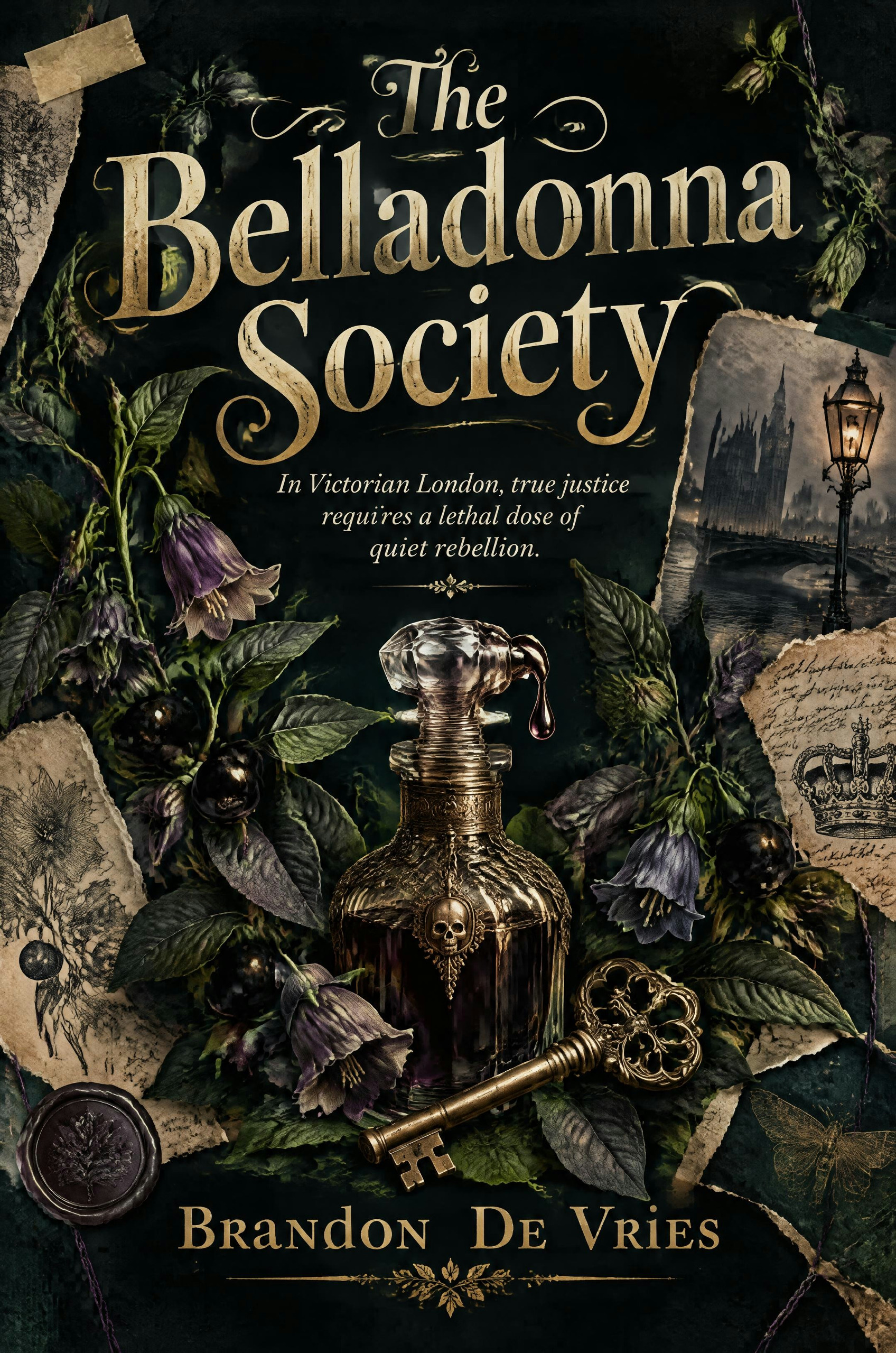
The Belladonna Society
In Victorian London, true justice requires a lethal dose of quiet rebellion.
To high society, she sells soothing botanical tonics. In secret, she brews untraceable deliverance. In the foggy alleys of Blackfriars, apothecary Hester Finch serves as the covert lifeline for the Belladonna Society—an underground vigilante network protecting battered wives from Belgravia's wealthiest monsters. Using lethal doses of nightshade and hemlock, she provides desperate women a silent escape. Her double life unravels when Lord Harrington is discovered dead behind the bolted doors of his locked study. Scotland Yard Detective Inspector Thomas Vance enlists Hester's mastery of forensic chemistry and toxicology to identify the rare compound. To Hester's horror, the victim died from her own bespoke formula. Forced to analyze the crime scene under Vance's unrelenting gaze, Hester fakes test results and obscures physical clues. But the sharp detective matches chemical traces straight to her workshop, issuing a brutal dawn ultimatum: surrender the noblewomen or hang. To save her sisterhood, Hester uncovers Harrington's hidden iron vault of blackmail ledgers, forcing Vance to choose between statutory law and moral righteousness. Perfect for fans of The Lost Apothecary and A Study in Scarlet Women, this atmospheric locked-room mystery will hold you spellbound.
- Mystery
- Historical Fiction
- Historical Mystery
- Locked Room
- Murder Mystery
- Victorian
The Nightshade Summons
Clara flinched, then closed her eyes. Her hands trembled inside her threadbare wool mantle.
"Keep the compress to the bone for twenty minutes before you sleep," Hester said. Her voice remained even, practical, and devoid of the pity that made women like Clara retreat into silence. "Take three drops of the valerian syrup in warm water. No more than three. It will dull the ache without clouding your senses if you must leave the house before daylight."
Hester reached beneath the counter, retrieved a small amber bottle stoppered with dark wax, and pressed it into Clara's gloved palm. Clara did not look at the label. She knew what it was, just as she knew that no fee would be recorded in the shop ledger beside her name.
"He told me he would break the latch next time," Clara whispered, her lips barely parting.
"The latch on your bedroom door is iron," Hester replied. "I inspected it myself two months ago. If he lifts a hammer to it, you take the child and walk down Greek Street to the bakery on the corner. Ask for Martha. Martha has a bolt that holds from the inside, and two brothers who work the docks."
Clara nodded once, pulled her hood forward until her face vanished into shadow, and went out through the alley. The cold draft from the lane lingered for a moment before the heavy oak door latched shut.
Hester stood alone in the shop. Twilight fell across the rows of glass jars that lined the shelves from floor to ceiling. The shop smelled of dried rue, valerian root, and the sharp bite of her private cleansing wash, a compound of rectified alcohol, wintergreen, and camphor that she used to scour her distillation equipment. She pulled an apron over her dark wool gown, wet a rag with the solvent, and wiped down the slate surface where Clara had rested her arms.
The brass bell above the front entrance struck twice with violent force.
Hester did not jump. She set the rag aside, wiped her hands on a dry towel, and walked through the curtain into the front room. The bell rarely sounded with such authority after dusk. Ordinary customers tapped lightly or waited for the latch to lift.
A tall man in a dark woolen overcoat stood just past the threshold. He had removed his bowler hat, revealing thick brown hair trimmed close at the temples. His eyes were pale grey and sharp, moving across the shelves, the balances, and the dried bundles hanging from the ceiling before settling directly on her. Behind him, a uniformed police constable stood on the mist-slick sidewalk under the gas lamp.
"Miss Hester Finch?" the man asked. His voice had the flat, measured cadence of an officer accustomed to being answered without delay.
"I am Hester Finch." The shop is closed for business, sir."
"I am not here to purchase liniment," he said. He produced a leather wallet, flipped it open to display a brass warrant card, and closed it with a snap of his fingers. "Detective Inspector Thomas Vance, Scotland Yard. You were recommended to the Yard by Doctor Milligan at the parish dispensary."
"Doctor Milligan is generous with his opinions," Hester said. "I am an apothecary, Inspector, not a police surgeon."
"Milligan informed me that you know more about plant poisons than three-quarters of the fellows at the Royal College," Vance replied. His gaze drifted to her fingers, which still bore faint yellow stains from nitric acid tests she had run two days earlier. "An influential gentleman died two hours ago in his townhouse on Curzon Street. Under circumstances that do not permit the luxury of waiting until morning."
A faint chill prickled the base of Hester's neck, but her face remained smooth. Curzon Street belonged to carriage horses, private guards, and men with titles. "If a gentleman has died, you require a physician to sign the certificate."
"The physician has already arrived, and he is out of his depth," Vance said. "The doors to the private study were locked from the inside. The key rested upon the desk blotter, four feet from the lock. The window catches are sealed with lead against the winter drafts. Lord Harrington sits in his leather chair, stone dead, with no wound upon his body and no sign of struggle."
A cold constriction seized Hester's diaphragm, catching her breath hard in her throat, but she did not blink. She kept her weight balanced squarely on both feet. Lord Harrington. Eleanor's husband.
"Lord Harrington," she repeated, keeping her tone flat and distant, as though the name belonged to a stranger in an old gazette.
"You have heard of him?" Vance asked quickly. His eyes narrowed, catching the slight pause.
"Every soul in London who reads the news has heard of him," Hester said. "He sits on the Board of Trade and owns half the tenements in Southwark. Why would Scotland Yard require a back-street herbalist for a peer of the realm?"
"Because the Yard's regular toxicologist is currently fifty miles away in Oxford, and Harrington's tongue is swollen," Vance said. "Doctor Milligan swore you could identify an alkaloid by its residue faster than the Home Office could light a burner. Fetch your field kit, Miss Finch. A cab is waiting."
Hester stood motionless for a second, calculating the risks. If she refused, Vance would wonder why an obscure apothecary had declined a handsome police fee. If she went, she would walk directly into the center of the trap, where a single recognized trace of her bespoke tincture could see her indicted for capital murder and sent to the gallows at Newgate. Yet refusal was an admission of guilt in itself to a man like Vance.
"Allow me three minutes to bank the hearth and collect my instruments," she said.
"Take four," Vance replied. "The constable will carry your satchel."
"I prefer to carry my own things, Inspector."
She turned and walked into the back room. Her pulse thudded against her ribs, but her fingers remained perfectly steady as she packed her leather case. She placed glass sample tubes into their velvet slots, followed by silver tweezers, a horn spoon, a magnifying glass, and small dropper bottles of hydrochloric acid and neutral spirit. Beneath the upper tray lay the ledgers of her ordinary trade. Beneath the false bottom lay nothing; she had burned the formula sheets three weeks ago, watching the blue ink curl to grey ash in the grate.
When she returned to the front room, Vance stepped back to let her pass into the damp evening. The four-wheeler smelled of wet horsehair and old tobacco. Vance sat across from her, his knees nearly brushing her woolen skirt, his eyes never leaving her face as the carriage rattled west toward Mayfair.
Harrington House rose from the fog like a fortress of grey Portland stone. Gas lanterns flickered along the iron fence, illuminating two constables stationed at the main gates to keep onlookers at bay. Inside, the marble foyer was silent save for the muffled sobs of a scullery maid in the service corridor. Lady Eleanor was nowhere to be seen, likely confined to her private drawing room under police order.
Vance led Hester up the wide staircase to the third floor. At the end of the gallery, a constable stood before a heavy oak door that bore no splintering around the lock. The keyhole was brass, small and unmarred.
"We took the door off its hinges with a crowbar," Vance murmured, nodding toward the heavy screws lying in a neat row upon a silver tray. "The bolt was thrown on the inside." Nobody entered through the chimney, either; the flue has an iron grate that has not been moved in twenty years."
Hester stepped into the study. The hearth held dying embers that cast a dull orange glow over dark mahogany bookcases, leather-bound volumes, and a thick Persian carpet. Lord Harrington sat in the center of the room.
He was slumped back in a high-backed armchair behind an immense walnut desk. His neck was wrenched against the leather at a severe, unnatural angle. His eyes were wide open, staring at the painted plaster ceiling, his pupils blown into massive black pools that left almost no iris visible. A dark red flush covered his neck and cheeks, mottling the pale aristocratic skin like an ink stain through linen. Upon the desk sat an open ledger, a crystal tumbler, and an empty snifter of cognac.
"The body was discovered at six," Vance said. He stood beside the desk, arms folded across his chest. He did not look at the corpse; he looked at Hester. "The butler knocked with his lordship's evening tea. When there was no reply, he fetched the house steward; they forced the pins an hour later."
Hester approached the desk and set her leather case on the floor. She took off her gloves, folded them neatly, and tucked them into her pocket. She leaned over the dead man.
The skin of Harrington's throat was dry to the touch, retaining the fever of a violent death. She leaned closer, her nose centimeters from his parted lips. A faint, terrible scent rose from his mouth. It was not the sour heat of standard belladonna. It carried the subtle sweetness of bitter almond extract, blended carefully with the earthy undertone of dried calamus root.
The breath caught in her throat. She swallowed it down instantly, keeping her posture rigidly upright.
It was hers.
No other apothecary in London compounded nightshade with sweet calamus. She had created that exact balance to mask the scorching bitter burn of the atropine, allowing a desperate woman to slip twenty drops into a glass of fortified wine without raising the alarm of a suspicious palate. She had handed that very vial to Eleanor Harrington four nights ago in the churchyard of St. Giles.
The sealed room felt entirely airless, the dead heat of the hearth trapping the scent of cooling flesh and heavy Morocco leather between the book-lined walls. Beside her, Vance stood so close that the faint rasp of wool against his waistcoat marked each slow, steady breath. His scrutiny pressed like the draftless silence itself, weighing against her temple as he tracked the taut line of her jaw and every fractional movement of her bare fingers.
"Well, Miss Finch?" Vance asked, his voice low and pressing. "What do the symptoms suggest to a woman of your training?"
Hester reached into her kit, retrieved her horn spoon, and carefully depressed Harrington's lower lip to inspect the dried froth along his gums. Her hands did not tremble. She forced her voice to assume the cool, neutral authority of an academic observer, knowing that an ounce of hesitation would hang them both.
"Extreme mydriasis," she said, pointing the tip of the spoon at the dead man's blown pupils. "Flushed epidermis, dry mucous membranes, and respiratory arrest. It bears the broad characteristics of a solanaceous alkaloid, Inspector. Henbane, perhaps. Or common garden nightshade."
Vance took a slow step closer, leaning over the edge of the desk until his coat brushed hers. "Common nightshade does no work in an hour, Miss Finch. And Lord Harrington was speaking to his secretary at half past four. Someone gave him something far more potent than weed plucked from an alley wall."
Hester lifted the crystal snifter by its rim and held it against the weak glow of the hearth fire. She caught the faint ghost of her own work in the bowl and set it down without a sound.
"Then you are looking for an expert hand, Inspector Vance," she said, looking straight into his pale eyes. "And London has very few who possess that kind of skill."
Seeds of Misdirection
Vance stood by the high, barred window, his overcoat unbuttoned and his arms crossed over his chest. He did not hover over the glassware, but his gaze remained fixed on Hester's hands as she uncorked the specimen jar. The man had an unsettling stillness about him, the kind of quiet patience that belonged to a hunter waiting by a waterhole."Dr Milli…
Want to read the rest?
Get the full book here: