

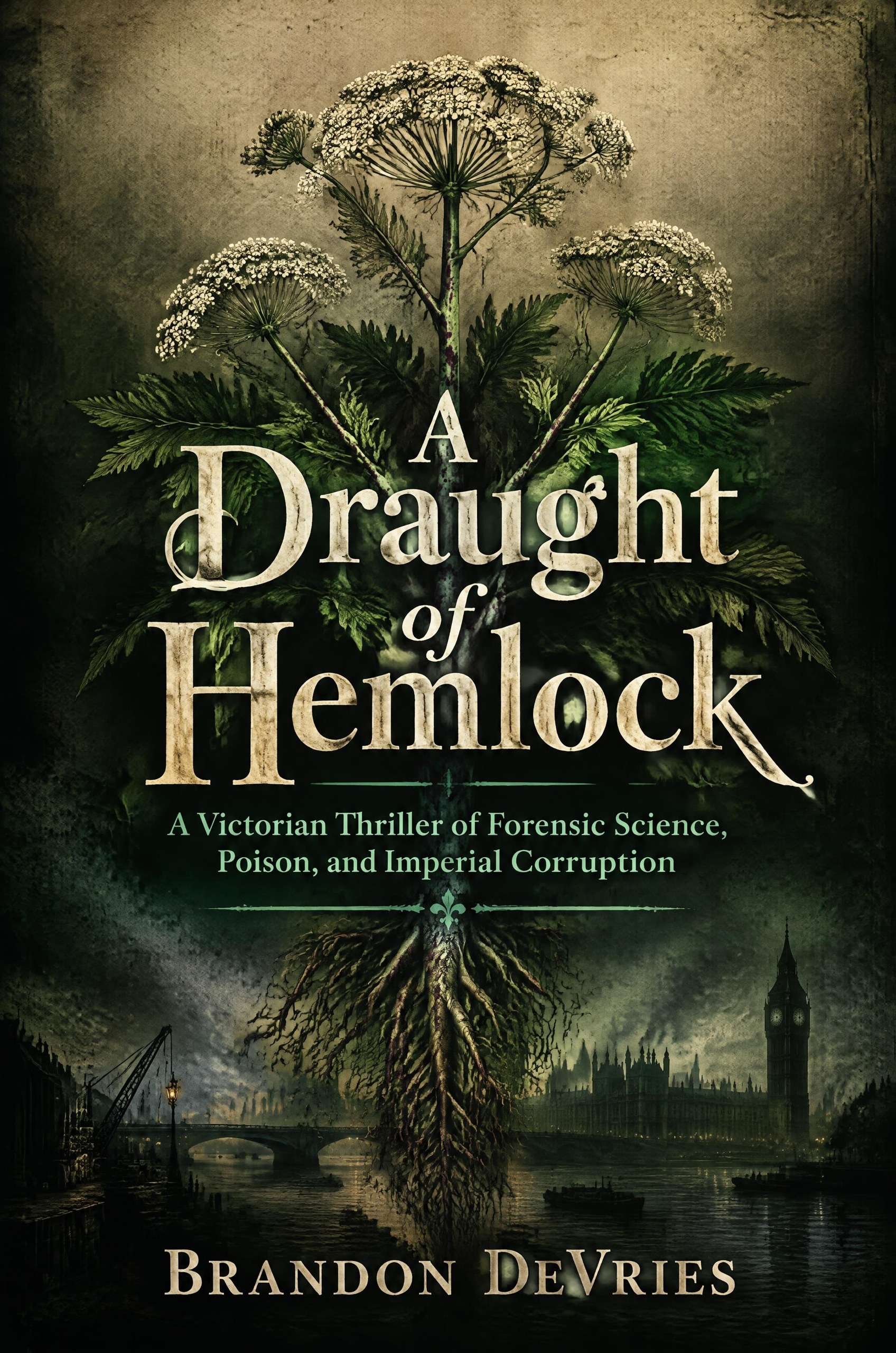
A Draught of Hemlock
A Victorian Thriller of Forensic Science, Poison, and Imperial Corruption
In 1890s London, hemlock is no longer just a poison—it has become a weapon of class warfare. When a lethal alkaloid formula slips from the shadows of an underground apothecary into the crystal decanters of Parliament, Scotland Yard Inspector Thomas Vance finds himself chasing a ghost. The only person who understands the lethal compound is Hester Finch, a brilliant former vigilante chemist whose radicalized ex-apprentice is systematically executing the city's ruling elite. Bound by an uneasy truce, Vance and Finch track the tainted tincture from toxic Thames wharves to the glittering ballrooms of Belgravia. As the body count climbs and public panic sparks draconian quarantine lockdowns across the capital, the pair unearths The Iron Vault—a ruthless aristocratic syndicate manipulating both the chemical trade and the courts meant to judge them. Armed only with nascent forensic toxicology—color assays, scales, and extraction analysis—Vance and Finch must unravel an imperial conspiracy before the final draught is served. A Draught of Hemlock is a dark, atmospheric historical thriller that exposes the razor-thin line between Victorian high society and the criminal underworld.
- True Crime
- Historical Non-Fiction
- Historical Crime
- Forensic Investigation
- Political History
The Carlton Club Murder and the Lethal Assay
Big Ben struck the half hour. Hester Finch counted the tolls from across St. James's Street, one gloved hand pressed flat to her coat pocket to quiet the clink of glass beneath the wool. Three vials rode there, each no larger than a thimble, packed in cotton against her hip. She had told herself they were bound for the chemist on Jermyn Street, payment on a debt six months overdue. She had almost believed it, too, until the first scream came through the fog.
The Carlton Club rose behind its stone façade like something carved rather than built, its windows glowing amber through the sulfur-yellow smog that had settled over Pall Mall since noon. Inside, she knew, men in white tie were working through their third bottle of port, the smoke from their cigars thick enough to cut, the talk running to railway shares and the Irish question and which of them might be knighted before the year was out. Outside, the air tasted of coal and wet stone. Hester stepped off the curb, her hand tightening over the vials in her pocket, then checked her stride as a hansom cab rattled past, throwing up a fan of black water from the gutter. She drew back against the damp iron railings, measuring the distance to the entrance—twenty feet across the macadam that might as well have been twenty miles.
The second scream was not a scream at all but a man's voice, high and cracking, calling for a doctor, calling on God, calling for anyone at all.
The Scene of the Crime: Inside the private dining room at the rear of the club, Arthur Pendleton, Member of Parliament for a Hampshire constituency that returned him without contest every three years, had been telling a story about a horse when the convulsion took him. His glass of '47 port sat half drunk on the white linen, catching the lamplight in a ring of garnet, and his hand rested near it, fingers loose, when the first spasm bent him forward like a man struck from behind.
He cracked his forehead against the mahogany table before anyone seated with him had risen from his chair. Then he was on the Wilton carpet, convulsing, his manicured fingers clawing through the deep red wool until two nails tore backwards from the bed. The men around him, five of them, all grey-whiskered and thick with vintage port, sat frozen in a slack-jawed stupor, crystal stems hovering midair and cigars poised between deadened fingers, their senses far too sodden to reckon with the dying man at their feet.
By the time the club steward reached him, Pendleton's lips had gone the dusky blue-grey of a drowned man, and a fine froth, pink at the edges, had gathered at the corners of his mouth. His back arched once more, a terrible bowing motion that lifted his shoulders and heels clear of the carpet, and then he lay still, his eyes open and fixed on the plaster rosette of the ceiling lamp above him.
The room emptied in a rush of shouting and toppled chairs. A crystal decanter went over on its side and rolled to the floor unbroken, trailing a dark stain across the carpet's vine pattern. Someone had the presence of mind to send a boy running for the police station on Little Vine Street, and it was this errand, more than any other accident of timing, that brought Thomas Vance to the Carlton Club before the port had finished dripping from the table's edge.
Vance was not a large man, but he filled a doorway the way a heavy door fills its frame, without appearing to try. He arrived to find the dining room full of club members who had no business in it, two uniformed constables arguing with a steward about whether the Prince of Wales dined there on Tuesdays, and a dead man on the floor whom nobody had yet thought to cover.
"Out," Vance said, not loudly. "All of you. Now."
A florid gentleman in a claret waistcoat began to object that he was a personal friend of the Home Secretary and would not be ordered from a room by a jumped-up constable. Vance looked at him with such complete indifference that the man's protest died somewhere in his throat. Within ninety seconds the room held only the body, the overturned decanter, the ruined carpet, and Vance himself, who stood in the doorway with his back to the corridor and did not move again until the room had gone quiet enough for him to think.
He did not approach the table immediately. He had learned, across eleven years with the Metropolitan Police, that a crime scene was a kind of living thing and that it died a little with every careless boot that crossed it. He crouched instead near the threshold and studied the room the way a man studies a house he intends to buy: the position of each chair, the spill pattern of the port across the tablecloth, the single goblet that had rolled beneath the sideboard and lay there unbroken, its rim catching the lamp's low flame. He noted that Pendleton's own glass, the one nearest his place setting, bore an oily film along its inner curve that had not come from any vintage port he had ever seen poured.
He caught the smell, too. Beneath the cigar smoke and spilt wine, something else lingered: faint and sour, a vegetable bitterness like a parsnip left too long in a root cellar. It was not a smell Vance could have named with any confidence. But he had learned, over the years, to distrust any odour in a dead man's vicinity that had no obvious reason to be there, and he filed it away as a man files a debt he intends to collect.
The Toxicological Assay He sent for Hester Finch within the hour, by a boy, a coin, and an address that existed on no official record of the Yard. She arrived at the service entrance off Carlton Gardens wearing a plain grey cloak with her chemist's satchel slung beneath it like contraband, because in the eyes of the law that was exactly what it was.
"You've kept me from my supper," she said, by way of greeting, though her eyes had already gone past him to the dead man on the carpet, cataloguing him the way a jeweller catalogues a stone, for flaws, for provenance, for whatever mark would tell her what he was worth.
"You'll keep your appetite a while longer," Vance said. He shut the door behind her and set his back against it, less from any fear of interruption than from old habit. "Tell me what you see."
She did not answer at once. She knelt beside the body, careful to keep her skirts clear of the stained wool, and studied the dead man's mouth, pulling back his lip with two gloved fingers to examine the gum line, the tongue, the faint froth already drying at the corners. She lifted his hand and turned it, noting the torn nails, the rigid curl of the fingers, the way the muscle had locked even in death.
"Convulsions before respiratory failure," she said quietly, more to herself than to him. "Cyanosis of the lips and nail beds. No vomiting that I can see, which rules out most of the common vegetable poisons a careless cook might introduce by accident." She rose, crossed to the table, and lifted Pendleton's goblet by its stem, holding it to the lamp at an angle that let the residue along its inner curve catch the light. "May I?"
Vance nodded once.
She carried the glass to a side table near the window, where the light was better. From her satchel she produced the tools of her trade with the economy of a surgeon: a small porcelain evaporating dish, a spirit lamp, a box of lucifer matches, an amber bottle of fuming nitric acid, and a second bottle of potassium hydroxide dissolved in absolute alcohol. Vance watched her hands. He always watched her hands. They were steady in a way that unsettled him more than trembling would have, because, in his experience, steadiness was something a person had to practise.
She tipped a careful measure of the goblet's oily residue into the dish, struck a match, and touched the flame to the spirit lamp's wick. A thin blue tongue of fire curled beneath the porcelain, and within a minute the liquid had reduced to a dark, resinous film clinging to the white china.
"The Vitali-Morin assay is built for alkaloids of the nightshade family," she said, as much for the record as for Vance's benefit, since she had learned that he liked his evidence narrated aloud, as though a courtroom might one day ask her to repeat herself under oath. "A drop of nitric acid on the dried residue, evaporated again, followed by alcoholic potash. Belladonna, stramonium, henbane, all of them answer with a violet flare if they are present."
She added the acid. The residue hissed and darkened, and she held the dish over the flame again until the moisture cooked away a second time. When she added the alcoholic potash, no violet appeared. Instead, the film curdled into a flat, resinous brown, with none of the royal colour she had expected.
"No violet," Vance observed, leaning close enough that she could smell the damp wool of his coat and the cold street still clinging to it.
"No," Hester agreed, and for the first time that evening something in her clinical composure flickered, a hairline crack in otherwise unbroken glass. "Which means it isn't belladonna. It isn't stramonium. It isn't anything out of the nightshade family at all."
She lifted the dish to her nose and drew a slow breath across it, the gesture of a woman sampling a wine she already suspected she would not like. Beneath the char of the acid test, faint but unmistakable, lingered that same bitter, vegetable note Vance had caught earlier near the dead man's mouth: parsnip, or something close enough to fool an untrained palate.
"Water hemlock," she said. "Cicutoxin, drawn from the root. Mashed, most likely in grain alcohol, and cut with sweet almond oil to mask the bitterness before it ever touched his glass." She set the dish down with exaggerated care, as though it might still bite her. "Look at the turbidity in what remains of the residue. It's cloudy. Uneven. A proper extraction clarifies on standing, strains out the pulp. This is the work of someone in a hurry, or someone who never learned to do it properly in the first place."
Vance said nothing for a long moment. He had a talent for silence that Hester had come, over their short and uneasy acquaintance, to find more unnerving than any direct accusation.
"Conium maculatum," he said at last, pronouncing the Latin with the flat correctness of a man who had looked it up rather than learned it, "leaves a coarser note. Someone taught you the difference once."
Hester's hands went still on the lip of the evaporating dish. "A great many chemists know the difference."
"A great many chemists aren't named three times in the Blackfriars file," Vance said, "under aliases the Yard never managed to prove, in connection with a string of poisonings the newspapers called vigilante justice because nobody liked to call it murder when the victims were slum landlords and procurers." He let that sit a moment before continuing, his voice as level as if he were reading from a report. "Or having an ambitious apprentice who happened to read a private journal she thought she'd burned."
The room went very quiet. Outside, through the heavy drapes, came the muffled clatter of a hansom and the distant bark of a costermonger's cry, the ordinary noise of London going about its evening with no notion that a Member of Parliament lay dead twenty feet from the street.
The Underground Circuit Hester did not deny it. Denial, she had learned long ago, only taught a clever man exactly where to dig next. Instead she turned the conversation, as she always did, toward the chemistry, because chemistry did not lie and did not accuse and asked nothing of her beyond precision.
"The root itself," she said, "doesn't grow wild along the Thames in any quantity worth the trouble. It favours damp ditches, water meadows, the sort of ground you'd find out past Deptford or up around the Lea marshes. Someone harvested this, dried it, and brought it into the city to process." She rubbed a trace of the residue between two gloved fingers, testing its grain. "And they processed it badly. See the fibre here, the unrefined pulp caught in the oil? A trained hand strains the mash through muslin three times before it's fit to serve as anything but rat poison. This was strained once, if that."
"Where would a man buy the root, strained or not?" Vance asked.
"Not a man of this club's acquaintance," Hester said, with the first trace of dry humour she had allowed herself all evening. "You won't find Conium maculatum behind the counter of any guild-certified dispensary in the West End. The apothecaries there keep their poisons locked, logged, and priced for gentlemen who can afford to be discreet about why they want them. This came from somewhere cheaper." She paused, calculating. "Wapping, most likely. There are dry-salters along the waterfront, men who trade in tar, ship's biscuit, bone meal, and anything else a dock needs cheap and in bulk. Some of them keep a second ledger, in pencil, for customers who want something sharper than bone meal. They buy root and leaf from mudlarks and marsh-cutters who don't ask what it's for, and they sell it on to whoever has the coin and doesn't mind a crude product."
"You've bought from them."
"I've bought from everyone, Inspector," Hester said, meeting his eyes without flinching. "That's rather the point of me."
"That is very nearly the first honest sentence you have given me since we met over a corpse three months ago," Vance said, his eyes narrowing slightly. "Though I notice candour comes easily enough when a woman suspects the gallows might hang on my good opinion."
"Do not flatter yourself, Inspector," Hester replied, her voice level and sharp as cut glass. "I know precisely what your good opinion is worth. We are both standing over a poisoned man in a locked room because neither of us trusts the other out of sight."
Institutional Obstruction. The pounding on the dining room door began before Hester had finished capping her bottles. Vance recognised the rhythm: three heavy blows followed by a pause, then the voice that came after.
"Vance! Open this door at once, in the name of the Commissioner!"
Chief Inspector Campbell had a voice built for parade grounds, and he used the whole of it now, loud enough that Vance could hear, beneath it, the shuffling and murmuring of club members gathered in the corridor like crows around a carcass they had not yet been given leave to pick clean.
"One moment," Vance said quietly to Hester. He crossed the room, cracked the door no wider than his shoulder, and stepped halfway through, blocking the gap with his body. Behind Campbell's broad red face, Vance could see two more detectives from Scotland Yard's political division, men who concerned themselves with Fenian dynamite and foreign anarchists rather than with ordinary poisonings, and whose presence here told him more about the dead man's politics than any obituary would.
"A Member of Parliament is dead in a locked room, Inspector," Campbell said, "and you've barred the door against the men meant to investigate it."
"I've barred the door against forty club members who would have tracked port and carpet fibre across every inch of evidence in the room within the first five minutes," Vance said. "The scene is secure. I am preserving it. That is the job, Chief Inspector, whatever the Commissioner's office would prefer to hear instead."
"Who's in there with you?"
Vance knew the question was coming, and he had already decided, in the time it took Campbell to climb two flights of stairs, exactly how he meant to answer it. He stepped back from the door, just enough to let Campbell see past him into the room, where Hester stood at the side table with her satchel closed and her hands folded before her, the very picture of professional composure.
"My consulting chemist," Vance said. "Miss Hester Finch."
Campbell's small eyes narrowed. "The Yard has consulting chemists on retainer at the Home Office. I've never heard the name."
"Because until tonight she wasn't retained," Vance said, and turned back into the room before Campbell could press the point further, leaving the Chief Inspector no obvious choice but to follow or to stand arguing with a closing door in front of an audience of peers and bankers.
Inside, Vance moved quickly. He drew a stamped silver warrant card from his coat, the kind the Yard issued to civilian experts called to testify at an inquest, and pressed it firmly into Hester's palm before she could object to the gesture or its implications.
"Raise your right hand," he said. "Quickly."
"Vance, this is madness. I have no standing to—"
"Repeat after me," he said, cutting across her with the flat patience of a man reading the last line of a contract he has already decided to sign. "I swear by Almighty God to deliver impartial toxicological counsel to the Metropolitan Police Service, in the matter of the death of Arthur Pendleton, and in any matter connected to it hereafter."
Campbell had reached the doorway by now, two Yard men crowding behind him, and whatever he had meant to say died on his lips at the sight of Hester Finch, her hand raised and the Inspector's silver card glinting in her palm.
Hester held Vance's gaze for a long moment, weighing, he suspected, every version of her own future that lay on either side of the oath: one in which she spoke the words and bound herself to a man she did not trust, and one in which she refused them and was led out through that corridor in handcuffs, past forty witnesses who would remember her face for the rest of their lives. She repeated the words. Her voice did not shake, though Vance, who had made something of a study of her by then, noticed the pulse jumping once, hard, at her throat.
"There," Vance said to Campbell, as though the matter were already closed and filed. "Miss Finch is sworn. Her findings are on the record. I'd be obliged if your men kept their boots off the carpet until she's finished with it."
Campbell looked from Vance to Hester and back again. His heavy jaw tightened, but he made no move to cross the threshold. Instead, he pulled a silver pocket watch from his waistcoat, snapped the case shut with a sharp, decisive crack, and raised an open palm to shoulder the two detectives back onto the landing. In the end he said only, "See that it's finished quickly, then," and withdrew into the corridor, though Vance did not imagine for a moment that the matter had ended there.
Forensic Deductions and Fallout. When the door shut again and the corridor noise subsided to a low murmur, Hester allowed herself to sit, for the first time that evening, in the chair nearest the window, her satchel across her knees like a shield.
"You've made me a servant of the Crown," she said, "in the same breath that you accused me of being its enemy."
"I've made you useful," Vance said. "It's the only reason you're not in a cell tonight." He drew the second chair around to face hers, close enough that their conversation would not carry to the door. "Tell me about the journal."
Hester's jaw tightened, the unyielding mask she wore so often settling over her features like a veil drawn down. "I kept records. Every chemist does. Dosages, extraction times, failures as well as successes, because a chemist who doesn't record her failures repeats them. I believed the records had been destroyed after Blackfriars."
"And now someone is repeating your work," Vance said, "badly, in a Member of Parliament's glass of port, in the most exclusive club in Westminster. Who had access to those pages?"
For a long moment Hester said nothing, and Vance recognised in her silence the particular stillness of a person deciding how much of the truth could be spent before the rest became unaffordable.
"I had an apprentice," she said at last. "A girl named Beatrice. Clever hands, a cleverer mind, and a hatred for the sort of men who sit in rooms like this one, burning hotter than anything I ever felt, even at my worst. I taught her the chemistry because I believed discipline would channel it. I was wrong about the discipline. I may have been wrong about all of it."
Vance turned that over, his eyes going once more to the dead man on the carpet, to the torn fingernails, the blue lips, the ruined wool beneath him stained with port and worse.
"Pendleton voted against the Dockworkers' Protection Bill not three weeks ago," he said slowly. "Spoke against it on the floor of the House, called the men asking for safer loading conditions 'agitators dressed as labourers.' It was in every paper that cared to print it."
"Then he was chosen," Hester said. "Not poisoned by accident, and not poisoned by a rival in love or money. Chosen, the way a magistrate chooses a verdict before he's heard the evidence." She looked down at the evaporating dish still sitting cold on the side table, its brown residue hardening now at the edges. "This wasn't meant to look clean, Vance. A clumsy extraction, root fibre left in the mash, almond oil laid on thick enough that a careful nose could still catch the parsnip beneath it. Whoever did this either didn't know enough to hide the evidence, or didn't care to."
"Or wanted it found," Vance said. "Wanted the Yard asking exactly the questions we're asking now. Wanted the newspapers writing about a vigilante poisoner working her way through the men who vote against the dockers, so that every labourer with a grievance in Wapping or Limehouse has a name to cheer for in secret, whether or not it's the right name."
Hester's eyes went to the window, to the fog pressing yellow and thick against the glass, somewhere beyond which lay the river, the wharves, the dry-salters' cellars where a girl with clever hands and a hotter hatred than her teacher's might even now be measuring root pulp into another glass meant for a second man who had voted the wrong way.
"Then we had better find her," she said, "before the Yard does it for us, with a rope instead of a reagent."
Vance rose, buttoned his coat against the cold that waited beyond the door, and looked down at her with the first expression all evening that might, in a less guarded man, have passed for something like respect.
"Welcome to the Metropolitan Police Service, Miss Finch," he said. "I hope you've no fondness for your Sundays."
The Commercial Street Purge and the Counterfeit Residue
The brass field scales at Scotland Yard hadn't been cleaned since Michaelmas, verdigris creeping along their stems like something growing in the dark. Vance noticed it sideways, the way he noticed most things that morning, without wanting to, while a man he had never met stood in the doorway of his office with a leather document case under one arm …
Want to read the rest?
Get the full book here: