

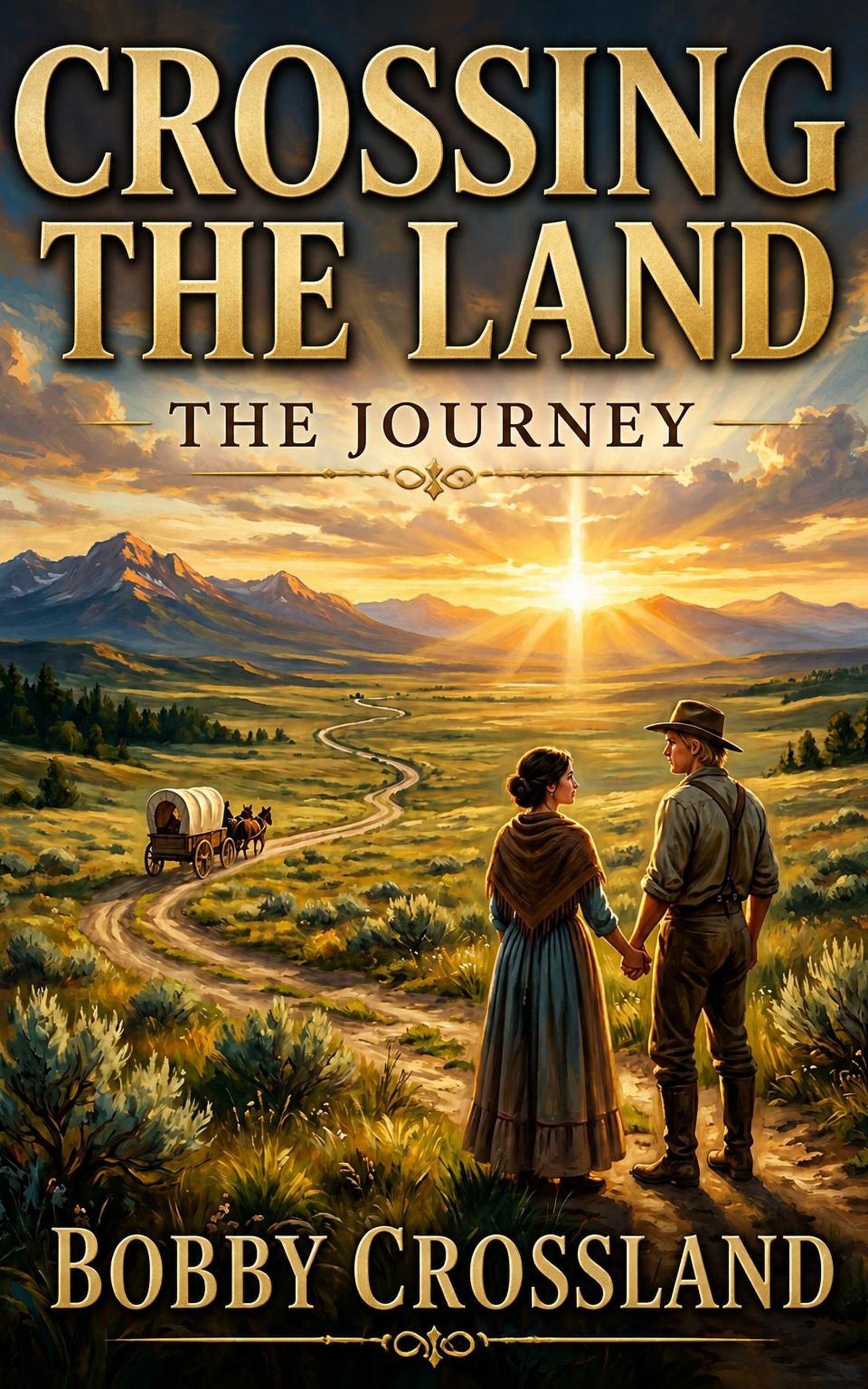
Crossing The Land The Journey
A sweeping saga of sacrifice, pioneering faith, and the enduring legacy of a town called Journey
by Bobby Crossland
In the shadow of the Big City, Robert and Misty Crossland find a love anchored in deep faith. But when the call of the western frontier whispers of a divine purpose, they leave everything familiar behind to forge a life in the untamed wilderness. Guided by the wisdom of seasoned mentors and the raw grit of survival, the couple faces an impossible choice: to pursue their mission of founding a sanctuary for the faithful, they must leave their firstborn daughter in the safety of another's arms. It is a sacrifice that will echo through generations. As the settlement of Journey rises from the dust, it becomes more than just a town—it becomes a beacon of hope for weary travelers and a testament to spiritual endurance. But with growth comes conflict, land disputes, and secrets that threaten to unravel the very fabric of the community. From the tragic loss of a beloved deputy to the eventual, heart-wrenching reunion of sisters who never knew they were bonded by blood, Crossing The Land The Journey is a powerful exploration of what it means to build a legacy that lasts long after the founders have returned to the earth. Experience a story of unwavering devotion and the miraculous ways that God weaves together the broken threads of our lives into a tapestry of grace.
- Historical Fiction
- Literary Fiction
- Wild West
- Family Drama
- Generational Saga
- Small Town Drama
A Meeting in Big City
The morning Terri announced that Robert had come home from the war, Misty was standing at the kitchen window watching a sparrow pick at the frost-stiffened ground below the elm tree. She did not turn around right away. She listened to her mother's words the way one listens to rain, aware of the sound without much caring about what it meant.
"Rebecca's boy," Terri said, her voice climbing with barely contained excitement. "He's back, Misty. Decorated, they say. More medals than any man in his regiment." She was nearly breathless with it, her hands clasped together as though holding the news like something fragile. "Rebecca told me herself, just yesterday at the market."
Misty turned from the window. Her mother stood in the middle of the kitchen, cheeks flushed, eyes bright. There was no harm in the woman's joy. Misty simply did not share it.
"That's kind news for Rebecca," she said, and went back to her tea.
Her father, Levi, looked up from his chair at the breakfast table where he had been quietly reading, his coffee going cool at his elbow. He studied Misty over the top of his newspaper with the patient eyes of a man who had learned not to rush things. "They say he carried men out of fire," he said, folding the paper down. "Brought soldiers home who would have died otherwise. That's not a small thing, Misty."
"I didn't say it was," she replied.
Levi nodded slowly, a faint smile at the corner of his mouth. "No. You didn't say much of anything at all."
Terri had already moved on to the matter of getting ready, her physical presence filling the kitchen as she swept from the hooks by the door to the dry sink, her skirts rustling like dry leaves. She snatched a shawl, draped it over her arm, and set her hands to smoothing Misty’s blue dress on the line, her movements so continuous and filled with momentum that she seemed to carry the air of the room with her. Misty watched her mother, swept up in the steady, inevitable current of her bustle, and decided it was easier to go along than to hold ground against such a tide. She went to change her dress.
The streets of Big City were alive that morning in the way they always were, thick with the clatter of iron wheels on cobblestones, the shouting of vegetable vendors, and full of themselves. The carriage rolled along the cobblestone lanes past market stalls and iron lamp posts and clusters of people going about their business with great purpose. Misty sat with her hands folded in her lap and looked out at the city she had known her whole life. It was familiar in the way that old furniture is familiar, comfortable but unremarkable. She wondered, not for the first time, if there was something beyond it. Some wider road that began past the edge of the last building and disappeared into country she had never seen.
Rebecca's tailor shop sat on a corner of the merchants' district, its front window dressed with bolts of fabric in muted, careful colors. A small bell rang above the door when they entered, and the smell of cotton and cedar and pressed linen settled around them. Misty smoothed her skirt and looked around the shop.
He was standing near the back, beside a long table spread with fabric samples. Tall, as her mother had said. Broad through the shoulders in the way that speaks less of vanity and more of work. His hair was the color of winter wheat, and he held himself with a quietness that surprised her, a stillness that did not seem practiced but simply natural, like a tree that does not need to announce itself to take up space.
Their mothers spoke first, as mothers do, filling the room with warm sound. Robert turned, and his eyes found Misty with a directness that was not rude but frank, the way a man looks when he is genuinely paying attention.
"Miss Misty," he said, and his voice was steady and low.
"Robert," she replied, and gave him a nod that was polite and nothing more.
She could feel her mother willing her to say something else, something warmer, something that would encourage the moment along. Misty held her ground. She was not unfriendly. She was simply careful.
Robert seemed to sense it. He did not push. Instead, he glanced down at the floor near her feet, then back up at her with an expression of exaggerated concern. "Forgive me," he said. "I need a moment." And before she could respond, he lifted both arms at his sides and began flapping them with great solemnity, like a man attempting to become a bird, marching in a slow circle around the spot where she stood.
Both mothers went quiet. Levi, who had wandered in behind them, looked up from examining a bolt of tweed.
Robert stopped and looked at the floor with satisfaction. "Bugs," he said simply. "Can't stand them. I believe the area is now clear."
Misty stared at him. Then something she had not intended escaped from her. A laugh, small and reluctant, but real. She pressed her lips together and looked away, but it was already too late, and she suspected he knew it.
After that, the afternoon went more easily. They walked back through the city with their families trailing at a considerate distance, and Robert spoke about small things, the layout of the streets, a baker whose rolls he had dreamed about during his years away, a cat that appeared to be conducting official business outside the post office. He did not talk about the war. She noticed that and respected it. He did not perform his medals for her. He simply walked beside her and seemed content to be there.
The months that followed moved in a way that surprised Misty, not quickly exactly, but fully. Robert came to call with a reliable steadiness. He brought her father a tin of good tobacco and sat with him on the porch without forcing conversation. He helped her mother carry packages without being asked. And he made Misty laugh again, more than once, in ways she had not expected. By the time the leaves on the city elms began to turn amber and gold, she had stopped bracing herself when she heard the knock at the door and started listening for it instead.
It was on one of those autumn afternoons, walking through a park where the maple trees shed their red and copper leaves across the gravel paths, that everything shifted. They had been walking in comfortable silence, the kind that no longer needed to be filled, when Robert slowed his steps and stopped beside a stone bench overlooking a small fountain. He turned to her, and his expression was different from his usual calm. There was something earnest in it, something unguarded.
"Misty," he said.
She watched him. He stood a little straighter than usual, then seemed to catch himself and adjusted, rolling his shoulders back in a way that was clearly meant to appear casual and clearly did not.
"Your posture," she said.
He blinked. "I beg your pardon?"
"You're standing like you're about to address a regiment," she said, tilting her head. "You might want to relax before whatever it is you're about to say."
He let out a breath, and his shoulders dropped, and then he laughed quietly at himself. "I've faced enemy fire," he said. "I did not expect this to be harder."
"It isn't harder," she said gently. "Say what's in your heart."
He looked at her, and something in his eyes steadied. "I want to marry you," he said. "I believe God put you in my path. I believe that with everything I am. And I would count it the greatest honor of my life if you would have me."
The fountain murmured behind them. A leaf drifted down between them and settled on the gravel. Misty looked at the man standing before her, not the soldier or the decorated veteran or the son of Rebecca from the tailor shop, but the man who had flapped his arms in a fabric store to make her laugh, who sat with her father without needing to fill the silence, who carried something quiet and steady inside him that she had come to trust.
"Yes," she said. "I'll have you."
They told their families that same evening, and the joy in both households was so full it spilled out into the street. Terri wept and clapped her hands. Levi shook Robert's hand and held it a moment longer than necessary. Rebecca embraced Misty and said something soft that Misty did not quite hear but felt in the warmth of it.
Later, they sat together by the fountain in the park, the city quieting around them as evening settled in. Robert held his Bible in his hands, the one he had carried through the war, its cover worn smooth and dark at the corners, the spine creased and repaired with a strip of leather. He had never shown it to her before, though she had suspected it existed. A man like Robert did not come through what he had come through without something anchoring him.
"This went everywhere with me," he said, turning it over in his hands. "When everything else was confusion, this was steady." He handed it to her, and she took it carefully, feeling the weight of it, the particular weight of a thing that had been held many times through difficult hours.
She opened it to a page near the middle and read a few lines to herself. The margins were marked with small notations in pencil, a word here, a verse number circled there. She closed it gently and gave it back to him.
"I'm not always certain I'm enough," she said quietly, looking at the fountain. "For something like this. The life you're speaking of. Whatever comes next."
Robert was quiet for a moment. "I don't ask you to be enough on your own," he said. "I'm not enough on my own either. That's the point, I think. We lean on something greater than both of us."
She looked at him. He was watching her with that same frank attention he had given her on the very first day, seeing her clearly without making her feel examined.
"I think I've known that for a long time," she said. "I just hadn't found anyone worth leaning with."
They were married in a small church at the edge of the city, on a Saturday in late autumn when the air was clean and cold and the sky was the kind of clear blue that looks newly washed. The ceremony was simple and earnest, spoken words and solemn vows and the feeling, real and present, that something larger than the two of them was attending. Misty wore her mother's lace at her collar. Robert wore his good coat and carried his Bible in his inside pocket, close to his chest.
When the minister pronounced them husband and wife, Robert took Misty's hand and looked at her with an expression that was not triumphant or relieved but simply grateful, the gratitude of a man who knows he has received something he did not earn but will spend his life honoring.
The weeks that followed were full of preparation. Robert had spoken, more than once, of going west. Not as a vague idea but as something he had been turning over for years, a sense that the life he was meant to live was not behind a city desk or inside familiar walls but somewhere out past the edge of the known. Misty had listened to him talk about it and had felt, each time, a mixture of excitement and apprehension that was not entirely unpleasant.
They made plans carefully. Robert spoke with a man named Ed, who knew the western trails and had contacts among groups of travelers making the same passage. Ed was a broad-shouldered, practical sort of man who measured everything twice before he spoke and had the hands of someone who had built things and fixed things his whole life. He helped them load the wagon in the gray early morning of their departure day, fitting supplies and tools and bundled provisions into the bed with an efficiency that left no wasted space.
"You've got enough flour and salt pork for six weeks if you're careful," Ed said, checking the ties on the canvas cover. "And I've arranged for a group of travelers heading the same direction. You'll meet them at the crossroads past Miller's Creek. Good people. They'll look out for you."
"We're grateful to you, Ed," Robert said, extending his hand.
Ed shook it firmly. "You're doing a brave thing," he said. He looked at Misty then, and his expression was kind. "Both of you."
Misty's parents stood on the front steps of the house where she had grown up, Terri with her hand pressed to her mouth and her eyes already bright, Levi standing beside her with his arm around her shoulders. He was not a man who showed feeling easily, but his jaw was tight, and Misty could see the effort it cost him to hold himself steady. She went to them and embraced them both, holding on a moment longer than she might have otherwise, breathing in the particular smell of her mother's hair and her father's coat, trying to commit it to memory without being mournful about it.
"You write," her mother said into her shoulder. "Every chance you get, you write."
"I will," Misty said.
Her father held her face in his hands for a moment and looked at her. "You're ready," he said quietly. It was not a question.
She thought about it honestly. "I don't know if I'm ready," she said. "But I believe I'm called."
He nodded once, slowly, and released her. It was the best answer, and he knew it.
Robert stood before Rebecca and held his mother's hands. Whatever passed between them was quiet and private, and Misty looked away to give it space. When Robert came to stand beside her again, his expression was composed but his eyes were full.
They prayed together before they climbed onto the wagon, the four of them standing in the early morning cold with their heads bowed. Robert's voice was steady as he spoke the words, asking for protection on the road, for wisdom in hard moments, for provision when their own resources ran thin. Misty listened to him pray and felt something settle in her chest, not the absence of fear but something placed alongside it, a quiet assurance that was not hers to manufacture but had been given.
When Robert said amen, the word hung in the cold air a moment before it dissolved.
They climbed up onto the wagon seat, Robert taking the reins, Misty beside him with a wool blanket across her lap. The horse moved forward, and the wagon wheels turned on the cobblestones, and Big City began to fall away behind them, street by street and then block by block and then all at once as they reached the open road beyond the city's edge.
Misty did not look back. She had made her peace with the looking back. She kept her eyes on the road ahead, wide and unpaved and stretching toward a horizon she had never before had cause to consider.
They had not been an hour out of the city when the sky, which had been clear and pale at dawn, began to gather clouds from the west. They came in low and fast, gray and purposeful, and before Robert had time to do more than note them, the rain arrived. Not a gentle rain but a full, honest downpour that drummed on the canvas cover and ran in runnels off the sides of the wagon and turned the road ahead into a dark ribbon of mud.
Misty tucked herself under the edge of the canvas and pulled her blanket tighter. Robert kept the horse moving, his shoulders hunched against the rain, his hat brim pouring water in a steady stream. He did not complain. He leaned forward and drove the wagon through it with the same calm he brought to most things, as though the rain were simply one more part of the road and not a disruption of it.
Then, as quickly as it had come, it stopped. The clouds broke apart and drifted, and the afternoon sun came through and struck the wet road and the wet grass and the wet leaves of the trees along the road's edge and turned everything brilliant. And there, spanning the whole wide sky ahead of them, was a rainbow, arching from one horizon to the other in colors so clear and certain they looked painted.
Robert pulled the horse to a stop and sat looking at it.
"A promise," he said quietly. He reached into his coat and brought out his Bible, holding it in both hands for a moment without opening it, just holding it the way a man holds a thing that has carried him through many miles. Then he looked at Misty beside him, his expression open and certain. "God made a covenant with a rainbow once," he said. "I believe He's still in the business of keeping promises."
Misty looked at the rainbow and then at her husband, and she felt it then with a clarity she had not expected, the full weight of what she had chosen and the fullness of what had chosen her. The skepticism that had lived in her since that first morning in the kitchen, that careful, measured distance she had kept between herself and the idea of Robert, was gone. Not worn away slowly but simply gone, replaced by something she could only call trust. Trust in the man beside her, yes, but more than that. Trust in the road itself. Trust in the One who had put them on it.
"I believe you," she said.
He looked at her. His voice, when he spoke again, was soft. "That's enough for me."
They drove on through the afternoon and into the early evening, the road drying beneath them as the sun descended. They passed other travelers, a family in a covered wagon with children peering out from the back, two men on horseback riding in easy silence, a woman walking alone with a large pack who waved at them without slowing her stride. Each encounter was brief, a nod, a raised hand, a few traded words, but each one reminded Misty that they were not alone on this road, that others had set out before them and others would come after.
When they made camp that first night, the sky was black and salted with stars so dense and close that Misty sat for a long while simply looking up at them. Robert built the fire with the efficiency of a man who had done it under worse conditions, and the small circle of warmth and light it cast felt like something deliberately given, a gift sized precisely for two people on their first night away from everything they had known.
She read to him by the firelight, the book of Proverbs, her voice steady and low, the words moving between them like something alive. Robert listened with his eyes on the fire, his hands resting easy on his knees, and she could see by his stillness that he was truly listening, not merely waiting for her to finish. When she closed the Bible, he did not reach for it or offer commentary. He simply said, "Thank you," and meant it entirely.
They slept under the open sky with the fire burning low beside them, and the night was cold but not cruel, and the stars stayed where they were, steady and numberless, all the way until morning.
The next day brought easier roads and warmer air, and by mid morning they reached Miller's Creek and the crossroads Ed had described. The group of travelers was already there, six wagons arranged in a loose half-circle around a stone well, families and single men and a pair of older women who appeared to be sisters, all of them in various stages of tending to horses or sorting through provisions or simply resting while they could.
A man came forward as Robert brought their wagon to a stop, a tall man with a sun-weathered face and the look of someone who had made this kind of trip before and knew what it asked. He introduced himself and shook Robert's hand and welcomed them both with the straightforward hospitality of the trail, where trust is built faster because it has to be.
Misty climbed down from the wagon and looked at the assembled group around her. Strangers, every one of them. Different faces, different histories, different reasons for leaving behind what they had known. But something common moved through all of them, a shared direction, a shared uncertainty, a shared willingness to go anyway.
She reached into the wagon and found Robert's Bible where it rested in the box beside the seat. She held it a moment, feeling the worn cover under her fingers, thinking about all the hard places it had accompanied him through, all the prayers spoken over it in the dark. She thought about what he had said at the fountain that evening in the park. We lean on something greater than both of us.
She placed it back carefully, exactly where it had been.
Robert came to stand beside her, and she took his arm without thinking about it, the way she had already begun to do in the weeks since their wedding, naturally and without ceremony. He looked down at her, and she looked up at him, and between them passed the kind of understanding that does not need words.
Around them, the other travelers were beginning to stir, children being called back to their wagons, horses being checked and hitched, the slow and purposeful movement of a group preparing to move forward together. The road ahead disappeared into the distance, past trees and hills and the long blue line of the horizon.
Misty felt the morning air on her face, clean and wide, carrying the smell of the creek and the grass and the faint sweetness of something she could not name. She breathed it in and let it settle.
She was not the woman who had stood at the kitchen window watching a sparrow on a frost-stiffened morning, waiting for life to arrange itself into something she recognized. She was something new, not yet named, still forming, but moving. Moving west, moving forward, moving in the direction that the road and her faith and the man beside her all pointed.
The wagon wheels turned. The horse moved. The horizon held its place, patient and unhurried, exactly as God-given horizons do, waiting for those who have the courage to come toward it.
And Misty, with her hand on her husband's arm and the morning light on her face and a long road stretching out before her, went toward it without looking back.
The Light on the Trail
The trail that morning was soft beneath their boots, the kind of soft that follows a night of quiet rain, and the trees on either side of it stood close and still in the early light. Robert walked with the reins loose in his hand, the horse moving at an easy pace, and Misty sat on the wagon seat beside him with her cloak pulled around her shoulders…