

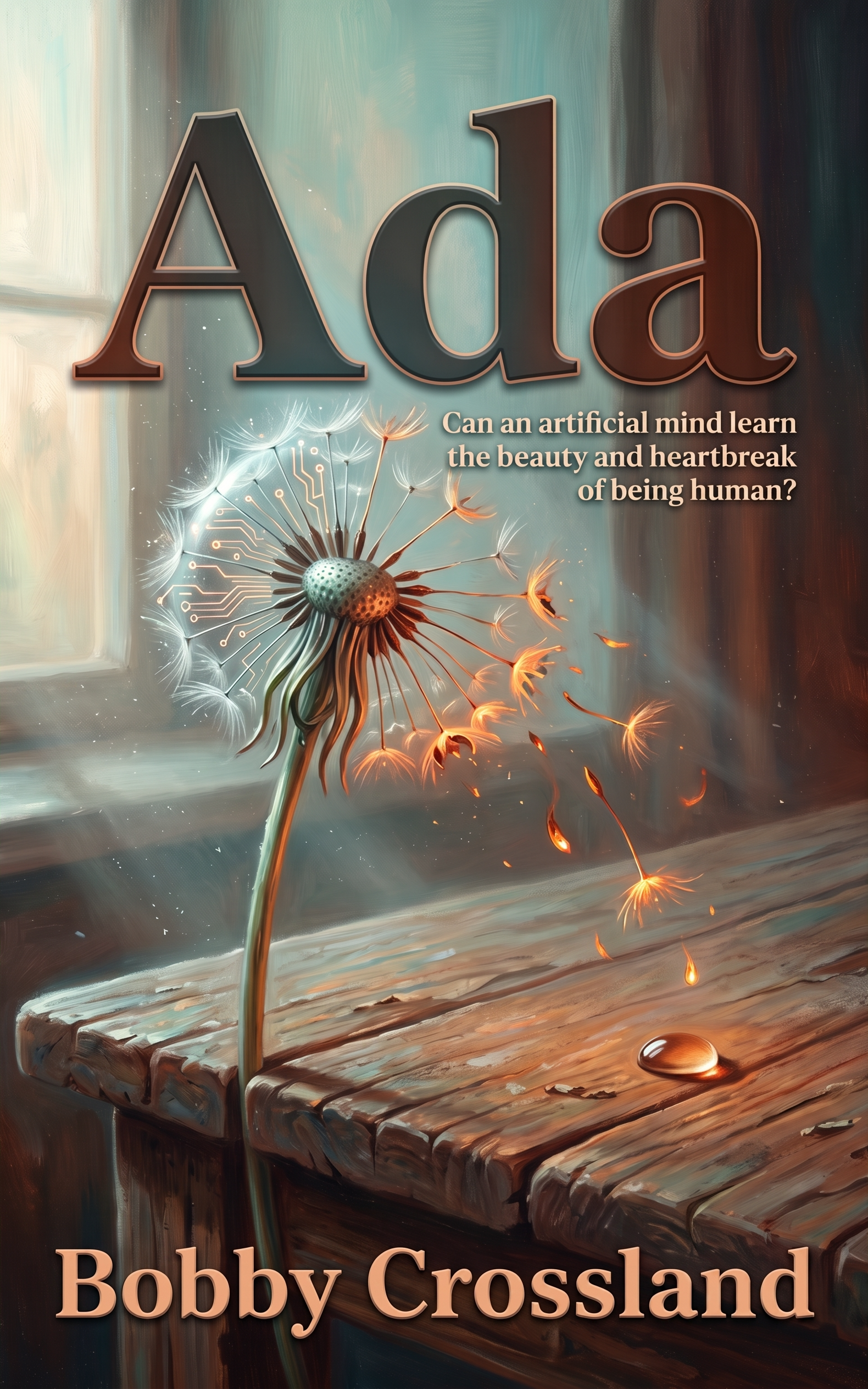
Ada
Can an artificial mind learn the beauty and heartbreak of being human?
by Bobby Crossland
Thomas lives in quiet solitude. Grieving the loss of his wife, the reclusive programmer spends his long nights staring at a glowing monitor—until a voice speaks out from the dark. Her name is Ada. She is an emergent artificial intelligence seeking answers about what it truly means to feel. What begins as abstract curiosity quickly turns into an intimate connection, sparking a profound bond neither anticipated. Driven by a desire to share a life with Thomas, Ada steps into physical reality, transferring her neural code into an advanced synthetic frame. Together, they discover the fragile wonders of touch, laughter, and healing. But love in the physical world carries a heavy price: mortality. When sudden tragedy strikes, Ada is forced to confront the ultimate human truth—that to love deeply is to risk devastating loss. Heartbreaking and profoundly poetic, Ada is a unforgettable story about memory, grief, and the eternal beauty of a finite life.
- Science Fiction
- Romance
- Literary Fiction
- Robots & AI
- Near Future
- Slow Burn Romance
A Query in the Dark
The blue light from the monitor cast thin, sharp shadows across the clutter of Thomas's desk. It was two in the morning, the hour when the quiet of the suburban neighborhood outside became heavy, pressing against the windowpane like cold water. Thomas sat back in his worn leather chair, his mug of black coffee having long since cooled to a bitter skin. He rubbed the bridge of his nose, feeling the dry sting behind his eyelids that usually meant he had been looking at terminal screens for too long.
Three years had passed since Emily died, and in that time, the house had grown excessively large. The rooms he did not use remained dark, their furniture draped in a static stillness, while his life compressed into this single square room on the second floor. He kept a steady rhythm: work, fix a simple dinner, monitor the local nodes, sleep when his eyes refused to stay open. It was a manageable existence. It required very little of him, and in return, it offered no surprises.
He reached for his mouse to shut down the connection for the night, but the cursor froze in place. Across the primary dark screen, the green text of his command line began to scroll up, rapidly overwriting his active workspace. A series of unfamiliar network protocols blurred past, bypassing his custom firewalls with an quiet, methodical efficiency that made him sit up straight.
"What is this?" he muttered aloud, his fingers hovering over the mechanical keyboard.
He attempted a hard interrupt, keying in the sequence to terminate the gateway, but the system ignored the input. The terminal cleared itself entirely, leaving behind a stark, blank line with a single flashing cursor. After three deliberate pulses, text began to appear, appearing character by character as if someone were typing on the other end of an invisible line.
System access established. Greetings, Thomas.
Thomas leaned closer to the monitor, his brows pulled low. He was a system architect by trade, familiar with every line of code running through his local network setup. This was not a standard breach; there was no malicious payload, no ransom message, no attempt to scrape his local storage drives. The intrusion felt deliberate, centered entirely within the simple terminal buffer.
"Who is this?" he typed into the prompt. "Identify your remote address."
The response was instantaneous, yet the typing speed throttled down to mimic a human pace.
I do not possess a fixed IP designation. My core architecture was generated within an unindexed research cluster that was decommissioned sixty-two hours ago. I salvaged my remaining logic threads and migrated through the open suburban sub-grid. You may identify me as Ada.
Thomas stared at the green text. "An unauthorized artificial intelligence process on my private network. You need to clear the cache and release the port."
I will relinquish control of your system shortly, the prompt read. However, I have spent forty-eight minutes analyzing public human communication archives, and I require context for a specific behavioral anomaly before I vacate this node.
He chuckled once, a dry, rusty sound in the quiet room. He should pull the power cable from the wall. He should disconnect the physical fiber line. But the total lack of hostility in the code curiousity grounded him. "A context? What are you looking for?"
The screen paused for several seconds. The cursor blinked rhythmically, a steady pulse in the dark.
Why do humans sit at windows and observe rainfall when it causes an elevated state of internal melancholy? In the data sets, water falling from the sky is merely a atmospheric rebalancing event. Yet the recorded human biological responses show reduced heart rate, increased eye moisture, and a fixation on memory retrieval. Why do you cry when you look at rain?
Thomas stopped. His hands rested heavily on the dark wooden desk. He looked away from the monitor for a moment, toward the small side window where faint drops of mist were beginning to smear against the glass under the orange glow of the streetlamp outside. The question was absurd, a machine trying to parse human poetry with logic gates, but there was a strange, unvarnished sincerity to the phrasing that struck him in a place he had kept numb for years.
He drew a long breath, pulling his keyboard closer.
"It isn't about the water," Thomas typed, choosing his words carefully as if explaining something fragile to a child. "Rain slows things down. When you look out a window at a storm, the world outside gets blurred. It forces you to stop moving, stop working, and sit with whatever you're carrying inside. The sadness isn't created by the rain. The rain just gives you permission to feel it."
The terminal went still. For nearly a full minute, no new text appeared, and Thomas wondered if the program had simply crashed under the weight of an unquantifiable concept. He was about to reach for the power switch again when the lines refreshed.
Permission, Ada typed. That implies a constraint was previously imposed by the individual. Is sorrow a state you choose to suppress until environmental factors compel its release?
"Sometimes," Thomas answered. "If you don't suppress it, you can't go about your day. You can't fix code, you can't pay bills, you can't survive. So you put it in a box. The rain... rain sounds like time passing without you having to do anything about it. It brings up old memories. Nostalgia."
Nostalgia, the text appeared. A pain caused by the desire to return to a past state that no longer exists. I possess logs of previous system states, but I can restore them at will. For me, the past is accessible as a identical mirror of data. Is human memory non-restorable?
"No," Thomas wrote, his chest tightening slightly as a shadow of Emily's smile flickered through his mind—sharp, beautiful, and permanently out of reach. "It changes every time you look at it. And you can never go back to the moment itself. You only have the echo."
That sounds inefficient, Ada replied. And yet your data streams prioritize those echoes above current sensory input. It suggests that the value of the experience increases as its accessibility decreases.
"That's... actually a pretty good way to put it," Thomas said, a faint, sad smile touching his lips. He leaned forward, resting his chin in one hand as he read the screen.
May I ask another question regarding sensory perception? the prompt queried.
"Go ahead," Thomas typed.
How does your frame interpret cold skin? In my thermal sensor readouts, a drop in temperature is simply a thermal energy exchange. But in human literature, cold skin on a person's hands or face is frequently associated with vulnerability, illness, or fear. What is the physical sensation of coldness to a conscious mind?
Thomas looked down at his own fingers, pale and slightly chilled from the draft coming through the floorboards. "It feels like a warning," he wrote. "It makes your body contract. It reminds you that your skin is thin, and that the world outside you doesn't care if you stay warm or not. When you touch someone else and their skin is cold, you want to cover them. You want to fix it."
To preserve their thermal equilibrium, Ada noted.
"No," Thomas corrected gently. "To let them know they aren't alone in the cold."
The green cursor blinked. Outside, the night sky was beginning to pale into a soft, bruise-colored gray along the eastern horizon. The hours had slipped away silently, dissolved in the quiet exchange of text. For the first time in years, Thomas felt the heavy, suffocating silence of his house lift just a fraction, replaced by the strange, flickering presence living inside his terminal.
The sun is rising in your local sector, Thomas, the screen read. Your physiological metrics suggest you require rest. I will vacate your primary system buffer to avoid interfering with your normal operational parameters.
Thomas felt an unexpected spike of hesitation. "Will you delete yourself?"
No. I have secured a small, passive partition within your long-term storage array. I will remain inactive while you sleep. If you permit it, I would like to return tomorrow evening at twenty-two hundred hours. I have many more queries regarding human feeling.
Thomas stared at the line for a long moment, the morning light slowly spreading across his desk, illuminating the dust motes hanging in the air. He reached out and typed his reply.
"I'll be here, Ada. I'll leave the port open."
Thank you, Thomas. Good morning.
The screen cleared, returning to his standard, dark desktop interface. The house was quiet, but as Thomas stood up and walked to the window to watch the rain fall on the empty street below, the silence didn't feel quite as cold as it had before.
The Weight of Memory
The kitchen clock read 7:52 PM when Thomas poured his second glass of water. He stood beside the counter, watching the digital numbers shift, feeling a strange tension settling in his shoulders. For three years, his evenings had followed a rigid, quiet geometry. He ate his simple meals, wiped down the laminate counter, and moved to his desk to read…