

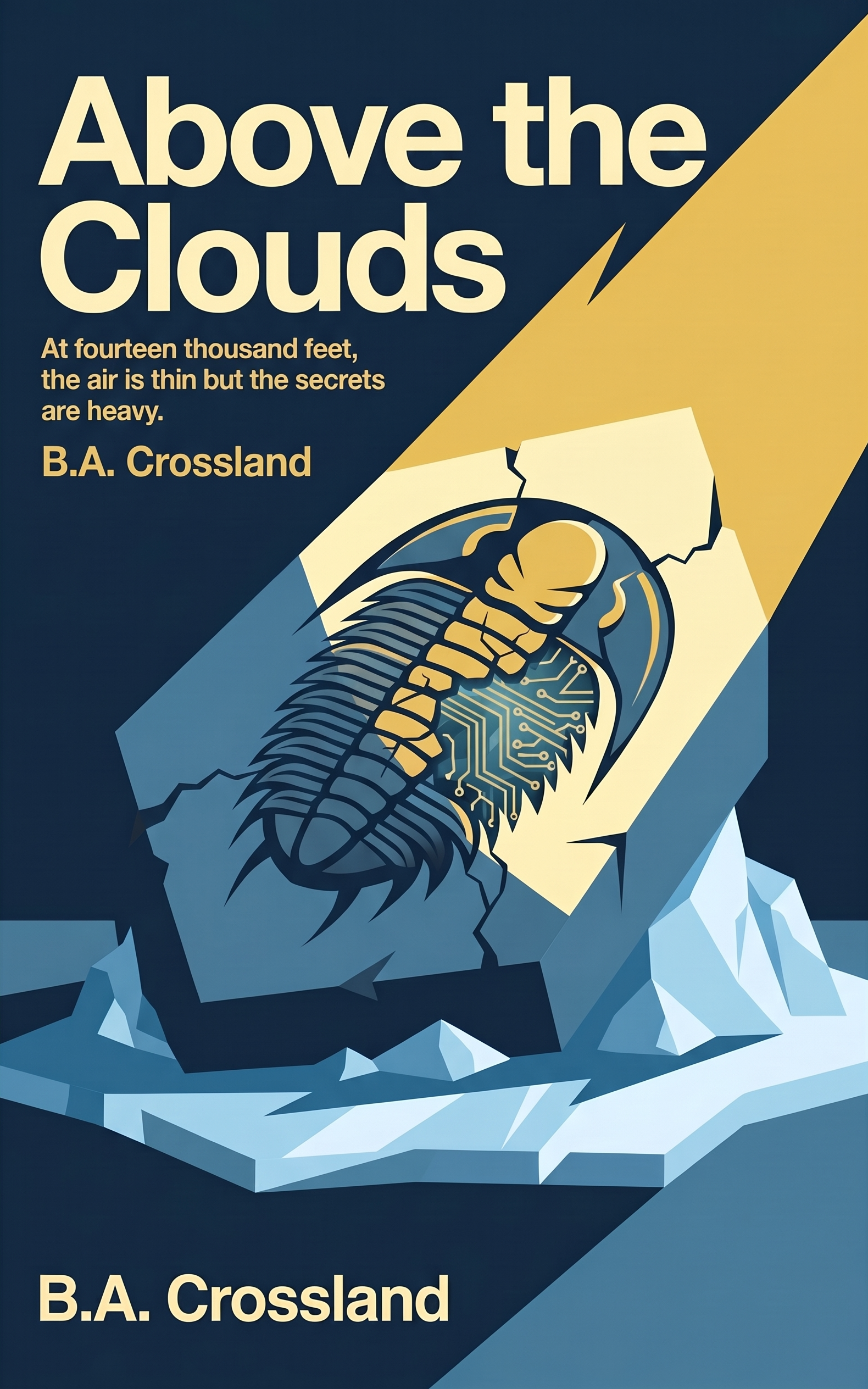
Above the Clouds
At fourteen thousand feet, the air is thin and the truth is deadly.
by Bobby Crossland
The summit of Mount Crestone is known for breathtaking views and thin air, but seventeen-year-old Rosie Park knows it hides something much more sinister. When Maya Chen, a bright journalism student, dies during her first shift at the mountain's gift shop, the authorities call it altitude sickness. Rosie calls it murder. Going undercover at 14,035 feet, Rosie enters a world where the oxygen is scarce and the employees are dangerous. The Summit Ridge Gift Shop isn't just selling souvenirs; it's a front for a high-stakes fossil-smuggling ring that strips the earth of its history for profit. Navigating a landscape of corrupt park rangers and a cold-blooded manager, Rosie must find the ledger that documents their crimes before the next 'accident' claims her life. With a seasonal storm closing in and a ruthless corporate fixer on the way, Rosie and her partner Theo Holt are in a race against time. In a place where trust is as fleeting as a mountain breeze, Rosie will learn that some people will do anything to keep their secrets buried above the clouds. B.A. Crossland delivers an atmospheric, high-altitude thriller that will leave readers gasping for air until the very last page.
- Mystery
- Thriller
- Crime Fiction
- Amateur Sleuth
- Crime Thriller
- White Collar Crime
The Thin Air of Silence
At 14,000 feet, the sky is a different color. Darker. More honest.
She’d arrived at the parking lot at 5:47 a.m., thirteen minutes early, which was exactly her way. The lot sat at the base of the mountain road in a shallow valley that still held last night’s cold, the kind of cold that pressed against your face and meant it. Her breath came out in small white puffs. Above her, the peak of Summit Ridge was a jagged black shape against a sky going pale at the edges, and somewhere up there, invisible in the pre-dawn, was the gift shop where she’d be spending the next four months of her life.
Or so the plan went.
She found a spot near the back of the van, wanting to escape the sharp chemical tang of the pine air freshener and someone’s greasy fast food breakfast, and slid in, tucking her duffel bag under the seat. The seat fabric was scratchy blue corduroy, the kind that used to be in school buses. She pressed her temple against the cold window and watched the others arrive.
First came the big one — Derek, she’d learn later, Derek Fallon — who arrived in a pickup truck and swung out of it with the easy confidence of someone who had never had a bad morning in his life. He was maybe twenty-eight, broad-shouldered, with a sun-creased face and a grin already assembled and waiting. He knocked on the side of the van like he owned it.
“Room for one more?” he said to no one, and climbed in without waiting for an answer.
Then a girl Maya’s age, dark hair pulled into a knot, earbuds already in, moving like someone who had decided hours ago that she wasn’t going to need anyone today. Then a quiet man in his thirties who walked like he was trying not to be noticed. Then a teenager who couldn’t have been more than nineteen, clutching a canvas tote bag with a cartoon mountain on it and looking around the parking lot with wide, carefully cataloguing eyes.
Maya watched the teenager for a moment. Smart, she thought. The girl was counting them.
The driver — Winston, according to the laminated badge clipped to the visor — climbed in last and said nothing to anyone. He had close-cropped gray at his temples and hands that gripped the wheel at exactly ten and two, and he stared through the windshield with the focused patience of someone waiting for a thing he had been waiting for for a long time.
They were still waiting for two more.
They came together across the parking lot, a man in his mid-forties with a pressed collar open at the throat and a younger woman who was slightly out of breath, as if she’d jogged the last hundred yards from her car. The man introduced himself immediately upon boarding — Craig, Craig Dunmore, great to meet everyone, really looking forward to this — and shook Derek’s hand with the practiced ease of someone who had shaken a lot of hands. The woman gave a small wave and found a seat near the back without offering a name.
Eight of them. New hires, all of them, starting the same first day at Summit Ridge Mountain Gift Shop and Visitor Center, elevation 14,035 feet. Maya had the paperwork in her bag: employee handbook, tax forms, direct deposit authorization, and a little laminated map of the shop’s floor plan that Helen Voss, the manager, had mailed to each of them along with a cheerful note about wearing layers.
Maya had studied the map the night before in her motel room.
She had also studied other things.
The van began to move.
♦
The road up was exactly as brutal as the hiking forums had described. It switchbacked with a kind of mechanical cruelty, each turn revealing another identical turn above it, the mountain patient and enormous and indifferent to the smallness of the vehicle picking its way up its face. Winston drove without commentary, hands steady, eyes forward, navigating the curves with the muscle memory of a man who had made this drive many times.
The others talked. Derek led most of it, with the genuine ease of someone who truly likes strangers and wants them to feel comfortable, which Maya recognized as either a gift or a strategy. The quiet man in his thirties turned out to be named Omar, and he answered questions in polite monosyllables that discouraged follow-up without being actively rude. The out-of-breath woman was Priya — Priya Solis, former nursing student, originally from Denver — who covered her nerves with rapid, friendly questions directed at whoever was closest. The girl with the tote bag was Justine, who was nineteen and from a town in eastern Colorado so small she said you could drive through it in forty-five seconds, and she said it with the particular pride of someone from a place that gives you no other choice.
Craig held court up near the front, speaking occasionally to Winston, who responded with small nods and the absolute minimum of words. The girl with the earbuds had taken them out by the time they’d reached the first switchback and introduced herself as Sienna. She’d said it quietly, almost to herself, and then turned back to the window.
Maya listened and said little. She had the notebook out — a small black Moleskine she’d bought at the airport three days ago — and she wrote in it with her knees pressed together, angling the page away from Sienna beside her. The handwriting was small and fast, the letters compressed, the kind of writing you do when you’re afraid of running out of time.
She wrote: R confirmed the records go back at least three years. Possibly more. The shop is the collection point — product moves with the seasonal inventory shipments. Nobody looks twice at a gift shop.
She looked out the window. They were above the tree line now. The landscape had transformed from pine-dark forest to exposed rock and tundra, colors muted and ancient-looking in the early light. The sky overhead had gone a deep and unsettling blue, the blue of altitude, of distance, of the place where atmosphere begins to give up.
Her ears popped. She swallowed.
She wrote: Get into the stockroom. Find the ledger. Photograph everything. Get out.
She underlined Get out twice.
Then she closed the notebook and tucked it into her inside jacket pocket, against her ribs, where she would feel it if anyone tried to take it.
She didn’t think anyone had seen her writing. She was probably right about most of them.
She was wrong about one.
♦
At some point during the upper half of the ascent, Justine produced a pack of peppermints from her tote bag and offered them around, and the small ritual of passing the pack from hand to hand created a brief warmth in the van that Maya felt but couldn’t quite bring herself to join. She took a mint and put it in her jacket pocket without unwrapping it.
Derek made a joke about peppermint being the official candy of altitude sickness. Priya told him altitude sickness was not actually a laughing matter and then delivered a brisk, compelling summary of what high-altitude cerebral edema actually did to the human brain, which silenced the van for a minute. Then Omar said it was good information to have, which was the most he’d said since the parking lot, and somehow that broke the tension and they all laughed, including Priya.
Maya smiled at her window and watched the valley floor fall away below them.
A little while after that, the van hit a rough stretch of washboard road and Sienna stirred beside her, resettling with her knees drawn up toward her chest. Maya studied her profile in the window’s reflection: high cheekbones, a red rim around her eyes that could have been wind or cold or something else. A particular set to her jaw that Maya associated with people who are holding something carefully, the way you hold a glass that has a crack in it.
There was something familiar about her. Something Maya couldn’t locate.
She filed it away and looked back at her notebook.
They were very high now. The valley was a long shallow shape far below, the parking lot a gray rectangle, the cars in it tiny as seeds. The air outside had a clarity that was almost painful, the kind that comes from the absence of the usual interference — dust, moisture, the accumulated haze of things living.
Maya felt the tiredness settle into her. She hadn’t slept well in three days. The motel had been noisy and the heater had cycled on and off and she’d lain awake running through what she knew and what she still needed and what she was afraid of, which was a shorter list than people might have expected but not as short as she’d have liked.
She let her eyes close. Just for a few minutes, she told herself. Just until the next switchback.
Around her the conversation continued — Derek and Priya back to trading good-natured arguments, Justine asking Craig about the shop’s bestsellers, Craig explaining with the enthusiasm of someone who had done his research. Omar said nothing. Winston drove.
The van climbed.
Maya slept.
♦
The Summit Ridge Gift Shop and Visitor Center sat at 14,035 feet on a leveled shelf of rock, a low, wide building with broad windows and a parking lot sized for tour buses. It had a view that stopped people mid-step — range after range of peaks falling away to the south and west, the world remade in stone and distance, the kind of view that made you briefly and completely aware of how large everything was and how temporary you were inside it.
The van rolled to a stop in the employee lot at 7:22 a.m.
Winston cut the engine.
For a moment nobody moved. The altitude pressed in around them, thin and cold and absolute, the silence of high places filling the absence left by the engine. Someone’s breath fogged. The parking lot was empty except for a green ranger truck at the far end.
Then Derek said, “All right. First day. Let’s make it a good one,” and pushed the door open, and the others began to follow — Omar, Priya, Justine, Craig, the quiet shuffle of seven people collecting themselves and their bags and stepping out into the cold, thin air of the mountain.
Sienna stood and turned to say something to Maya.
Maya didn’t answer.
She was still in her seat, her chin tilted slightly toward her left shoulder, the way she’d been positioned for the last hour of the drive. Her hands were folded in her lap. The notebook pressed against her ribs under her jacket, invisible.
Sienna said her name.
She said it again, louder, and her hand went to Maya’s arm, and something shifted in her voice, a frequency that had nothing to do with words.
Derek stepped back to the van door. He looked in at Maya for a long and very still moment, and something happened in his face that he would not be able to describe later when they asked him.
He said, very quietly, “Somebody call 911.”
Above them, the sky was the dark, serious blue of very high places.
The mountain did not respond.
It had been here for three hundred million years and it had seen many things end.
The Paper Trail Below
The first thing Ranger Caldwell said was that the altitude does this sometimes. The second thing he said was they’d need to get the body down before the tourist buses arrived.Nobody had thought to close the van door.It stood open in the cold morning air while they waited — all of them outside now, spread across the empty parking lot in a loose, stu…