

Ready, Set, Play!
100 Simple Play Plans to Build Toddler Speech, Language, and Social Skills Through Everyday Fun
by Art McCoy
Unlock your toddler's natural ability to communicate through the power of play. In Ready, Set, Play!, parent coach Art McCoy delivers a practical, evidence-informed roadmap designed to transform everyday moments into powerful learning opportunities. You don't need expensive toys or special training to help your child thrive—you just need to know how to connect. Featuring 100 step-by-step Play Plans, this essential guide shows you how to follow your child's lead, foster imagination, and build speech, language, and social skills without pressure. From simple games with bubbles and balls to turning routine bath times and grocery runs into interactive fun, you will learn how to boost your child's confidence and connection. Each Play Plan breaks down why the activity works, what to say, how to adjust difficulty, and key insights from speech-language pathology professionals. By the end, you won't just have a list of activities—you will possess the lifelong skills to support your child's development every single day.
- Parenting & Family
- Instructional Guide
- Educational & Academic
- Self-Help
- Child Development
- Infant & Toddler Care
Introduction: Welcome to Ready, Set, Play!
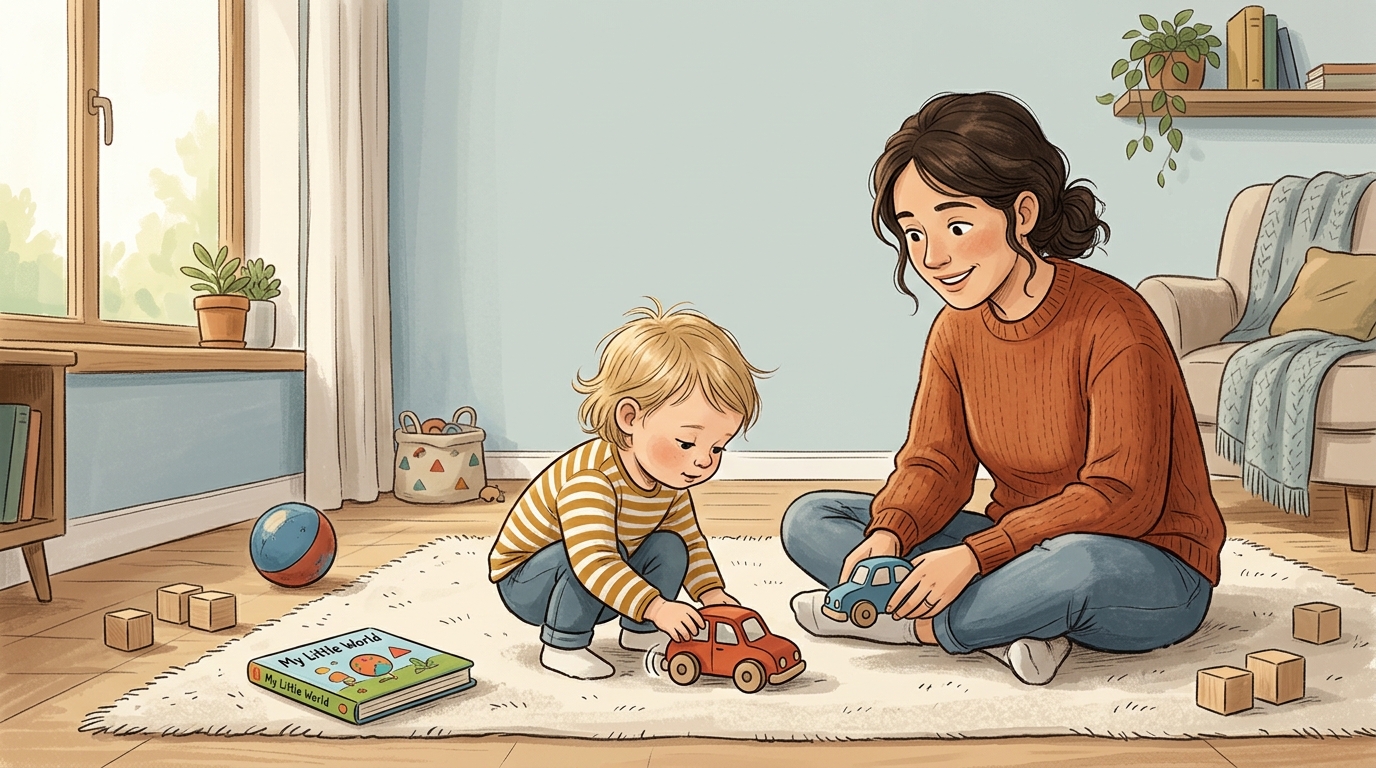
"Play does not have to look like teaching for learning to be happening."
You are sitting on the floor. Your child is nearby, maybe stacking blocks, maybe spinning the wheels of a toy car, maybe just holding a toy and looking at it. And you find yourself wondering: what am I supposed to do right now?
Should you name the colors of the blocks? Should you ask a question? Should you hand over a different toy, one of the "better" ones you bought because it promised to build language skills? Should you say the word again, slower, clearer, hoping this time it sticks?
If you have ever felt this way, you are not alone, and you are not doing anything wrong. Most parents feel this exact uncertainty at some point. Play looks simple from the outside. A child with a few toys and a few minutes of free time. But when you are the one sitting there, trying to figure out what will actually help your child grow, simple can start to feel complicated fast.
You might wonder if you talk too much during play, or not enough. Perhaps you've asked, "What's that?" so many times you feel like a quiz show host instead of a parent. It is easy to catch yourself repeating a word five or six times, waiting for your child to say it back, only to feel discouraged when they don't. Looking at a shelf full of toys, you might simply think that none of it is working the way it should.
Take a breath. You do not need new toys. You do not need a script. You do not need a degree in child development to help your child grow through play. What you need is a way of seeing what is already happening in front of you, and a few simple tools for joining it.
That is exactly what this book is for.
You Do Not Need to Become a Therapist
Let's clear up something right away: this book will not ask you to become your child's speech-language pathologist. That is not your job, and it is not the goal of anything you will read here.
Your job is to be your child's parent. Someone who is present, warm, responsive, and willing to get down on the floor and figure things out together. The activities in this book are built by a speech-language pathology assistant, but they are written for you, the parent who wants practical, doable ways to support your child's growth without turning every afternoon into a lesson.
You will not need expensive toys or a Pinterest-worthy playroom. Almost everything in this book uses items you probably already have: balls, bubbles, cars, blocks, board books, laundry baskets, kitchen containers, blankets. The goal is not to add more to your plate. The goal is to help you see the moments you are already in, and know what to do with them.
More Than 100 Activities
This book contains 100 Play Plans, and each one is a real, ready-to-use activity you can try today. But if you think of this simply as a list of 100 games, you will be missing the bigger purpose.
Ready, Set, Play! is a coaching guide. It is a roadmap. It is a way of thinking about play that, once it clicks, will let you create your own Play Plans long after you've finished the last page.
By the time you reach Play Plan 100, the goal is not for you to have memorized 100 activities. The goal is for you to look at whatever your child is doing, whether it's lining up cars, splashing in the bathtub, or dropping a spoon off the high chair tray for the tenth time, and know how to step into that moment in a way that supports connection, communication, and growth.
The activities are the practice. The thinking behind them is the real skill.
Why Play Matters So Much
Play is not a break from learning. Play is one of the primary ways young children learn.
When your child stacks blocks and watches them fall, they are experimenting with cause and effect. When they roll a ball back to you, they are practicing the rhythm of back-and-forth exchange that later shows up in conversation. When they pretend a banana is a phone, they are stretching their imagination and their ability to hold an idea in mind that isn't literally in front of them. When they wait for bubbles to come out of the wand, they are building patience, anticipation, and attention.
Play supports:
- Early communication and language
- Social interaction and relationships
- Thinking and problem-solving
- Imagination and flexibility
- Motor skills and coordination
- Emotional regulation and confidence
None of this requires flashcards or worksheets. A child stacking blocks with you nearby, narrating and celebrating and occasionally knocking the tower down on purpose so you can both laugh, is doing real developmental work. It just doesn't look like a lesson. It looks like play, because that's exactly what it is.
Communication Is Bigger Than Words
One of the most important ideas in this book is one that many parents haven't heard clearly stated before: communication does not begin with spoken words. It begins long before that.
Your child is communicating when they:
- Look toward something they want
- Reach for an object
- Point at something interesting
- Push a toy toward you
- Hold something up to show you
- Use a gesture, like waving or raising their arms
- Use a sign, like "more" or "all done"
- Make a sound to get your attention
- Say a word approximation, like "ba" for ball
- Say a full word, a phrase, or a sentence
- Select a word or picture on an AAC device
Every one of these is meaningful. Every one of these deserves a response.
If you only count spoken words as "real" communication, you will miss dozens of messages your child sends you every single day. Worse, your child may learn that their looks, reaches, and gestures don't matter, which can actually slow down their motivation to keep trying to connect with you.
So throughout this book, when we talk about encouraging communication, we mean all of it. Every form counts. Every form is a step on the same path.
Opportunities, Not Demands
Here is a distinction that will come up again and again in this book, because it changes everything about how play feels for both of you.
A communication opportunity says: "I'll pause here and give you room to communicate, in whatever way works for you right now."
A communication demand says: "I won't continue until you say the word I'm waiting for."
These can look almost identical from the outside. In both cases, an adult pauses during an activity. But the feeling underneath is completely different, and children can tell the difference.
An opportunity might sound like holding the bubble wand still, looking at your child with an expectant, playful expression, and waiting to see what they do. Maybe they reach. Maybe they say "bub." Maybe they sign "more." Whatever they do, you respond right away by blowing more bubbles, and you might add a word: "More bubbles! Up, up, up!"
A demand sounds like holding the bubbles out of reach and saying, "Say bubbles. Say it. Bub-bles. Say bubbles and I'll blow them," while your child gets more and more frustrated and the bubbles never come.
This book will teach you to create opportunities, not demands. That means you will pause, you will wait a little longer than usual, and you will watch closely. But you will not withhold something your child needs or wants for a long time, and you will not require a specific word before letting the fun continue. We follow the communication your child already has, and we build from there.
Follow Before You Lead
If there is one idea to carry with you through every chapter of this book, it's this: join first, expand second.
Before you introduce a new idea, a new word, or a new way to play, take a moment to notice what your child is already doing and step into it. If they're lining up cars, line up a car too. If they're splashing water, splash a little water yourself. If they're spinning in circles, spin nearby.
This might feel like it's not "teaching" anything. But joining your child's play first does something powerful: it tells them, "I see what you're doing, and I want to be part of it." That message builds connection, and connection is the foundation everything else is built on.
Only after you've joined do you gently add something new; a word, a small twist, an invitation to try something slightly different. This is what we mean by "expand second." You are not replacing your child's idea. You are adding one small piece onto it.
Follow before you lead. Join first, expand second.
The Ready, Set, Play! Framework
To make this way of playing practical, here is a simple framework you can carry with you into almost any moment with your child. It has seven parts: Watch, Join, Connect, Wait, Respond, Expand, and Keep It Fun.
Watch
Before you do anything, watch. What is your child looking at? What are they doing with their hands? What made them smile a moment ago? Watching for even ten or fifteen seconds before jumping in gives you real information about what matters to your child right now.
Join
Once you know what has your child's attention, join them there. Sit down. Pick up a matching toy. Do what they're doing, not what you think they should be doing.
Connect
Connection is more than proximity. It's the moment your child notices you're really there with them, playing alongside them instead of directing them. You might see it in a glance, a smile, or a toy pushed in your direction.
Wait
After you join and connect, pause. Give your child a chance to do something next, whether that's continuing their idea, responding to yours, or communicating in some way. This pause doesn't need to be long. A few quiet seconds is often enough.
Respond
Whatever your child does during that pause, respond to it. A look, a sound, a word, a gesture; treat it as meaningful, because it is. Your response teaches your child that communication works.
Expand
Now you can add just a little. If your child says "car," you might say "fast car" or "car go." If your child pushes a block toward you, you might build it into the tower and say "up high." Small additions. Not corrections, not lectures, just one small next step.
Keep It Fun
If at any point the activity stops feeling enjoyable for your child, that's your signal to loosen up, follow their lead again, or simply let the moment be what it is. Fun is not the reward for learning. Fun is the setting where learning happens.
You will see this framework referenced throughout the book, because it applies almost everywhere: bath time, mealtime, block play, car rides, bedtime stories, and every one of the 100 Play Plans ahead.
To make those Play Plans as easy to use as possible, every single activity in this book is organized in the exact same way.
How Each Play Plan Works
Every Play Plan in this book follows the same easy-to-scan structure, so you always know what you're looking at and can find what you need quickly, even during a busy day.
- Why This Matters: A short explanation of the communication, language, or developmental purpose behind the activity.
- What You'll Need: A simple materials list, usually things you already own.
- How to Play: Step-by-step guidance for getting started and keeping the activity going.
- What to Say: Example words and phrases you can model, matched to different communication levels.
- Make It Easier: Ways to simplify the activity for a child who needs more support.
- Make It More Challenging: Ways to stretch the activity for a child who is ready for more.
- What Your Child Is Learning: A clear look at the skills being practiced, even when the activity just looks like fun.
- SLPA Tip: A short, practical note from a speech-language pathology assistant's perspective, offered to help you fine-tune the activity for your child.
You'll also find recurring features throughout the chapters: real parent stories that show these ideas in action, SLPA Insights that unpack the "why" behind a strategy in plain language, quick things to try today, a "Play Detective" section that invites you to notice your child with curiosity rather than judgment, and key takeaways you can return to later.
Not a Checklist
Please don't feel like you need to complete these 100 Play Plans in order, or complete them at all, or treat them as a to-do list your child needs to master.
These are possibilities, not assignments.
Some days, you'll pick a Play Plan because it matches exactly what your child is already doing. Other days, you'll skip fifteen Play Plans ahead because your child suddenly loves trucks and you want ideas for that right now. You might play the same Play Plan every day for two weeks, because your child asks for it every single time, and that repetition is doing real good. You might set an activity aside for months and come back to it later, when your child is ready for it in a new way.
There is no wrong way to move through this book, as long as you are following your child, not a schedule.
Meeting Your Child Where They Are
Every child communicates differently, and this book is written with that in mind.
Your child might not be talking yet, and that's completely okay. For children at this stage, the focus is on building connection, joint attention, and simple back-and-forth exchanges; the building blocks that communication grows from.
Your child might be using gestures, signs, or an AAC device. These are valid, powerful forms of communication, and this book will show you how to support and respond to them just as you would spoken words.
Your child might be using single words or short phrases. Here, the focus often shifts to gently expanding what they already say, adding one small piece at a time.
Your child might already be speaking in full sentences and asking you a hundred questions a day. Even here, play remains valuable. It supports imagination, storytelling, problem-solving, and the back-and-forth flexibility of real conversation.
Throughout the Play Plans, you will find suggestions labeled "Make It Easier" and "Make It More Challenging" specifically so that no matter where your child is right now, you can adjust the activity to fit them, rather than forcing them to fit the activity.
A Word About Professional Support
This book is meant to help you turn everyday moments into meaningful play and communication opportunities. It is not a diagnostic tool, and it is not a replacement for individualized evaluation or treatment from a qualified professional, such as a speech-language pathologist, occupational therapist, or developmental pediatrician.
If you have concerns about your child's development, communication, or behavior, please talk with your child's pediatrician or a qualified specialist. Early support makes a real difference, and reaching out is never something to feel guilty about. This book is a wonderful companion to that kind of support, but it isn't a substitute for it.
What this book will do is help you make the most of the time you already spend with your child, whether or not you're also working with a professional team.
Five Good Minutes Count
If you're a busy parent (and most parents are), you might be wondering how you're supposed to fit "intentional play" into a day that already feels full.
Here's the truth: you don't need an hour. You don't need a perfectly set-up activity table. You don't need your child in a good mood the entire time.
Five focused, connected minutes can matter more than thirty distracted ones. One shared laugh over a silly mistake can matter more than an entire afternoon of activities your child wasn't really interested in. One successful back-and-forth turn, one spontaneous point, one moment where your child looked at you to share something funny; these small moments are not "less than." They are exactly the kind of moments this whole book is built around.
You don't have to do this perfectly. You just have to show up, notice what's in front of you, and try.
Continuing the Conversation
If you've read Ready, Set, Talk!, you already know the foundation this book stands on: that communication develops through connection, that children learn language in the context of relationships, and that understanding your child's stage of development helps you know what to expect and how to support them.
Ready, Set, Play! picks up exactly where that understanding leaves off. Now that you know why communication develops the way it does, this book shows you what to actually do about it, one afternoon, one bath time, one bedtime story at a time.
If this is the first book of ours you're reading, welcome. Everything you need is here.
Where This Journey Goes
The 100 Play Plans in this book are organized into ten sections, each one building on the last.
You'll start by learning how to become your child's favorite play partner, someone they light up around, before layering in strategies for back-and-forth play, communication opportunities, imagination, and pretend play. From there, you'll explore how to use favorite toys and books to deepen language and connection, followed by ways to bring these same principles into household play, everyday routines, and time spent with siblings and friends.
Each section moves a little further into your child's world, from one-on-one connection with you, outward into imagination, independence, and relationships with others. You don't need to rush through it. You're building a way of playing, not racing toward a finish line.
Where to Begin
You already know your child better than any book ever could. You know what makes them laugh, what toy they crawl toward first thing in the morning, what song makes them wave their arms with excitement.
That knowledge is your starting point. Not a chapter number. Not a checklist. Your child.
So here is where we begin: sit down where your child is. Watch for a moment. Notice what they love. And when they invite you in, even in the smallest way, a glance, a toy pushed toward you, a giggle; take that invitation. That's the beginning of everything this book is about.
You don't need to have this figured out before you start. You just need to be willing to get on the floor and try.
Ready...
Set...
Play!
Chapter 1: How Do I Become My Child’s Favorite Play Partner?
Every parent already has the most important qualification for helping a child learn to play and communicate. You know your child. You know what makes them laugh, what they reach for first thing in the morning, and what they will happily do fifty times in a row even when you are ready to move on to something else. That knowledge is worth more than a…