

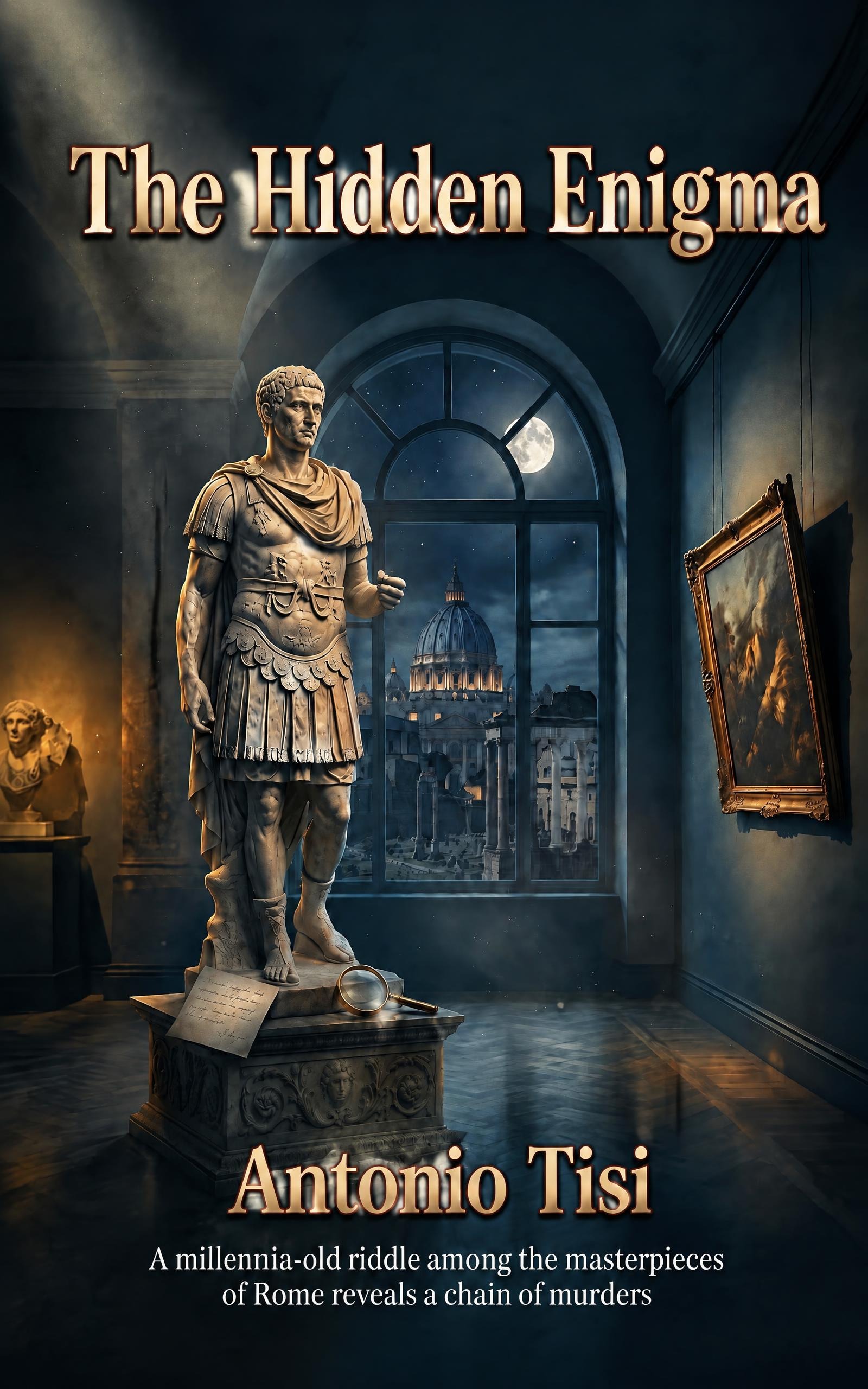
The Hidden Enigma
A millennia-old riddle among the masterpieces of Rome reveals a chain of murders
by Antonio Tisi
In Rome, a statue of the Emperor Augustus at the Capitoline Museums suffers a mysterious act of tampering: its marble arm is rotated to point to a riddle in verse. Called in to investigate, Inspector Lorenzo Valeri finds himself thrust into a deadly treasure hunt through the halls of the capital's most prestigious museums. From Palazzo Barberini to Villa Borghese, from Centrale Montemartini to the Catacombs of San Sebastiano, each artistic clue brings to light the truth behind a series of unsolved murders: scholars, restorers and numismatists killed in the shadows over the past five years. With the help of Chiara Marchetti's sharp intuition — a brilliant university student — Valeri realises that the trail of blood conceals a multi-million-pound trafficking operation in forged artefacts. But the puppeteer behind the scenes will not leave his design unfinished without one final, theatrical tribute of death. A taut and elegant thriller that traverses the eternal beauty of Rome, where classical art is tinged with crime and obsession.
- Mystery
- Thriller
- Crime Fiction
- Police Procedural
- Detective Story
- Whodunit
The Finger of Augustus and the Note in the Marble
The morning art ceased to be innocent, Inspector Lorenzo Valeri had already spilled half his cappuccino over his midnight-blue tie and misplaced one of the two keys to his old, powder-blue Lancia Ypsilon.
It almost always happened like that when he had lingered the night before rereading dusty old case files, illuminated only by the desk lamp in his apartment in Monteverde Vecchio. Lorenzo was thirty-eight, with a brown forelock that rebelled against any comb, green eyes cut through by a perpetual look of distracted wonder, and that slightly rumpled, neo-realist actor’s charm that made the trainees at the Questura sigh and his superiors despair. He always arrived five minutes after the film had started, yet, while everyone else was staring at the finger, he was already studying the shadow cast on the opposite wall.
Before heading up to the first floor of the Trevi-Campo Marzio police station, however, there was a ritual that no emergency on earth could ever abolish: dropping by the Bar Sant'Eustachio Piccolo, wedged between a seventeenth-century doorway and a bookbinder’s workshop two hundred metres from the station.
‘Inspector, your tie had breakfast before you did today,’ said a clear voice, laced with a smile that would have melted even Pentelic marble.
Behind the till, framed between a pyramid of flaky croissants and the chrome espresso machine, was Chiara Marchetti. Twenty-three years old, her dark hair gathered in a high ponytail from which two rebellious wisps always escaped at the nape of her neck, with lively dark eyes and a burgundy apron that she wore with the same ease as she would have worn a barrister's gown in the Court of Assizes. Chiara was studying Law and Investigative Sciences at La Sapienza, sat her exams with an average of twenty-nine and a half out of thirty, and paid for her rent, books, and dreams by ringing up receipts from seven in the morning until lunchtime.
Lorenzo instinctively brought a hand to the knot of his tie, blushing like a schoolboy caught red-handed. ‘It’s a camouflage technique, Chiara. If a suspect stares at the milk foam, they let their guard down and confess. Applied psychology.’
‘Of course, naturally. In the meantime, take this napkin and a double espresso; you look as though you’ve slept on a code of criminal procedure today.’ She handed him the saucer, brushing his fingers for a fraction of a second. That brief touch was all it took for Lorenzo to lose the thread of any speech prepared the night before.
‘How do you know I stayed up late with the files?’
‘Because when you sleep well, you come in whistling De André, whereas when you spend the night in the archives, you walk in with a furrow between your brows and order a double without sugar.’ Chiara rested her elbows on the counter, lowering her voice just enough to create a private bubble amidst the clinking of coffee cups. ‘What are you looking for in those cold cases, Inspector? Something big?’
Lorenzo was about to reply with the usual evasive formula from the confidentiality manual, but his work phone burst into life in his jacket pocket with a shrill ringtone. Flashing on the screen was the name of Detective Chief Superintendent Ettore Rinaldi.
‘Speak of the devil,’ Lorenzo murmured, swallowing the scalding coffee in one gulp. ‘I must dash, Chiara. But I’ll drop by for an afternoon snack. I need an unauthorised consultation.’
‘I’ll be waiting, Inspector. And get rid of that stain before you meet Dr Rinaldi, or he’ll start grilling you on the stairs.’
Ten minutes later, the unmarked police car carrying Lorenzo and Senior Constable Matteo Conti was laboriously climbing the Cordonata ramp of the Capitoline Hill designed by Michelangelo, dodging groups of Japanese tourists and school trips armed with fluorescent backpacks. Matteo, twenty-nine, built like a rugby player, with a crew cut and a prodigious talent for tripping over even the smoothest laid rugs, was holding an already opened notebook on his lap.
‘Inspector, I don’t understand why they’re sending us to a museum,’ grumbled Matteo, adjusting his thick-rimmed glasses. ‘We’re Homicide and Major Crime, not the cultural heritage branch of the local police. If some tourist stuck chewing gum on Marcus Aurelius’s hand, let them call the conservators.’
‘Dr Rinaldi doesn’t leave the Ministry of the Interior at half past eight in the morning for a piece of chewing gum, Matteo,’ replied Lorenzo, observing the symmetrical façades of Palazzo Nuovo and Palazzo dei Conservatori, bathed in the sharp, clear autumn sunlight. ‘And he certainly doesn’t have us summoned under classified status by the Capitoline Superintendence.’
Waiting for them beneath the portico of Palazzo Nuovo were the director of the Capitoline Museums, Professor Elena De Sanctis, an elegant woman of about fifty-five with silver hair swept up into an impeccable chignon, and Detective Chief Superintendent Ettore Rinaldi, who was pacing back and forth along the flagstones, checking his watch every four seconds.
Rinaldi was a forty-eight-year-old man in a bespoke charcoal-grey suit, acting as unofficial liaison between Central Command and the offices of the Viminale. He possessed an innate talent for turning any mishap into an international diplomatic crisis, and regarded Lorenzo’s investigative methods as a dangerous brand of anarchy, tolerated solely because, in the end, the culprits invariably wound up in handcuffs.
‘Finally, Valeri!’ Rinaldi said, spreading his arms theatrically. ‘The Minister’s Cabinet has already demanded two preliminary reports from me before Forensics have even arrived. The press mustn't catch wind of this. Zero leaks. We are in the oldest public museum in the world, do you understand how delicate this is?’
‘Good morning to you too, Dr Rinaldi,’ Lorenzo replied calmly, his hands in his coat pockets. ‘If you explain what happened, we might actually manage to keep the press from finding out tomorrow.’
Professor De Sanctis gestured for them to follow her inside. They crossed the courtyard dominated by the fountain of Marforio and climbed the monumental staircase to the Hall of the Emperors on the first floor, which was closed to the public with a burgundy velvet rope and guarded by two uniformed officers.
‘The doors opened to the public at half past nine sharp,’ explained the director, her voice still shaken, stopping in the centre of the room. ‘At nine forty-two, a French couple, both retired architects, urgently summoned the attendant on duty. See for yourselves.’
Lorenzo stepped forward across the polished floor, amidst the marble busts lined up along the walls like a silent senate of imperial ghosts. In the centre of the eastern wall stood a togate statue of a young Octavian Augustus, restored in the eighteenth century with his right arm outstretched and his index finger pointing forward in a solemn oratorical gesture.
Except that, this morning, Augustus’s marble finger was no longer pointing into the empty space of the gallery.
Someone, with the surgical precision of a professional conservator, had rotated the entire ancient forearm along the eighteenth-century joint pin, angling it downwards so that it pointed directly at the moulded travertine plinth. And there, wedged precisely beneath the tip of the stone finger, protruded the corner of an ivory-coloured card, folded in four and sealed with a drop of sealing wax the colour of congealed blood.
‘No perimeter alarms were tripped,’ Lorenzo murmured, crouching beside the pedestal without touching anything. ‘No signs of forced entry at the windows, no broken glass.’
‘The nighttime motion sensors detected no movement whatsoever,’ Rinaldi confirmed with mounting anxiety. ‘The gallery’s CCTV system shows the statue in its normal position at nine thirty-one, when the first guard enters on his patrol round. Then, at nine thirty-six, a group of twelve people passes through. At nine forty-two, the two French visitors raise the alarm.’
‘So the culprit acted in broad daylight, in front of the cameras and the visitors,’ observed Matteo, for once without a trace of irony in his voice. ‘They’d have to possess immense strength, or know the exact inner mechanism of the eighteenth-century pin, to turn that arm without snapping it.’
‘It wasn't brute force,’ Professor De Sanctis interjected. ‘That arm was remounted in 1748 with a bronze bayonet fitting. Only someone familiar with the archival records of that eighteenth-century restoration, or someone who has examined the diagnostic X-rays kept in our archives, would know that a mere three-millimetre upward pressure is enough to release the pin and rotate it forty degrees.’
A shiver ran down Lorenzo's spine. This was neither the act of a vandal nor the stunt of a madman. It was a signature. A mise-en-scène orchestrated with an extraordinary degree of museological expertise.
The forensic officers donned their nitrile gloves, extracted the cotton card with tweezers, and examined the seal on the portable table; everyone held their breath.
Inside, there was neither a political claim nor a demand for ransom. On the paper, penned with a fountain pen in iron gall ink in an elegant, slightly slanted cursive script, was merely a tercet engraved like an epigraph:
Where the She-Wolf suckles her destiny,
the shadow of time marks the first step;
seek the key where the wine falls silent.
Rinaldi knitted his brow, visibly irritated. ‘A nursery rhyme? All this commotion for a puzzle from a puzzle magazine?’
‘It isn't a nursery rhyme, sir,’ Lorenzo said, getting to his feet, while his eyes shone with a feverish light Matteo knew all too well. ‘It's the beginning of a game. And whoever set the board knows Rome like the back of their hand.’
Lorenzo walked over to the window overlooking the piazza and looked towards Palazzo Senatorio, then down towards the Roman Forum bathed in the golden morning light.
‘“Where the She-Wolf suckles her destiny,”’ he repeated under his breath. ‘We are already in the domain of the Capitoline She-Wolf, the very symbol of the founding of Rome, kept right across from here, in Palazzo dei Conservatori. But the clue doesn't stop there. It says: “the shadow of time marks the first step; seek the key where the wine falls silent.”’
Matteo flicked frantically through his notebook. ‘Wine? Historic taverns? La Cantina Tirolese? Or the wine amphorae at Trajan's Market?’
‘No,’ Lorenzo said, turning sharply towards the director. ‘Professor De Sanctis, here at the Capitoline Museums, among the collections of Palazzo dei Conservatori or the Centrale Montemartini, is there a work linked to wine, to Bacchus, or to a particular silence?’
The director pondered for a moment, then her eyes widened. ‘The young Bacchus in the Galleria Lapidaria... no, that's a fragment. But in the Sala delle Oche, or rather, in the underground corridor connecting Palazzo Nuovo to Palazzo dei Conservatori — the Galleria Lapidaria, in fact — there's a Roman funerary inscription famous among epigraphers: Hic silet vinum, hic loquitur lapis. “Here the wine falls silent, here the stone speaks.” It's the epitaph of a wealthy wine merchant from Ostia Antica from the second century AD, mounted right next to the ancient sundial from the Campus Martius!’
‘The shadow of time... the sundial,’ Lorenzo murmured, already darting towards the door of the hall. ‘And the key where the wine falls silent. Let's head to the Galleria Lapidaria at once!’
Rinaldi followed them at a brisk pace, wheezing slightly. ‘Valeri, wait! If there really is a connection to something more serious, I want every move officially logged. I don't want any personal initiatives!’
‘No personal initiatives, sir,’ Lorenzo replied, taking the stairs two at a time. ‘We are simply following the museum catalogue.’
The Galleria Lapidaria, carved into the very belly of the Capitoline Hill to connect the two palaces beneath Piazza del Campidoglio, held a quiet, almost hypogeal atmosphere, cool even on the mildest days. The walls were lined with hundreds of marble slabs bearing Latin and Greek inscriptions, illuminated by raking spotlights that brought out every millennia-old chisel mark.
Lorenzo reached the trades and professions section of ancient Rome: he located the solar dial in Lunense marble and, two metres further to the right, the stele of the merchant from Ostia.
He switched on his phone's tactical torch and angled the beam across the frame of the tablet. At first, there seemed to be nothing. Matteo, bending down to tie a shoe that had inevitably come undone on the stairs, looked up and bumped his head against the edge of the stone shelf.
‘Ouch! Bloody hell!’ the officer swore, rubbing the back of his neck. ‘Inspector, look under the shelf! There's something stuck upside down!’
Lorenzo ducked down beside him. Beneath the lower fillet of the funerary stele, invisible to anyone standing upright, a small brass cylinder no more than four centimetres long was fixed with a thin strip of reversible conservation tape, resembling the barrel of an old pocket-watch key, sealed with a screw cap.
The forensics technician opened the cylinder: inside were a precisely cut fragment of negative film and a second rolled-up slip of paper.
Under the magnifying glass, the negative showed a black-and-white detail of a famous seventeenth-century painting: a pale, slender hand holding a lute, beside a clear glass carafe containing three cut flowers.
‘Caravaggio,’ whispered Professor De Sanctis, turning pale. ‘The Hermitage Lute Player... no, the Giustiniani version? No, look at the carafe with the flowers: it's a detail from an ancient copy or a painting kept at Palazzo Barberini, or at the Galleria Borghese!’
Lorenzo unrolled the second slip of paper. The same hand had written:
Where the boy sings among the flowers and the glass,
the second wound lies in wait.
Look beyond the canvas, before the curtain falls.
The word wound cast a sudden chill over the subterranean gallery. Until that moment it might have seemed like an intellectual challenge, a treasure hunt staged by an eccentric collector. But the word wound changed everything.
‘Dr Rinaldi,’ Lorenzo said, his voice grave, ‘I must return to the station immediately and cross-reference the case files from the last five years. Something has been buzzing in my head since this morning, and I don't believe this game is a game at all.’
* * *
Technical and Historical Brief: The Capitoline Museums and the Galleria Lapidaria
• Foundation: The Capitoline Museums are regarded as the first public museum in modern history. Their origins date back to 1471, when Pope Sixtus IV donated a fundamental collection of ancient bronzes, previously kept at the Lateran, to the people of Rome (including the Capitoline She-Wolf, the Spinario, the Camillus, and the colossal head of Constantine).
• Architecture: The complex is arranged around Piazza del Campidoglio, redesigned by Michelangelo Buonarroti beginning in 1536, comprising Palazzo dei Conservatori and Palazzo Nuovo, the latter constructed in the seventeenth century to create perfect perspectival symmetry.
• The Galleria Lapidaria: Opened in its modern arrangement in 1957 but fashioned from a 1930s underground tunnel, it houses over 1,300 inscriptions, both pagan and Christian, from Rome and its suburbs, documenting the daily life, trades, cults, and private stories of the citizens of the Urbs between the Republican era and late antiquity.
Before leaving the Capitoline Museums for good to return to the station with the first two exhibits sealed in the forensics case, Lorenzo Valeri stepped over for a few moments to the balustrade bounding the southern side of Piazza del Campidoglio, right beside the small passage leading to the terrace that overlooked the Roman Forum.
Below him, bathed in the clear autumn sun, stretched the monumental valley where the destiny of the Mediterranean world had been decided for over a thousand years: the Arch of Septimius Severus with its lost bronze inscriptions, the eight surviving columns of the Temple of Saturn that had once housed the Roman state treasury, the Basilica Julia, the elegant profile of the three columns of the Temple of Castor and Pollux, and, further in the distance, the colossal bulk of the Flavian Amphitheatre closing the horizon towards the Caelian Hill.
Beside him, Professor Elena De Sanctis also came to a halt, drawing her grey cashmere shawl tightly around her against the breeze rising from the Tiber.
‘Do you know what unsettles me most about this whole staging, Inspector?’ the director said, gazing at the ruins below. ‘Whoever moved Augustus's arm and hid the brass cylinder under the wine merchant's tablet didn't treat the works like objects to be stolen or defaced. They treated them with meticulous care. They used reversible Japanese conservation tape, iron gall ink compatible with cotton rag paper, acid-free sealing wax. It's someone who loves our museum heritage deeply... or someone who considers it a personal extension of themselves.’
‘Or both, Professor,’ Lorenzo replied quietly. ‘In our line of work, the most difficult cases aren't the ones driven by blind hatred, but those governed by an orderly obsession. When a criminal adheres to the rules of museum conservation while violating every law of the land, it means they consider themselves above both the curators and the judges.’
Matteo Conti caught up with them just then, his notebook open and a biro gnawed at the end. ‘Inspector, I've just spoken on the phone with the operations room. They ran the plate of the taxi that dropped off the man in the beige trench coat and Borsalino hat at Piazza Venezia at nine twenty-five, captured on the Palazzo Nuovo cameras. The taxi driver says he picked him up in Largo di Torre Argentina, but the man paid in cash and wore a silk scarf wrapped up to his chin and tortoiseshell-framed spectacles. However, the driver noticed a curious detail: before getting out, the man was consulting a small red leather-bound notebook with a gold bookmark and was talking to himself in impeccable, almost theatrical Italian.’
‘A man who moves through the historic heart of the city, knows the eighteenth-century archives of the Capitoline Museums, and takes a taxi paid in cash to leave no electronic trail,’ Lorenzo summarised, turning towards the steps of Palazzo Nuovo. ‘He's no amateur, Matteo. Nor is this his first move. Let's head to Palazzo Barberini: the second wound won't wait on our convenience.’
The Cashier's Coffee and the Shadows of Palazzo Barberini
At five in the afternoon on that same day, the briefing room of the Trevi-Campo Marzio police station resembled a gas chamber saturated with the vapour from Rinaldi's electronic cigarettes and the steam of four small plastic cups of vending-machine coffee that no one dared drink.Pinned to the magnetic whiteboard were the high-resolution photographs…