

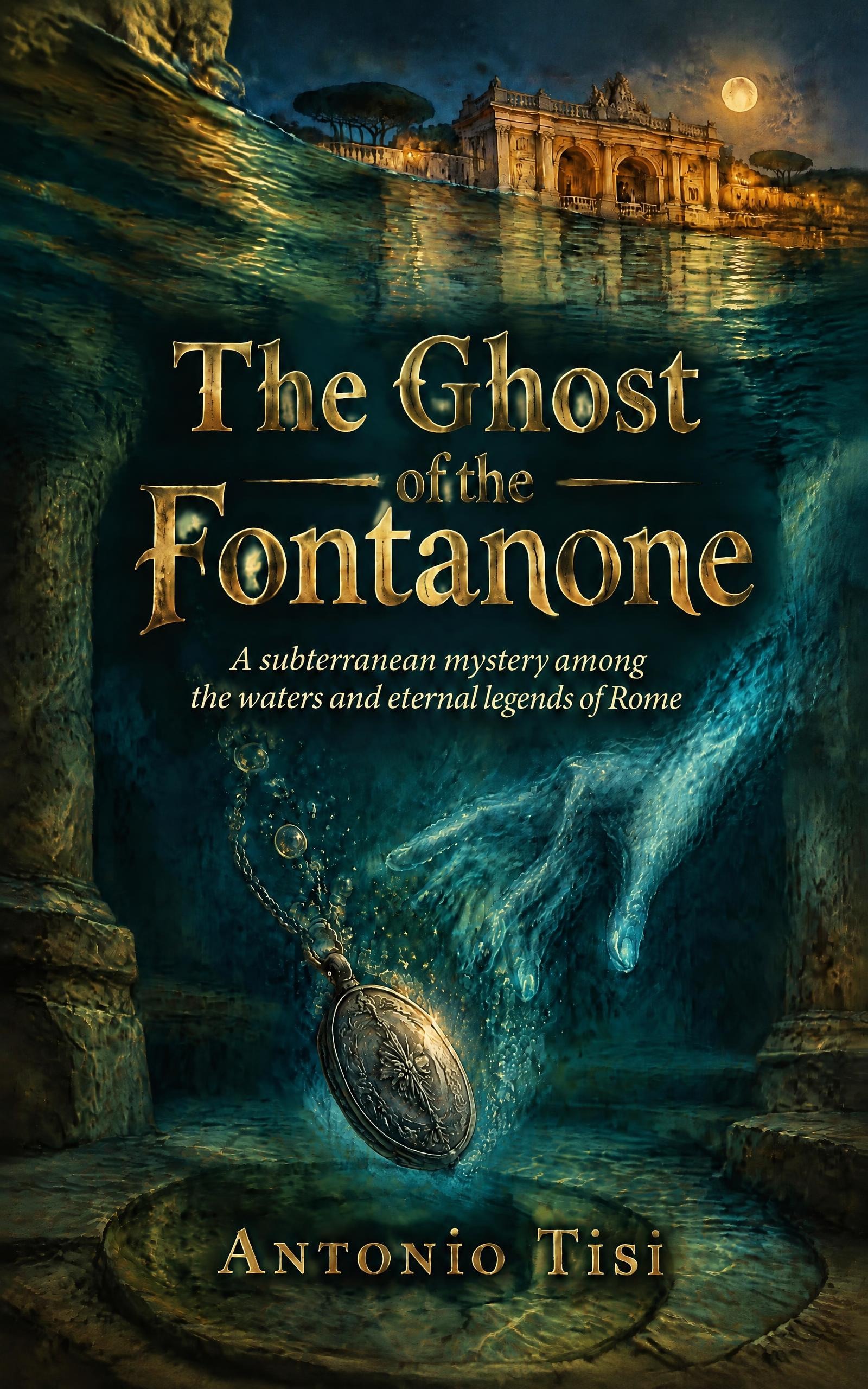
The Ghost of the Fontanone
A subterranean mystery among the waters and eternal legends of Rome
by Antonio Tisi
On the terrace of the Janiculum, before the majestic cascades of the Fontanone, impossible wonders unfold: small items vanish into thin air from the hands of passers-by, only to reappear, intact and wet, in their locked rooms. When Giulia Blanco, a passionate archivist and heir to a dynasty of water keepers, loses her family pendant only to find it dripping on her bedside table, she refuses to dismiss the event as a mere quirk. Alongside Matteo Greko, an urban speleologist who knows the city's stone lungs, she follows the trail of an invisible presence gliding through the millennial aqueducts of the Acqua Paola. Yet the shadow of the Fontanone also attracts Lorenzo Riccjo, a ruthless antiquarian willing to tamper with ancient Roman sluices just to wrest a forgotten papal treasure from the depths. With the foundations of Trastevere threatened by rising floodwaters, Giulia and Matteo must descend into the capital's dark recesses before an ancient marvel drowns the city forever. The Ghost of the Fontanone is an enthralling journey steeped in mystery, navigating Capitoline legends, secret passages, and the immortal pulse of Roman water.
- Mystery
- Fantasy
- Paranormal
- Urban Fantasy
- Cozy Mystery
- Ghost
The Wet Pendant
The ceaseless roar of the water on the Janiculum was unlike any other sound in Rome. It was neither the metallic clamour of Viale Trastevere nor the dense murmur drifting up from the café tables of Piazza Santa Maria. It was the voice of an organ, deep and constant, pouring forth from the five great pale marble arches of the Acqua Paola, plunging into the three basins with a force that made the stone balustrade vibrate imperceptibly.
Giulia Blanco stood motionless against the parapet, relishing the light breeze that carried a mist of icy droplets against her face. Below her, the city spread out like a basin of warm roof tiles, faded rooftops, and domes slowly losing their outline against the amber light of dusk. At that hour, Rome looked fashioned from baked clay and woodsmoke. Giulia slipped her fingers into the worn leather shoulder bag she wore across her chest, feeling the reassuring contour of her ruled notebook and the barrel of the pencil tucked between its pages.
She had been working for two weeks on revising a historical guidebook dedicated to the hill rioni, but the truth was that any excuse was good enough to climb up here. Her grandfather Carlo had always said that the water of the Acqua Paola held the memory of woodland and stony ground, because it came straight from Lake Bracciano without ever seeing the sun until it tumbled into the Fontanone. “Remember, Giulia,” he would repeat to her when he took her for walks along the hill as a young girl, “in Rome, water isn't just something to drink. It's a map running beneath your feet, and it's the one in charge.”
Beside her, a tourist couple paused to take in the view. They were two youngsters with heavy rucksacks and cheeks flushed from the climb. The young man pointed at the urban sprawl with a hesitant finger.
“Excuse me,” he said in halting Italian, clearly struggling to find the right phrasing. “Over there... is that the dome of St Peter’s?”
Giulia smiled, gently shaking her head with the customary warmth that came naturally to her with lost foreigners. “No, that one over there with the flattened profile is the Pantheon,” she explained, stretching out an arm to trace an imaginary line in the clear air. “St Peter’s is behind you, a little further north, around the curve of the hill. From this spot on the Janiculum, you mostly see the rooftops of the historic centre and the blocky silhouette of the Vittoriano.”
“Oh, thank you very much,” the girl replied, leaning against the low wall with a sigh of relief before snapping a photograph on her phone. “It’s huge.”
“It’s old, more than anything,” Giulia countered with half a smile. “And it takes up its space.”
The two strolled slowly away towards the cannon terrace, melting into the other dark figures ambling across the square. Giulia was left alone once more with the thunderous rush of the fountain. She reopened her notebook, searching for the page where she had jotted down the dates of the seventeenth-century restorations commissioned by Pope Paul V Borghese. She pulled the pencil from her hair, letting a lock of brown curls fall back across her forehead, and bent over her handwritten notes.
At that moment, an anomalous draught brushed past her. It was not the usual Ponentino breeze blowing up from the Tiber. A thread of freezing air, compact and swift as a cellar draught, slid over the nape of her bare neck, right below her hairline. The sensation lasted the blink of an eye, accompanied by a barely perceptible rustle, like the suction of a storm drain swallowing a dry leaf.
Giulia instinctively brought her hand to her throat. Her skin was bare.
The silver chain, slender yet sturdy, was gone. The pendant was missing too: an old oval medal with a rim shaped like laurel leaves, which her grandfather had given her for her graduation. It had not unclasped; there had been no tug, no metallic chime of snapped links striking the travertine.
“What on earth...?” Giulia muttered, glancing down.
She crouched immediately, scanning the damp cobblestones and the crevices between the paving stones. She dropped to her knees, heedless of the dust soiling her light-coloured trousers, searching with bare fingers along the rim of the drainage channel. There was nothing. She widened the radius of her search to the base of the fountain, where the spray formed small, clear puddles. No glint of silver, no broken chain.
She straightened up abruptly, turning towards the piazza. The thief had to be somewhere nearby, she thought; in Rome, pickpockets had velvet hands, but slipping a chain from someone's neck without them feeling the clasp give way required either magic or unheard-of audacity. Around her, however, there was no one within fifteen metres. The foreign couple were already far off, engrossed in a postcard vendor's stall; an elderly woman was walking a scruffy dog on a lead, and two lads were sitting on idle scooters gazing at their phone screens. No one was running away. No one appeared agitated. The emptiness of the piazza was almost surreal.
“Stay calm, Giulia,” she said under her breath, feeling a dull knot tighten in her stomach. “You must have lost it earlier. Maybe it fell into your bag.”
She emptied the leather bag onto the flat stone of the balustrade: out came the State Archive receipts, tissues, her wallet, three half-spent pens, and a small brass torch she always carried for consultations in dusty basements. The pendant was not there. She had touched it before climbing the steps of San Pietro in Montorio; she was absolutely certain of it. She had run her thumb over the worn relief of the metal as she walked uphill, as she always did whenever she thought of her grandfather.
She spent another twenty minutes scouring the piazza, inch by inch, until the orange light gave way to a deep blue and the evening damp seeped under her linen trench coat. In the end, she had to admit defeat. The pendant was gone.
She walked down towards Trastevere with a nagging heaviness in her chest, following the steep ramps cutting through the slopes of the Janiculum between ivy-clad walls and quiet villas. Every step on the stone stairs reminded her of how attached she was to that little piece of metal. It held little commercial value, but it held a lifetime of Saturdays spent amidst archival papers and construction site stories. Carlo Blanco had worked for forty years for the municipal waterworks, back when pipes were still repaired with tow and Burgundy pitch, and he knew every diversion of the Renaissance conduits.
Giulia’s flat was on the second floor of a building in Via della Lungaretta, wedged between an old bakery and a courtyard with two large potted lemon trees. She climbed the stone stairs, worn down in the centre, pulled out her heavy bunch of keys, and unlocked the two turns of the reinforced door. The bolt clicked home with its usual sharp sound, familiar and comforting.
She shut the door behind her, slipping the security chain on at once, and set her bag on the chest in the hallway. The air inside the flat was still, lukewarm, carrying the familiar scent of old paper and ground coffee. The windows overlooking the alleyway were closed with the shutters fastened tight, exactly as she had left them before going out at four in the afternoon.
She took off her coat, switched on the hall lamp, and stepped into the bedroom to change her shoes. She reached for the bedside lamp switch, but her fingers froze mid-air.
On the dark wood surface, atop a green-cloth-bound volume of urban land registers, lay something.
Giulia froze. Her heart thudded heavily against her ribs.
It was her silver pendant. It lay at the exact centre of the cover, its chain laid out neatly, without knots or tangles. Around the piece of jewellery, the polished surface of the wood was marked by a radiating halo of crystal-clear water droplets.
She took a step forward, holding her breath. No one could have broken in. The door had been double-locked, and the second-floor windows were barred with nineteenth-century wrought-iron grilles as tight as the mesh of a cage. She reached out a hesitant hand and touched the medal.
The metal was freezing. It was not cold like an object left in an unheated room; it was a living, biting frost, as though freshly hauled from a deep cavern. She brought her wet fingers to her nose. It did not smell of chlorinated tap water. It smelled of fresh limestone, damp moss, and tufa washed clean by a subterranean current.
“It's not possible,” she murmured aloud, the sound of her words shattering the room's silence.
She took the pendant between her fingers. The drops trickled down the back of her hand, cool and thick. She closed her eyes for a second, recalling the words her grandfather used to say before the old hydraulic cross-sections of Trajan's aqueduct: “The Acqua Paola never sleeps, Giulia. It slips into blind culverts and always finds an outlet that the engineers never drew.”
She opened her eyes. The pendant was real, heavy in her palm, and soaking wet.
Without hesitation, Giulia turned towards the hallway cupboard. Stepping onto the small wooden stool, she fetched down a heavy rigid cardboard tube from the highest shelf, sealed with yellowed adhesive tape. Carrying it to the kitchen table, she moved the breakfast mugs aside and pulled off the cap with a sharp tug.
From inside slid three large sheets of linen-backed paper, yellowed and creased along the folds. They were the Indian-ink surveys her grandfather had kept for decades: the map of the ancient branches of the Acqua Paola beneath the spine of Trastevere, complete with spot heights and the blind spots of old abandoned cisterns. Giulia smoothed out the first sheet, setting four tumblers at the corners to hold it down, and stared at the blue line connecting the Janiculum to the bowels of the neighbourhood.
Pressure Variations
The morning light washed the facade of the Acqua Paola with a raw white, stripped of the previous evening's gold. Beneath the great arches, the basins overflowed with their customary rush, but the sound was different at that hour: duller, almost as though the pipes were swallowing gravel along with the current. Giulia Blanco climbed the steps runni…