

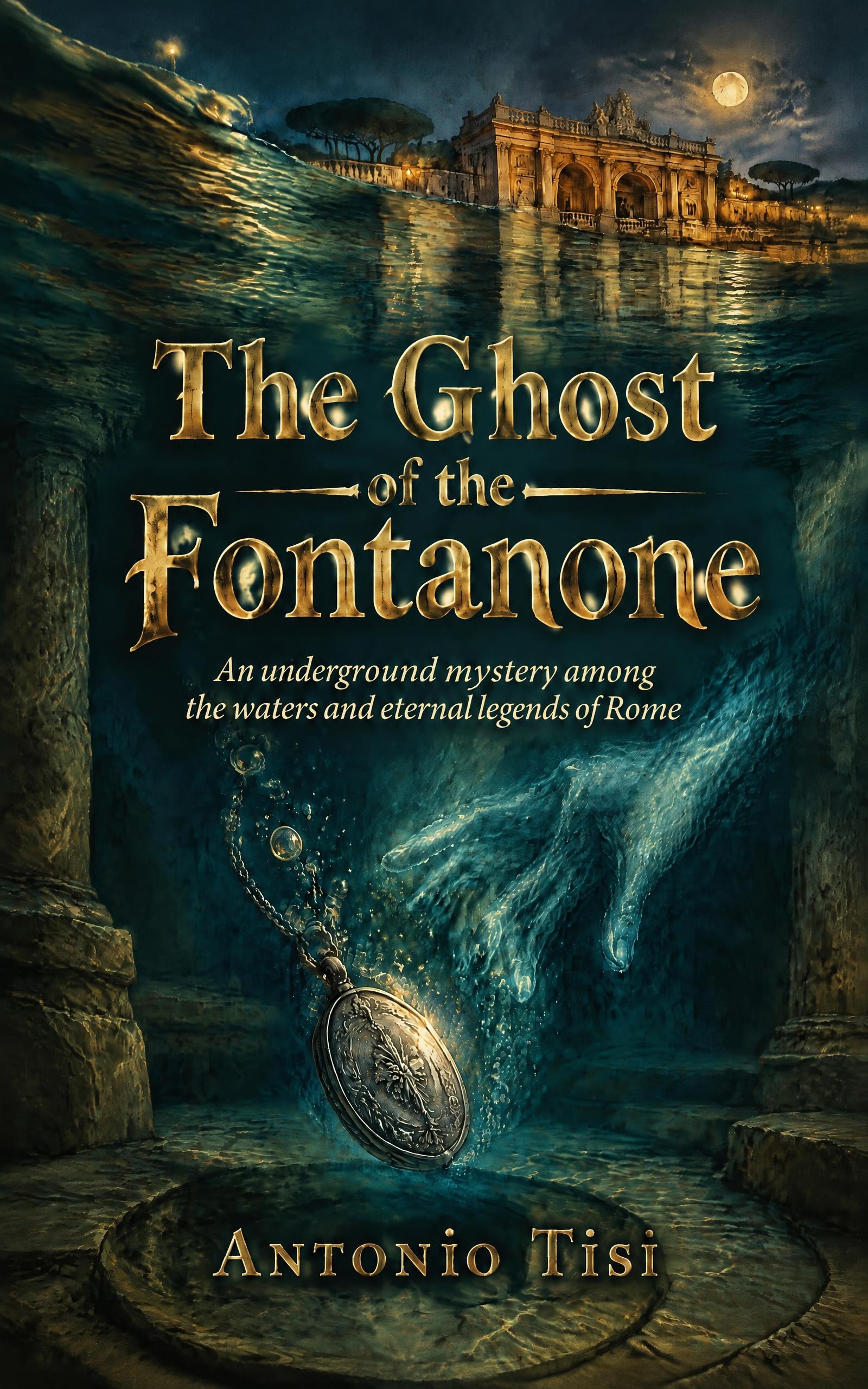
The Ghost of the Fontanone
An underground mystery among the waters and eternal legends of Rome
by Antonio Tisi
On the Gianicolo terrace, before the majestic jets of the Fontanone, impossible prodigies occur: small objects vanish into thin air from the hands of passersby only to reappear, intact and wet, in their locked rooms. When Giulia Blanco, a passionate archivist and heir to a dynasty of water keepers, loses her family pendant only to find it dripping on her own nightstand, she decides not to file the incident away as a mere oddity. Together with Matteo Greko, an urban speleologist who knows the stone lungs of the city, she follows the traces of an invisible presence that slips through the millenary aqueducts of the Acqua Paola. But the shadow of the Fontanone also attracts Lorenzo Riccjo, a ruthless antiquarian willing to tamper with the ancient Roman sluice gates to wrest a forgotten papal treasure from the depths. With the foundations of Trastevere threatened by rising water, Giulia and Matteo must descend into the dark meanders of the Capital before an ancient wonder drowns the city forever. The Ghost of the Fontanone is a fascinating journey full of mystery among Capitoline legends, secret passages, and the immortal heartbeat of Roman water.
- Mystery
- Fantasy
- Paranormal
- Urban Fantasy
- Cozy Mystery
- Ghost
The Wet Pendant
The continuous roar of water on the Gianicolo sounded like no other noise in Rome. It wasn't the metallic clamor of Viale Trastevere nor the thick murmur rising from the tables of Piazza Santa Maria. It was the voice of an organ, deep and constant, bursting forth from the five great arches of pale marble of the Acqua Paola, plunging into the three basins with a force that made the stone balustrade imperceptibly tremble.
Giulia Blanco stood motionless against the parapet, enjoying the light wind that brought a cloud of icy droplets to her face. Below her, the city spread out like a basin of warm roof tiles, faded rooftops, and domes that slowly lost their profiles against the amber glow of sunset. At that hour, Rome appeared made of baked clay and woodsmoke. Giulia slipped her fingers into the worn leather shoulder bag she wore across her chest, the reassuring outline of the lined notebook and the barrel of the pencil tucked between its pages.
She had been working for two weeks on revising a historical guidebook dedicated to the hill districts, but the truth was that any excuse was good enough to come up here. Her grandfather Carlo always used to say that the water of the Acqua Paola remembered forests and scree, because it came straight from Lake Bracciano without ever seeing the sun until it plunged into the Fontanone. “Remember, Giulia,” he would repeat when he took her for walks along the hill as a young girl, “in Rome, water isn't just something to drink. It's a map walking beneath your feet, and it's the one in charge.”
Beside her, a tourist couple stopped to look at the view. They were two young people with heavy backpacks and cheeks reddened from the climb. The young man pointed at the urban expanse with a hesitant finger.
“Excuse me,” he said in halting Italian, clearly struggling to find the right sentence. “That over there... is that the dome of St. Peter's?”
Giulia smiled, gently shaking her head with the customary kindness that came naturally to her with lost strangers. “No, that one down there with the flattened profile is the Pantheon,” she explained, stretching out an arm to trace an imaginary line in the clear air. “You have St. Peter's behind you, a bit further north, behind the curve of the hill. From this spot on the Gianicolo, you mainly see the roofs of the ancient center and the blocky silhouette of the Vittoriano.”
“Oh, thank you so much,” the young woman replied, leaning against the low wall with a sigh of relief before taking a photo with her phone. “It's huge.”
“It's old, more than anything,” Giulia replied with half a smile. “And it takes up its space.”
The two walked slowly away toward the cannon terrace, blending among the other dark silhouettes strolling along the square. Giulia was left alone once again with the thunderous water of the fountain. She reopened her notebook, searching for the page where she had jotted down the dates of the seventeenth-century restorations commissioned by Pope Paul V Borghese. She pulled the pencil from her hair, let a lock of brown curls fall over her forehead, and leaned over her handwritten notes.
An anomalous draft brushed past her. It wasn't the usual westerly breeze rising from the Tiber. A thread of frigid air, dense and swift as a cellar draft, slid across her bare neck, right beneath the nape of her hair. The sensation lasted for the blink of an eye, accompanied by a barely perceptible rustle, like the suction of a storm drain swallowing a dry leaf.
Giulia instinctively brought her hand to her throat. Her skin was bare.
The silver chain, delicate yet sturdy, was gone. The pendant was missing, too: an old oval medallion with an edge shaped like laurel leaves, which her grandfather had given her for graduation. It hadn't unfastened—there had been no tug, no metallic sound of broken links striking the travertine.
“What on earth...?” Giulia muttered, looking down.
She knelt immediately, scanning the damp cobblestones and the cracks between the paving stones. She searched with bare fingers along the edge of the drainage gutter, heedless of the dust dirtying her light-colored trousers. There was nothing. She widened the scope of her search to the base of the fountain, where splashes formed small, clear puddles. No glint of silver, no broken chain.
She straightened up abruptly, turning toward the square. The thief had to be nearby, she thought; in Rome, pickpockets had velvet hands, but slipping a chain off someone's neck without them feeling the clasp give way required magic or unheard-of audacity. Around her, however, there was no one within fifty feet. The foreign tourist couple was far away by now, busy watching a street postcard vendor; an elderly woman was walking a scruffy dog on a leash, and two teenagers were sitting on turned-off scooters staring at their phone screens. No one was running away. No one seemed agitated. The emptiness in the square was almost surreal.
“Calm down, Giulia,” she said under her breath, a dull knot tightening in her stomach. “You must have lost it earlier. Maybe it fell into your bag.”
She emptied her leather shoulder bag onto the flat stone of the balustrade: out came receipts from the State Archives, tissues, her wallet, three half-empty pens, and a small brass flashlight she always carried for consultations in dusty basements. The pendant wasn't there. She had touched it before climbing the steps of San Pietro in Montorio; she was certain of it. She had run her thumb over the worn relief of the metal as she walked uphill, as she always did when thinking of her grandfather.
She spent another twenty minutes scouring the square, inch by inch, until the orange light gave way to deep blue and the evening dampness seeped beneath her tobacco-colored linen trench coat. In the end, she had to give up. The pendant was gone.
She walked down toward Trastevere with a heaviness in her chest, following the steep ramps that cut through the slopes of the Gianicolo between ivy-covered walls and quiet villas. Every step on the stone stairs reminded her of how attached she was to that piece of metal. It held little commercial value, but it held a lifetime of Saturdays spent among archival documents and job-site stories. Carlo Blanco had worked for forty years for the municipal waterworks, back when pipes were still repaired with oakum and colophony, and he knew every bypass of the Renaissance conduits.
Giulia's apartment was on the second floor of a small building on Via della Lungaretta, nestled between an ancient bakery and a courtyard with two large potted lemon trees. She climbed the stone stairs, worn down in the center, pulled out her heavy ring of keys, and turned the two deadbolts of the armored door. The latch engaged with its usual sharp sound, familiar and reassuring.
She closed the door behind her, immediately fastening the security chain, and set her bag on the trunk in the entryway. The air inside the house was still and warm, with the usual scent of old paper and ground coffee. The windows overlooking the alley were closed with the shutters drawn tight, exactly as she had left them before going out at four in the afternoon.
She removed her coat, turned on the hallway lamp, and went into the bedroom to change her shoes. She reached toward the bedside lamp switch, but her fingers stopped in midair.
On the dark wood surface, atop a green-cloth-bound volume of urban land registries, something lay waiting.
Giulia froze. Her heart gave a dull thud against her ribs.
It was her silver pendant. It lay at the exact center of the book cover, its metal chain laid out neatly, without knots or tangles. Surrounding the piece of jewelry, the polished surface of the wood was marked by a radiant pattern of crystal-clear water droplets.
She took a step forward, holding her breath. No one could have entered. The door was locked with two turns of the key; the second-floor windows had nineteenth-century wrought-iron grates, as dense as the bars of a cage. She reached out a hesitant hand and touched the medallion.
The metal was frigid. It wasn't cold like an object left in an unheated room; it was a living, piercing ice, as if it had come out of a deep cavern. She brought her wet fingers to her nose. The scent wasn't that of tap water treated with chlorine. It smelled of fresh limestone, damp moss, and tufa washed by an underground current.
“It's not possible,” she muttered aloud, the sound of her words breaking the silence of the room.
She took the pendant between her fingers. The drops trickled onto the back of her hand, cool and dense. She closed her eyes for a second, remembering the words her grandfather used to say before the old hydraulic cross-sections of Trajan's aqueduct: “The Acqua Paola never sleeps, Giulia. It slips into blind tunnels and always finds an outlet that the engineers never drew.”
She opened her eyes. The pendant was real, heavy in her palm, and soaking wet.
Giulia turned toward the built-in closet in the hallway. She climbed onto the small wooden stool and pulled a heavy cardboard tube down from the highest shelf, sealed with yellowed tape. Bringing it to the kitchen table, she moved the breakfast cups aside and pulled off the cap with a sharp tug.
From inside slid three large sheets of linen-backed paper, yellowed and creased along the folds. They were the India-ink surveys her grandfather had kept for decades: the map of the ancient branches of the Acqua Paola beneath the spine of Trastevere, complete with elevations and the blind spots of the old abandoned cisterns. Giulia smoothed out the first sheet, setting four glasses on the corners to hold it flat, and stared at the blue line connecting the Gianicolo to the belly of the neighborhood.
Pressure Variations
The morning light washed the facade of the Acqua Paola in a harsh white, stripped of the previous evening's gold. Beneath the grand arches, the basins overflowed with their usual fury, but the noise sounded different at that hour: duller, as if the conduits were swallowing gravel along with the current. Giulia Blanco walked up the steps alongside t…