

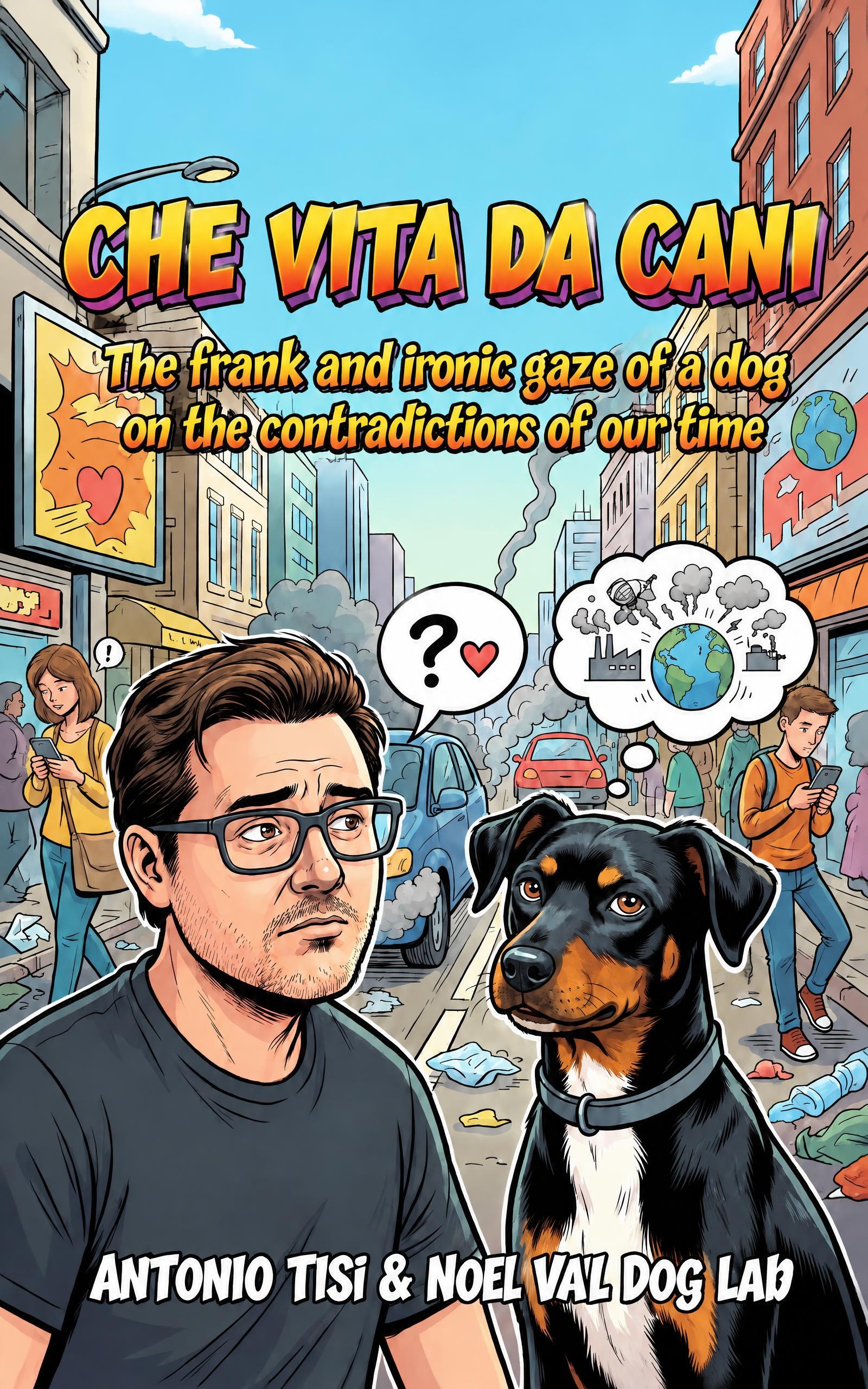
CHE VITA DA CANI
The frank and ironic gaze of a dog on the contradictions of our time
by Antonio Tisi
What does our dog really think while we walk with our eyes glued to our smartphone, dodging useless construction sites and breathing air thick with smog? Noel is no ordinary dog: endowed with a disenchanted, sharp gaze steeped in irresistible irony, he accompanies his human companion Toni through the landscapes and contradictions of contemporary society. From walks among asphalt and plastic waste to offices choked by bureaucracy, Noel observes the absurdity of the civilized world, comparing it to the perfect simplicity of nature. Together, the two reflect on the neuroses of compulsive consumerism, the alienation of wage labor, the tragedy of war, and rivers reduced to dry furrows by drought. And yet, beneath Noel's biting sarcasm lies an unwavering affection for the human race. CHE VITA DA CANI is a lucid, entertaining, and touching modern fable. A four-legged walk that invites us to stop, breathe, and rediscover the authenticity of the present before it's too late.
- Literary Fiction
- Character Study
- Book Club Fiction
The Invention of Scorching Asphalt and Flying Plastic
The eight o'clock morning sun was already beating down mercilessly on the main avenue's sidewalk, turning the bituminous conglomerate into a griddle ready for a paw barbecue. The air held that sticky heat that only metropolises know how to incubate in early summer, a thick blend of particulate matter, burnt rubber, and the stale resignation of thousands of people waking up against their will.
Toni plodded, his shoulders hunched under a linen shirt already wrinkled and his eyes still swollen with sleep. He held the leash loosely in his right hand, giving me that union-mandated meter and a half of autonomy, while with his left he battled his jeans pocket to pull out a roll of biodegradable poop bags without sending his house keys, his magnetic office badge, and a half-melted pack of mints flying across the pavement.
"Damn it," he muttered through clenched teeth when the metal ring jingled precariously on the edge of the pocket. "One of these days they'll invent pants with rational compartments, or maybe a third biological hand for anyone who has to juggle leashes, droppings, and corporate deadlines all at the same time."
I stopped to sniff the chipped base of a lamppost. To a dog, that piece of rusty metal is the equivalent of the local newspaper's front page, only infinitely more truthful: the usual chemical cocktail of acid rain, territorial markings of three neighborhood dogs—including the irascible dachshund from apartment four, who kept claiming the stature of a Doberman through the height of his spray—and the caustic residue of synthetic lemon detergent, dumped with Olympian nonchalance from the second-floor window by Signora Adele.
I rested my paw pads for an instant on a crack in the asphalt, jerking them back at once with a shudder. The surface was already simmering at an improper temperature for any creature endowed with living skin.
I looked up at Toni, wrinkling my black nose and tilting my head forty-five degrees to give my expression the right dose of philosophical perplexity. "Toni," I said with a clear, rhythmic bark, a sharp modulation of throat and diaphragm that only he, after years of symbiotic coexistence, knew how to translate perfectly into human syllables: "Explain something to me: what is the prodigious logic of covering square miles of the planet with this greasy black crust that turns every summer walk into a medieval torture for our paws and doesn't even allow the ground to take a single breath of fresh air in winter?"
An elderly man walking with a shopping cart turned to look at me, as if I were merely begging for a treat, and shook his head, muttering something about the lack of discipline in modern four-legged creatures.
Toni ignored the passerby, sighed deeply, and knelt down to adjust my harness, which had twisted sideways during my lamppost exploration. His brown eyes, circled by a purplish tint from too many hours spent in front of spreadsheets, stared at me with that blend of patience and guilt he always reserves for my morning inquiries.
"It's called asphalt, Noel," he whispered under his breath, as if confessing an original sin of our two-legged species. "It's a mixture of bitumen and mineral aggregates. It's used to create smooth, stable, waterproof surfaces. It helps cars, trucks, and buses move quickly. Without asphalt, our vehicles would sink into the mud with every autumn storm, wheels would spin in potholes, and no one would be able to reach the office or factory before nine in the morning."
"Ah, the Schedule!" I snorted loudly through my nostrils, shaking my long, furry ears until my collar tag clinked. "The Schedule, the great invisible idol to which you sacrifice every crumb of serenity! That extraordinary and insane collective invention by which you wake up to the hysterical blare of a screeching alarm, gulp down scalding coffee without even tasting it, curse at red lights, and rush cramped inside a metal box just to reach another reinforced concrete box, where you'll sit for eight hours straight staring at a luminous rectangle full of letters and numbers!"
I took a step back, taking shelter under the meager shade of a tram stop awning. "And to achieve this admirable outcome—rushing in order to stay still—did you really need to lay a tarry shroud over centuries-old meadows, suffocating earthworms, roots, and slumbering seeds? Look at that!"
With my muzzle and a nod of my chin, I indicated a clear plastic bottle, deformed and crumpled in half. A gust of dry air, kicked up by a speeding delivery van, sent it rattling noisily across the sidewalk, dancing amid torn trash bags overflowing from an apartment dumpster that had never been emptied.
Toni stared at the bottle with the bitter expression of someone who knows the diagnosis by heart but has no idea how to get the cure. He took three steps forward, bent down, and picked up the battered object from the ground, clasping it between his fingers along with an old fluttering receipt, before tossing both into the meager space left inside the public trash can.
"Plastic was considered the greatest technological blessing of the twentieth century, Noel," he explained in a calm tone, trying to reconstruct the historical reasons behind that daily madness. "It was the democratic promise of material progress: lightweight, malleable, impossibly cheap, sterile, and, above all, practically indestructible. It made goods that were once reserved only for the very wealthy accessible to everyone; it saved lives in hospitals in the form of IV bags and disposable syringes; it made it possible to preserve food without it rotting after a few hours in the sun."
"Indestructible!" I retorted, pricking my ears and aiming my nose straight at his stomach with a mix of canine indignation and brotherly compassion. "And that very word is precisely where your colossal naivety lies, my dear biped! Inventing a material that resists the elements for four or five hundred years just to drink two sips of lukewarm water out of it in ninety seconds, before throwing it out the car window or leaving it floating in the park pond where I try to chase ducks!"
I licked my dry nose, eyeing a fragment of a snack wrapper wedged between two paving stones. "You humans have a rather bizarre conception of magic, to say the least. You were handed a planet that functioned like a perfect continuous-cycle feast: an earth capable of digesting anything, where fallen leaves turn into fertilizer, carcasses feed insects, fruits disperse seeds, and every single dead cell becomes the fertile womb of the next life. And what do you do? You come along with your test tubes and create a chemical abomination that the soil doesn't know how to chew, an immortal poison that never dies and ends up suffocating fish in the ocean depths and birds in the woods."
I paused for dramatic effect, scratching vigorously behind my left ear before delivering the dialectical blow. "Think about the anthropological difference between our species, Toni. If a dog digs a hole and carefully buries a stripped bone, after a week the living earth has already dissolved the marrow, the bacteria have done their job, and the humus emerges enriched with calcium and phosphorus. If a human buries a grocery bag or a plastic coffee cup, in three hundred years your great-grandchildren will dig in the exact same spot and find that hideous piece of polyethylene completely intact, a perpetual testament to how lazy, distracted, and arrogant their ancestors were."
Toni remained silent for a long stretch, his right hand firmly clutching the loop of the leash handle. The volume of traffic along the avenue had picked up: impatient honking, diesel engines rumbling at red lights, the hissing brakes of sanitation trucks. He looked toward the ring of asphalt squeezing the suffering trunks of the linden trees planted along the sidewalk, their roots deforming and cracking the stone in a desperate attempt to drink a drop of rainwater.
"You're right, Noel," he finally murmured, and there wasn't a trace of rhetoric in his voice, only the clear sadness of a man admitting a generational mistake. "We made a Faustian bargain: we traded immediate efficiency, convenient speed, and the illusion of absolute control for the long-term destruction of our natural habitat. The tragedy of modernity is that we have proclaimed ourselves spectators seated in the front row of a lavish theater, spectators with the right to criticize or consume the show as we please, forgetting that we aren't up in the balcony: we are an integral part of the orchestra and the scenery. If the stage collapses, we go down with it."
"Spectators who demand not to get their shoes dirty while tearing down the foundations of the hall," I noted, tugging slightly at the leash to urge him to pick up his pace toward the wrought-iron gate marking the entrance to the municipal park.
Beyond that rusted entryway, a strip of meadow that had escaped urbanization finally came into view: a few leafy poplars, patches of wild Bermuda grass not yet mowed, and bare, fragrant, cool earth. The scent of damp grass filled my nostrils with a burst of animal joy, shaking off the dust and the foul heat of the street.
"Come on, Toni," I said, breaking into a trot and wagging my tail like a propeller. "Leave the asphalt behind for half an hour. Let me show you what the world tastes like when it isn't wrapped in cellophane."
"Spectators with dirty paws," I added as we reached the grass.
The Rush of the Big Thumb and the Blindness of the Road
At the intersection of Via Roma and Via delle Magnolie, the scene was always the same. A metallic river, packed bumper to bumper across four lanes, pulsed sluggishly beneath the early morning heat. The running engines exhaled that dense, slimy vapor of burnt hydrocarbons that makes my whiskers curl and tickles my trachea with an intolerable itch. T…