

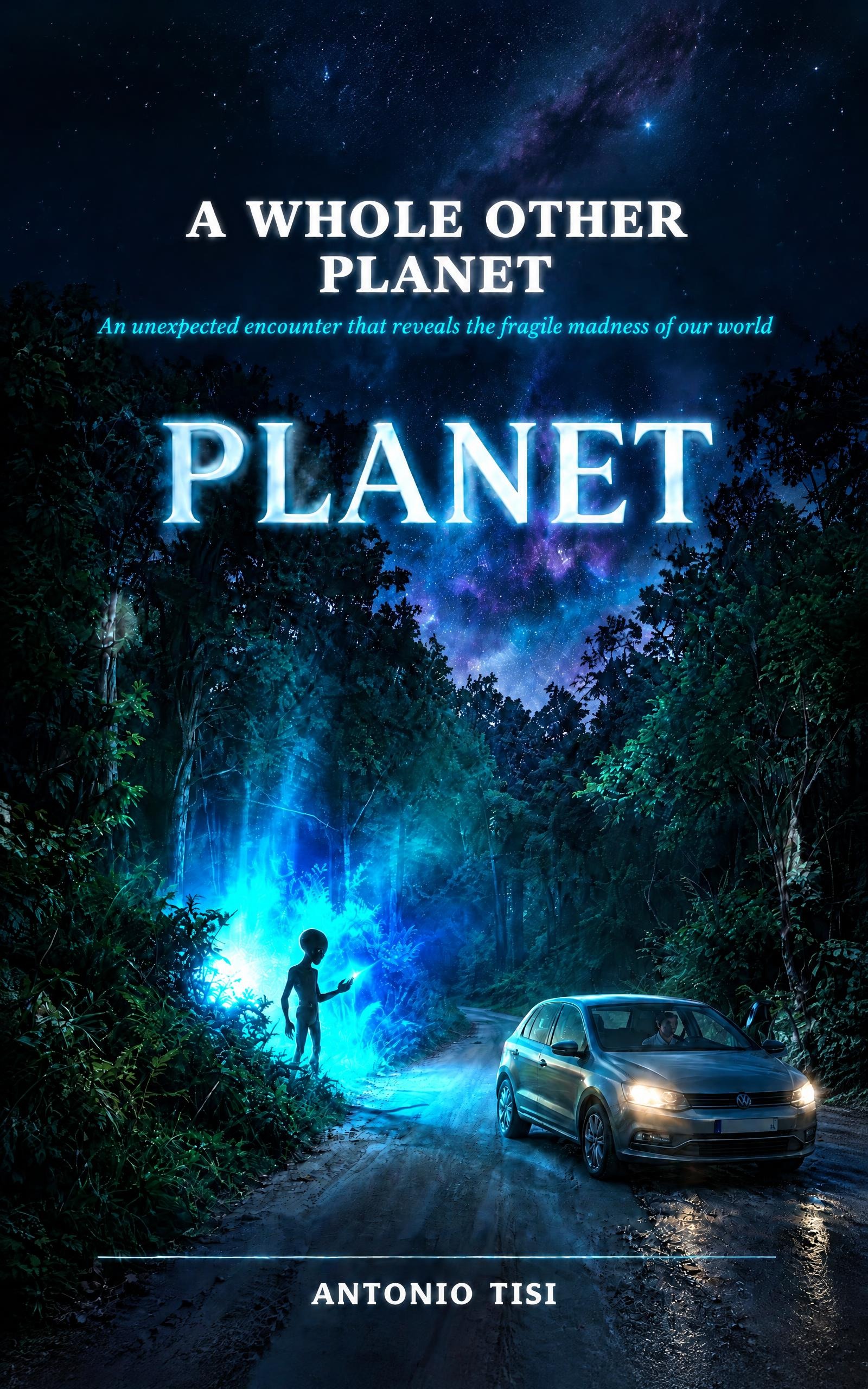
A WHOLE OTHER PLANET
An unexpected encounter that reveals the fragile madness of our world
by Antonio Tisi
Antonio Rossi, known as Totò, spends his thirties amidst the quiet halls of a provincial museum, convinced that life is entirely contained within that reassuring, dusty routine. Everything changes on a dark night along a country road, when a cobalt-blue light pierces the woods. Stepping into his old Fiat Punto is Astros, an alien observer from the Xeo star system. For a week, during clandestine meetings, Astros observes our world and takes it apart piece by piece with relentless irony: the obsession with consumerism, the blind worship of GDP, the absurdities of bureaucracy, the borders drawn upon the earth, and the loneliness disguised as connection on social media. Before the alien's disenchanted gaze, Totò's certainties collapse one after the other. Yet time is running out, and the Supreme Council's verdict on Earth looms like an unappealable sentence. A WHOLE OTHER PLANET is a bitter, brilliant, and deeply human novel that forces us to look at ourselves from the outside to rediscover the unrepeatable worth of our fragile planet.
- Science Fiction
- Literary Fiction
- Alien Contact
- Character Study
The Encounter in the Undergrowth and the Blue Light
C H A P T E R I
"All planets appear perfect when viewed from a light-year away; up close, one finds only traffic jams and bureaucracy."
If there is one irrefutable truth one learns well into one's thirties working as a third-tier museum assistant in a provincial town, it is that time does not flow in a straight line at all: rather, it floats, like a listless jellyfish in a half-lit Riviera aquarium in November.
My fixed-term contract, renewed by sheer grace and pure ministerial inertia every six months, provided a salary that barely covered petrol and the instalments on a washing machine bought during the pandemic. In return, it granted me unlimited access to centuries-old dust and a monumental boredom, the sort that settles upon your shoulders like volcanic tuff.
My daily life was a rigorous, unbroken sequence of eight-hour shifts spent explaining to hyperactive school parties that no, the black-gloss cups from the fourth century BC were not used for evening drinks with friends from Hellas, and discouraging over-enthusiastic groups of pensioners from touching Etruscan artefacts protected by scratched Perspex sheets with focaccia-greasy fingers. There was a placid despair in all this: an existence measured out by the buzz of flickering neon tubes in the numismatic section and round rubber stamps pressed onto triplicate forms that no sentient being in Rome would ever read.
Antonio Rossi, known to friends and the entire registry office of San Lorenzo in Selva as «Totò»: one metre seventy-five of bureaucratic resignation, a degree in Classics hanging behind the bathroom door, and a chronic inability to say no to anyone asking for a hand with flat-pack furniture or covering the closing shift.
That Tuesday night was carbon-copied from all the others. My battered aubergine-metallic Fiat Punto sputtered along the secondary road that cut through the dense forest of oaks and holm oaks, separating the archaeological site from the town centre. It was around eleven thirty-five, the tarmac was sweating the sticky dampness typical of early May evenings, and mist hung stagnant in the drainage ditches.
The engine produced that characteristic cavernous, metallic hiss which my trusted mechanic, master Carmine, had bluntly christened «the death rattle of the main bearing»: a rhythmic wheeze that grew in intensity with every gear change, accompanied by the reassuring, chemical smell of burnt oil and sun-baked wiper blades. From the dashboard, the crackling radio broadcast a nineties synth-pop track remastered for the fourth time to fill the dead air of late-night broadcasting, while I counted the kilometres separating me from the sofa and half a portion of microwave-reheated lasagne.
The patch of bushes on the verge of the road exploded with light.
It was not the high beams of an off-road vehicle off course, nor the silvery reflection of the full moon on frost-drenched leaves. From the dense vegetation, no more than twenty metres from the roadside, burst a cobalt-blue beam: a pillar of light so thick, surgical, and solid it sliced through the darkness like a blade of cold glass. By comparison, the yellowed halogen headlamps of my Punto looked like the dying flicker of a cemetery candle.
I slammed on the brakes by instinct. The wheels skidded on the gravel and rotting leaves heaped on the hard shoulder, bringing the car to a halt sideways across the lane. My heart leapt straight into my throat.
I feared the worst: a road accident, a motocross bike in the ditch, an experimental agricultural drone crashed in the branches, or, far more likely, yet another local poacher caught in his own wild-boar trap. That foolish impulse of civic duty always led me to poke my nose into other people's business instead of driving home at ninety kilometres an hour.
Once the engine was cut, the Punto shuddered with one last hiccup of its connecting rod before giving up; the silence of the woods fell instantly, deep and heavy with the pungent tang of damp earth and moss, broken only by the dry ticking of the overheated radiator. I fumbled in the glove compartment, pushing aside the 2018 road-tax receipt and a worn box of plasters, until my hand found the yellow plastic emergency torch. I flicked the switch: the bulb gave off a dull, flickering glow typical of a zinc-carbon battery on the verge of decomposition. I sighed, opened the door, and stepped out into the tall, wet grass.
«Is anyone there? Does anyone need help?» I shouted, trying to muster the authoritative tone of a model citizen, despite the unpleasant chill running down my spine.
The hawthorn and bramble bushes parted with almost geometric composure, barely rustling. From the gloom stepped a figure that at first glance might have belonged to a man in his forties: tall, lean, with sharp features devoid of any blemish or asymmetry.
He wore a high-collared overcoat of matte slate-grey, a garment of inconceivable tailoring, cut from a fabric as smooth as silk yet visually as heavy as lead, lacking seams, buttonholes, zips, labels, or buttons. There was not a single speck of mud on the hem, despite his having just emerged from a muddy ravine amidst ancient oaks.
In his right hand he held a rigid sheet, as thin as a credit card but as transparent as fused quartz. It was from this rectangle that the cone of cobalt light radiated, a glow that cast no sharp shadows upon the ground, as if rewriting the physics of optical refraction.
«Have... have you broken down? Do you need help?» I stammered, stepping back half a metre until my calves hit the dented bumper of the Fiat. «If you're lost, the valley road is closed due to a landslide, but I can call roadside assistance... or the Carabinieri...»
The man brushed the top edge of the transparent sheet with his thumb. The bluish light collapsed in on itself in a fraction of a second, leaving a faint trail of a pungent smell in the air, similar to the ozone released during summer storms after lightning strikes a pylon.
He raised his head and fixed an indecipherable gaze upon me. His eyes were orbs of a brown so dense and deep that it was impossible to distinguish the circle of the iris from the black of the pupil. He did not blink; he observed me with the meticulous attention with which an entomologist inspects a beetle stunned by a drop of chloroform.
«The phrasing of your inquiry presumes a condition of mechanical disadvantage or biological vulnerability on the part of the undersigned,» he said. His voice was crystal clear, metallic yet velvety at the same time, calibrated to perfect mid frequencies, free of regional inflections, hesitations, or accents. He spoke Italian like speech-synthesis software designed by Accademia della Crusca linguists with an obsession for punctuation.
«However,» he continued, surveying my car from the bent aerial to the rattling exhaust pipe, «estimating the modest kinetic efficiency of this fossil-fuel artefact and calculating the linear distance separating this woodland from anthropised urban hubs, I accept the availability of your vector for transit.»
I blinked. «Er... do you want a lift?»
«Precisely. The conceptual synthesis matches my logistical necessity,» he replied with a slight, almost imperceptible incline of his chin. «My conventional designation is Astros. And, in order to avert sterile misunderstandings or hermeneutic fallacies during our initial vector exchange, I deem it proper to inform you that my biological and cultural matrix does not originate from this planetary quadrant.»
I stared at him, mouth half-open, the half-dead torch pointing straight down at my muddy shoes. For a moment I suspected an elaborate prank by museum colleagues, or actors from the railway workers' amateur dramatic society trying out costumes for the open-air sci-fi festival.
«Right, of course. And I'm the reincarnation of Tutankhamun with a VAT number,» I muttered under my breath. «Get in, before the Forestry Corps drive past and take us for a pair of timber thieves.»
We climbed aboard, and never before had I felt the abyssal distance between deep space and provincial central Italy so acutely.
The interior of my Punto was a stratigraphic museum of personal chaos: on the passenger footwell lay crumpled receipts from three different cafés, forms requesting untaken annual leave, two dusty catalogues from an exhibition on pre-Roman fibulae that had flopped in 2019, and three Scots pine air fresheners, by now shrivelled and stripped of any olfactory virtue since the days of the second Conte government.
The contrast between this squalor and the elegant, ascetic figure of Astros was hilarious.
Astros shifted a plastic spectacle case aside with the tips of two fingers and settled into the seat with an almost hieratic solemnity. He kept his torso rigidly upright, never resting his back against the threadbare checked fabric, as though to minimise the molecular contact area between his tunic and the fossilised traces of custard croissant crumbs dotting the upholstery.
He tucked the quartz sheet into the inner lapel of his overcoat, which resealed itself instantly without leaving a trace of a pocket or seam. I felt guilty about the smell of stale tobacco and loam pervading the cabin.
«So... Astros,» I began, trying to keep my voice steady as I engaged first gear. «Where are you from, exactly? Are you here on holiday or something?»
Astros turned his head towards me with a smooth, calibrated movement, lacking the involuntary jerk typical of human vertebrae. His hands remained composed upon his knees, slender, with nails as smooth as grey pearls.
«My point of origin lies within the Xeo star system, situated in the peripheral region of the Perseus Nebula. According to your rudimentary trigonometric and temporal conventions, an estimated distance of approximately two hundred and forty-five light-years. My active presence on the crust of this celestial body conforms to a rigorous ethnographic, social, and environmental monitoring protocol enacted by the Supreme Council of Xeo prior to sanctioning the definitive closure of transit routes.»
I burst into a short, jagged laugh that bounced off the misted windscreen. «Two hundred and forty-five light-years? Full marks for imagination, honestly. Come on, out with it: who sent you? The lads from the community centre? Is this a hidden-camera thing for YouTube? Let me guess: there's a camera hidden behind the vanity mirror or inside the air-con vent, isn't there?»
I ran my hand along a seam on the dashboard, both ridiculous and alarmed. Astros did not move a muscle. His dark eyes remained fixed on my profile with a disarming calm, as if holding an aseptic pity for my defence mechanisms.
«Incredulity is the primary homeostatic barrier of pre-scientific species,» Astros murmured, without altering his vocal inflection.
He produced the transparent sheet once more and tapped an invisible point in mid-air, a few centimetres from the dashboard. There was a high-pitched whine, imperceptible to the human ear, but the hairs on my arms stood on end. Instantly, the small green liquid crystal display of the Pioneer car stereo — a 2004 relic with a half-peeled volume knob — went haywire.
The letters for Radio Subasio vanished, replaced by swirling strings of unknown characters, tensor equations, and pale-blue numerical matrices floating half a centimetre clear of the display in a razor-sharp holographic projection. From the Punto's crackling speakers came not the usual mattress advert or the repeat of the regional news, but an impeccably clear audio stream, devoid of hiss.
«...Fuffi, you bloody wretched beast... get off the dresser or you'll break my Capodimonte cups... go on, to your basket, off with you...»
It was the raspy, unmistakable, slightly phlegmy voice of my Aunt Agnese, squabbling in her sleep with her obese Persian cat inside her terraced house on Via delle Ginestre, just over three and a half kilometres away as the crow flies.
I switched the radio off with a panicked jab of my finger. «How on earth did you do that?!»
«Simple non-invasive interception of local frequencies and quantum decoding of low-emission synaptic and electrostatic fluxes,» Astros explained, in the same even tone an auto-electrician might use to explain the replacement of a ten-amp fuse. «No stage artifice, Totò. Or do you deem it more appropriate that I use your civil registration: Antonio Rossi, museum employee number 4409, born 14 April 1994, holder of a bank current account with a credit balance of three hundred and twenty-four euros and sixty cents?»
The mention of the exact balance in my account — which indeed stood at that desolate figure following the payment of my car insurance — took the wind out of me. My fingers clenched the rough steering wheel so hard my knuckles turned white. I struggled to swallow a mouthful of dry air.
EXOPLANETARY OBSERVATION NOTE — SYSTEM XEO #001
Subject: Psychological reaction of the average Earthling to an extraordinary event.
Outcome: The examined specimen (Antonio «Totò» Rossi) immediately activates a cognitive denial immune response. When confronted with the manifest rupture of ordinary physical coordinates and superior technological evidence, he prefers to retreat into the regressive hypothesis of commercial deception, practical jokes, or television manipulation, rather than reformulate his own placement within the universal continuum. An evident symptom of chronic planetary provincialism.
I stared at the dark ribbon of tarmac carved out by the headlights, while the drone of the main bearing ticked off the remaining minutes of my sanity. The beams illuminated the silhouettes of the oaks, silent sentinels of a night that had ceased to be normal.
As the Punto laboured uphill towards the outskirts amidst the scent of alien ozone and the dust of Etruscan sarcophagi, I grasped two fundamental truths: first, that my quiet, dull, predictable provincial existence had evaporated forever; second, that the universe out there was vastly more bizarre, cynical, and boundless than any catalogue of the Cultural Heritage Superintendency would ever have dared to concede.
Xeo versus Earth: The Great Ecosystemic Misunderstanding
C H A P T E R I I"You were given the gift of an idyllic garden, and you fenced it off to turn it into a pay-and-display car park."We arranged to meet almost every evening, right after the museum closed. My working hours ended at half past seven, but between handing back the audio guides, checking the seals on the Roman display cases, and the inevi…