

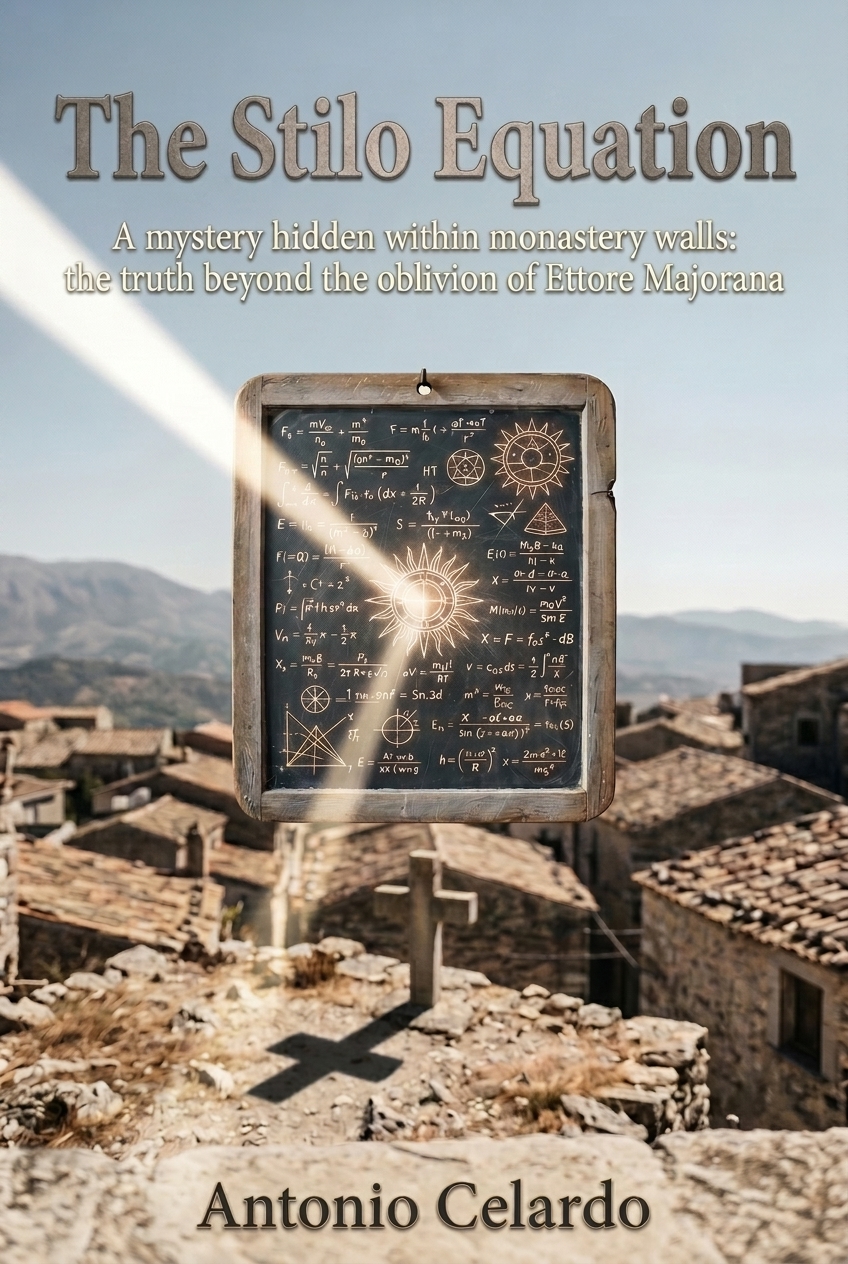
The Stilo Equation
A mystery hidden within monastery walls: the truth beyond the oblivion of Ettore Majorana
by Antonio Celardo
March 1938. The physics genius Ettore Majorana vanishes into thin air. Suicide? Flight? Kidnapping? For decades, silence has been the only answer. Jean-Pierre Celard, a Franco-Calabrian detective with a tormented past, returns to Stilo, the village that holds his family's roots. In his hands, he clutches an old letter that whispers of an impossible link between the missing scientist and the utopia of Tommaso Campanella's 'City of the Sun'. This is not a quest for glory, but an investigation that leads him towards the shadows of the Monastery of San Giovanni. There, amidst whispered prayers and centuries-old secrets, Celard discovers 'conscious subtraction'. Majorana is not dead; he chose silence to protect humanity from the destructive weight of his own discoveries. While an unscrupulous historian attempts to seize the final, fatal equations, Celard must face a truth that shakes the foundations of his sanity and his father's hidden connection to this legendary escape. The Stilo Equation is a metaphysical journey between science and faith, a thriller of the soul that explores a man's right to disappear to save the world from itself.
- Mystery
The Guardian of Silence
The climb towards the Monastery of San Giovanni was an exercise in patience and dust. Jean-Pierre Celard proceeded at a slow pace, letting the soles of his worn-out boots find a secure footing among the uneven stones of the Calabrian path. Around him, the grey rock of the mountain seemed to tighten in a grip of ancient silence, broken only by the hiss of the wind through the branches of rare wild shrubs. Inland Calabria offered no sweetness to travellers; it was a land of sharp edges, of trapped heat and long shadows that seemed to hide secrets as old as the world. Jean-Pierre stopped for a moment to catch his breath, clutching the old leather notebook in the pocket of his dark coat. He felt the weight of his fifty years in his joints, but the restlessness driving him forward was stronger than physical fatigue. This search was not just a case to be solved; it was a personal labyrinth that threatened to swallow his very lucidity.
When the severe walls of the monastery emerged from the low mountain mist, Jean-Pierre felt a strange sensation of familiarity. The limestone, corroded by time and the elements, appeared as a natural extension of the surrounding rock. Beyond the massive wooden door, the inner courtyard welcomed rare visitors with an air of absolute detachment from the outside world. There, in a corner of the cloister where light struggled to penetrate, sat a small man with a hunched back and a threadbare habit that smelled of incense and damp paper. It was Father Anselmo. His gnarled hands, constantly stained with black ink, moved with a ceremonial slowness as they leafed through an old volume.
Jean-Pierre approached with respect, his footsteps echoing on the stone slabs. The old monk did not look up immediately, continuing his silent reading as if time had no therapeutic value for him. When he finally raised his eyes, revealing two irises of a faded but extraordinarily lucid blue, the welcome was as cold as the stone of the cloister.
"Foreigners are always looking for something that does not belong to these places, sir," Father Anselmo said. His voice was thin but firm, laden with an ancient distrust. "This is a place of prayer and oblivion, not of answers for the world out there."
Jean-Pierre took off his hat, letting the wind ruffle his greying hair. "I am not looking for easy answers, Father. I am looking for a man who might have found his final resting place here. A man who fled from the weight of his own discoveries. Ettore Majorana."
The name fell between them like a stone into a deep well. Father Anselmo did not flinch, but his gaze became even more distant, almost glassy. "That name means nothing to us. Here we welcome only souls who wish to strip themselves of their past, not ghosts of scientific history. You have climbed too high for a mirage, detective."
Jean-Pierre took a step forward, lowering his voice. "I do not believe it is a mirage. Some call it a flight, others suicide. I call it by its true name: a conscious subtraction."
At those words, Father Anselmo's fingers, which until then had remained resting on the yellowed page of the book, gave a violent jolt. His knuckles whitened for an instant, and the old monk gripped the edge of the parchment with a sudden tension, almost risking tearing it. It was an imperceptible movement to anyone else, but not to Jean-Pierre's clinical eye. That glimmer of physical reaction was the confirmation he sought. The silence that followed was dense, almost tangible.
"The library is open to those who wish to meditate," Father Anselmo finally said, recovering a tone of studied indifference. "But you will not find what you seek among our sacred texts."
Jean-Pierre took his leave with a nod and headed towards the monastic library. The environment was a perennial twilight, lit only by faint candles and narrow slits that cut through the stone walls. The smell of mould, wax and centuries-old parchment was almost suffocating. On the dark wooden shelves, hundreds of leather-bound volumes were lined up. Celard began to examine the spines with methodical patience, guided by an intuition that bordered on obsession. His gaze finally settled on an old edition of The City of the Sun by Tommaso Campanella.
He took the volume gently, placing it on a wooden lectern. Leafing through the yellowed pages, he immediately noticed something unusual. In the white margins, next to Campanella's philosophical passages on the order of the cosmos and light, there were dense annotations written in dark ink. They were not simple theological reflections. Jean-Pierre sharpened his vision: they were strings of mathematical symbols, wave equations and calculations on the decomposition of matter. Whoever had penned those notes possessed a knowledge of advanced theoretical physics, a mind that saw the invisible structure of reality behind the words of the seventeenth-century philosopher. It was an indelible trace, a fingerprint of pure intelligence left in a place destined for oblivion.
While his mind tried to decipher that connection, the silence of the library was broken by the sound of firm footsteps and the rustle of an elegant dress. Jean-Pierre turned around. In the adjacent cloister, just beyond the threshold of the library, a woman had appeared. The contrast with the austere solemnity of the monastery was jarring. It was Greta Bernhardt. Her ash-blonde hair was pulled back in a severe bun, and she wore an impeccably tailored grey coat that emphasised her detached and academic bearing.
The historian advanced towards him with a smile devoid of warmth, her eyes behind thin frames analysing every detail of the room. "I knew I would find someone else hunting for shadows, Mr Celard," she said, her cold and assertive voice echoing under the stone vaults. "But I fear this territory is already occupied."
Jean-Pierre gently closed the Campanella volume, keeping a protective hand on the cover. "History belongs to no one, Mrs Bernhardt. Least of all to those who seek it with the haste of someone who must publish an article."
"This is not a matter of simple academia, and you know it well," Greta retorted, taking a step towards him. Her tone became harder, devoid of any affectation of politeness. "I have been here for days, studying every single stone and every register of this place. I know exactly what has passed within these walls. I will not allow a private detective in search of personal redemption to get in the way of my work. The equations that man developed here belong to the progress of science, not to the silence of a monastic cell."
"Science has already proven it can destroy enough even without those formulas," Jean-Pierre replied, his voice calm but charged with a tension that reflected his inner conflict. "Perhaps the one you seek understood that the only salvation for humanity lay precisely in this subtraction."
"A romantic illusion," she replied with a disdainful half-smile. "Knowledge does not stop for the moral doubts of a single man. If you do not find them, I will find those papers. I have resources you cannot even imagine, Mr Celard. Step aside."
From the corner of the cloister, partially hidden by the shadow of a column, Father Anselmo observed the verbal clash between the two. A bitter smile, devoid of joy, was etched on his wrinkled face. The old monk slowly shook his head, seeing in that confrontation the eternal human drama: blind ambition clashing with the search for a tormented peace. The centuries-old quiet of the Monastery of San Giovanni had been violated, and the secret it had protected for decades began to tremble under the weight of that inevitable intrusion.
The Call of the Stone
There is a precise moment when the light of Calabria stops being a physical phenomenon and becomes a blade. It happens at midday, when the sun beats vertically upon the limestone rocks of Stilo, planing away every shadow, forcing one's eyes to squint. Jean-Pierre Celard walked in that white glare, feeling the heat rise from the soles of his shoes t…