
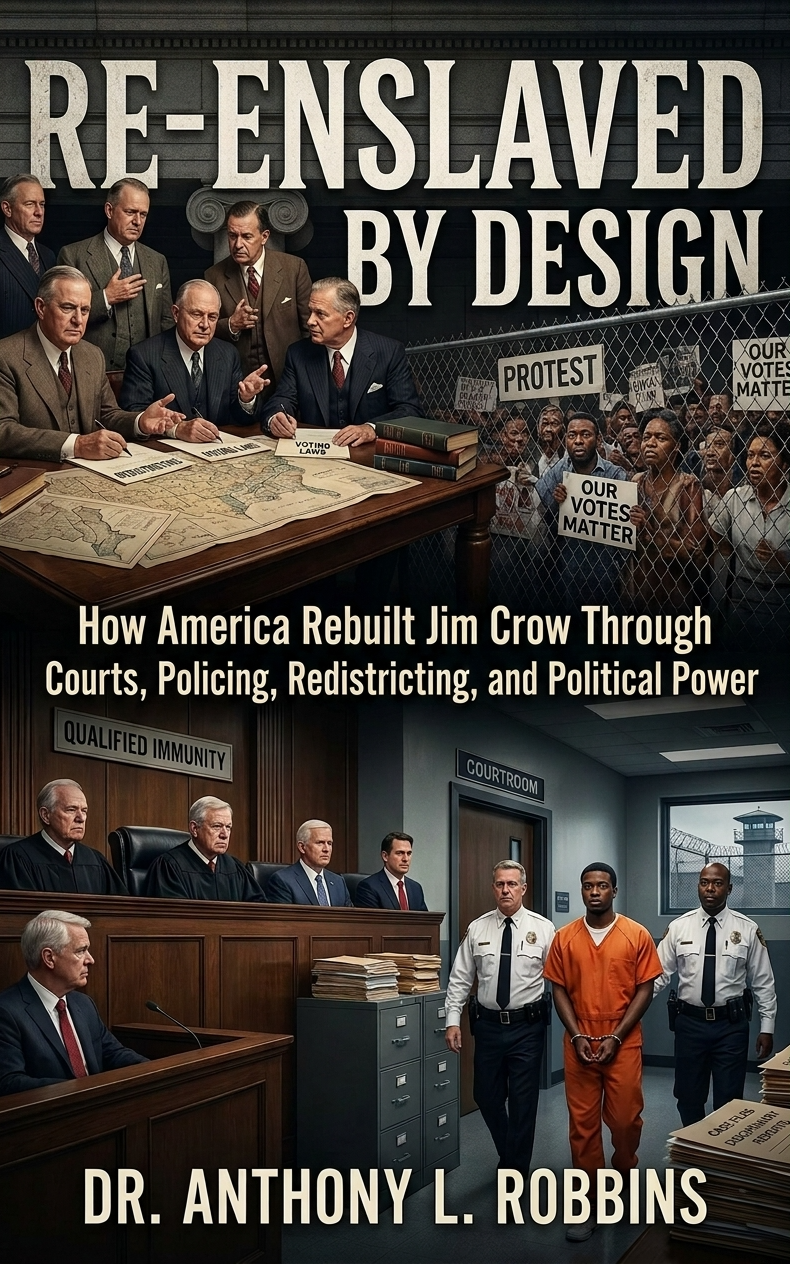
RE-ENSLAVED BY DESIGN
A forensic examination of how modern institutions legalized, professionalized, and modernized racial control
by ANTHONY ROBBINS
The chains of the past did not break; they simply changed shape. In this unflinching investigative finding, Dr. Anthony L. Robbins—a forensic criminal investigator and veteran of the law enforcement system—exposes the hidden machinery of modern racial control. Re-Enslaved by Design is not a mere theory; it is a case file of institutional evolution. Dr. Robbins traces the direct line from the plantation to the boardroom, and from the slave codes to modern criminal statutes. Drawing on decades of experience inside police departments and courtrooms, Robbins reveals how America’s systems of justice and politics have been redesigned to produce unequal outcomes through neutral-sounding policies. From the surgical precision of gerrymandering to the bureaucratic walls of qualified immunity and the systemic dismantling of DEI, this book uncovers how oppression now hides behind paperwork, procedure, and professional authority. This is a rigorous analysis of how the badge, the gavel, and the ballot box are used to maintain a modernized version of Jim Crow. Dr. Robbins provides a chilling look at a system where the ‘new plantation’ no longer needs a fence when every office keeps a file. Powerful, evidence-based, and urgent, this book is an essential toolkit for anyone seeking to understand, expose, and ultimately dismantle the sophisticated architecture of systemic inequality in the twenty-first century.
- Non-Fiction
- Civil Rights
- Political Science
- Criminal Justice
- Law & Legal Studies
- Psychology & Neuroscience
Punishment That Kept the Chain
The Thirteenth Amendment closed the formal slave market while leaving an exception powerful enough to carry forced labor into a new legal age.
The Investigative Finding
The first mistake Americans make when discussing punishment that kept the chain is to treat it as a debate over feelings rather than a record of structure. An investigator does not ask whether the accused system sounds polite. An investigator asks what the system does when it has power, what it repeats, who pays the cost, who receives the benefit, and what explanation appears after the harm is challenged.
In this chapter the working finding is simple: The Thirteenth Amendment closed the formal slave market while leaving an exception powerful enough to carry forced labor into a new legal age. The question is not whether every person inside the structure carries racial hatred in his heart. The question is whether the structure produces a racialized result with enough consistency that denial becomes less credible than design.
The old language of racial domination was direct. The modern language is administrative. It speaks in deadlines, rules, forms, reports, credentials, maps, risk assessments, standing doctrines, and official discretion. That change matters because it gives the system plausible deniability. It allows public officials to say the decision was neutral while the effect is anything but neutral.
The investigator must separate vocabulary from function. A system may change its label while preserving its outcome. A chain can be made of iron or it can be made of court dates, probation fees, employment records, school suspensions, and district lines. The material changes. The restraint remains.
Investigator’s Note
In every section of this chapter, follow the same investigative sequence: motive, method, opportunity, pattern, paper trail, and beneficiary. Those six questions prevent the discussion from becoming abstract. They force the reader to examine how convict leasing and debt peonage operate in real life.
The Historical Record Beneath the Modern Language
History matters here because the present did not invent itself. The modern vocabulary around convict leasing, debt peonage, vagrancy, labor control grew out of older practices that had already taught American institutions how to control Black movement, Black labor, Black credibility, and Black political participation. The names changed because the old names became too costly to defend in public. The technique survived because the beneficiaries still needed the result.
The transition was not always announced. It happened through adjustment. A law that once targeted Black people expressly became a rule that empowered officials to choose where to look and whom to discipline. A practice that once depended on open racial command became a practice that depended on discretion. A hierarchy that once relied on visible exclusion became a hierarchy that relied on standards only some people had the resources to satisfy.
That is why the historical record cannot be treated as background decoration. It is evidence of method. The same country that created slavery, defended segregation, tolerated racial terror, and resisted voting rights did not become incapable of racial control because it learned neutral phrasing. It became more skilled at defending the control it kept.
History matters here because the present did not invent itself. The modern vocabulary around convict leasing, debt peonage, vagrancy, labor control grew out of older practices that had already taught American institutions how to control Black movement, Black labor, Black credibility, and Black political participation. The names changed because the old names became too costly to defend in public. The technique survived because the beneficiaries still needed the result.
The transition was not always announced. It happened through adjustment. A law that once targeted Black people expressly became a rule that empowered officials to choose where to look and whom to discipline. A practice that once depended on open racial command became a practice that depended on discretion. A hierarchy that once relied on visible exclusion became a hierarchy that relied on standards only some people had the resources to satisfy.
That is why the historical record cannot be treated as background decoration. It is evidence of method. The same country that created slavery, defended segregation, tolerated racial terror, and resisted voting rights did not become incapable of racial control because it learned neutral phrasing. It became more skilled at defending the control it kept.
The old order did not disappear into the past. It left habits behind: who is presumed dangerous, who is presumed credible, whose pain is treated as evidence, whose anger is treated as misconduct, whose mistake becomes a crime, whose history becomes disqualifying, and whose power is called normal.
History matters here because the present did not invent itself. The modern vocabulary around convict leasing, debt peonage, vagrancy, labor control grew out of older practices that had already taught American institutions how to control Black movement, Black labor, Black credibility, and Black political participation. The names changed because the old names became too costly to defend in public. The technique survived because the beneficiaries still needed the result.
The transition was not always announced. It happened through adjustment. A law that once targeted Black people expressly became a rule that empowered officials to choose where to look and whom to discipline. A practice that once depended on open racial command became a practice that depended on discretion. A hierarchy that once relied on visible exclusion became a hierarchy that relied on standards only some people had the resources to satisfy.
That is why the historical record cannot be treated as background decoration. It is evidence of method. The same country that created slavery, defended segregation, tolerated racial terror, and resisted voting rights did not become incapable of racial control because it learned neutral phrasing. It became more skilled at defending the control it kept.
History matters here because the present did not invent itself. The modern vocabulary around convict leasing, debt peonage, vagrancy, labor control grew out of older practices that had already taught American institutions how to control Black movement, Black labor, Black credibility, and Black political participation. The names changed because the old names became too costly to defend in public. The technique survived because the beneficiaries still needed the result.
The transition was not always announced. It happened through adjustment. A law that once targeted Black people expressly became a rule that empowered officials to choose where to look and whom to discipline. A practice that once depended on open racial command became a practice that depended on discretion. A hierarchy that once relied on visible exclusion became a hierarchy that relied on standards only some people had the resources to satisfy.
That is why the historical record cannot be treated as background decoration. It is evidence of method. The same country that created slavery, defended segregation, tolerated racial terror, and resisted voting rights did not become incapable of racial control because it learned neutral phrasing. It became more skilled at defending the control it kept.
History matters here because the present did not invent itself. The modern vocabulary around convict leasing, debt peonage, vagrancy, labor control grew out of older practices that had already taught American institutions how to control Black movement, Black labor, Black credibility, and Black political participation. The names changed because the old names became too costly to defend in public. The technique survived because the beneficiaries still needed the result.
The transition was not always announced. It happened through adjustment. A law that once targeted Black people expressly became a rule that empowered officials to choose where to look and whom to discipline. A practice that once depended on open racial command became a practice that depended on discretion. A hierarchy that once relied on visible exclusion became a hierarchy that relied on standards only some people had the resources to satisfy.
That is why the historical record cannot be treated as background decoration. It is evidence of method. The same country that created slavery, defended segregation, tolerated racial terror, and resisted voting rights did not become incapable of racial control because it learned neutral phrasing. It became more skilled at defending the control it kept.
The old order did not disappear into the past. It left habits behind: who is presumed dangerous, who is presumed credible, whose pain is treated as evidence, whose anger is treated as misconduct, whose mistake becomes a crime, whose history becomes disqualifying, and whose power is called normal.
History matters here because the present did not invent itself. The modern vocabulary around convict leasing, debt peonage, vagrancy, labor control grew out of older practices that had already taught American institutions how to control Black movement, Black labor, Black credibility, and Black political participation. The names changed because the old names became too costly to defend in public. The technique survived because the beneficiaries still needed the result.
The transition was not always announced. It happened through adjustment. A law that once targeted Black people expressly became a rule that empowered officials to choose where to look and whom to discipline. A practice that once depended on open racial command became a practice that depended on discretion. A hierarchy that once relied on visible exclusion became a hierarchy that relied on standards only some people had the resources to satisfy.
That is why the historical record cannot be treated as background decoration. It is evidence of method. The same country that created slavery, defended segregation, tolerated racial terror, and resisted voting rights did not become incapable of racial control because it learned neutral phrasing. It became more skilled at defending the control it kept.
Composite Scene: The Human Cost
Consider a composite scene drawn from recurring patterns rather than a single named case: a recently freed laborer arrested for vagrancy because freedom without an employer was treated as a threat. On paper, the situation begins with a neutral rule. In real life, the rule arrives inside a social world already shaped by race, wealth, access, geography, and institutional memory.
The person at the center of the scene does not experience the system as a theory. He experiences it as a notice, a stop, a file, a missed opportunity, a delayed hearing, a district line, a report, or a label. Every office involved may claim to be doing only its narrow job. The police officer says he enforced the law. The clerk says she processed the form. The judge says he applied the standard. The agency says it followed policy. But the person living through it experiences the combined force of all of them.
That combined force is the story American institutions often refuse to tell. The public sees separate decisions. Black communities often experience a chain. The difference between those two perspectives is the difference between denial and diagnosis.
The person at the center of the scene does not experience the system as a theory. He experiences it as a notice, a stop, a file, a missed opportunity, a delayed hearing, a district line, a report, or a label. Every office involved may claim to be doing only its narrow job. The police officer says he enforced the law. The clerk says she processed the form. The judge says he applied the standard. The agency says it followed policy. But the person living through it experiences the combined force of all of them.
That combined force is the story American institutions often refuse to tell. The public sees separate decisions. Black communities often experience a chain. The difference between those two perspectives is the difference between denial and diagnosis.
The person at the center of the scene does not experience the system as a theory. He experiences it as a notice, a stop, a file, a missed opportunity, a delayed hearing, a district line, a report, or a label. Every office involved may claim to be doing only its narrow job. The police officer says he enforced the law. The clerk says she processed the form. The judge says he applied the standard. The agency says it followed policy. But the person living through it experiences the combined force of all of them.
That combined force is the story American institutions often refuse to tell. The public sees separate decisions. Black communities often experience a chain. The difference between those two perspectives is the difference between denial and diagnosis.
The person at the center of the scene does not experience the system as a theory. He experiences it as a notice, a stop, a file, a missed opportunity, a delayed hearing, a district line, a report, or a label. Every office involved may claim to be doing only its narrow job. The police officer says he enforced the law. The clerk says she processed the form. The judge says he applied the standard. The agency says it followed policy. But the person living through it experiences the combined force of all of them.
That combined force is the story American institutions often refuse to tell. The public sees separate decisions. Black communities often experience a chain. The difference between those two perspectives is the difference between denial and diagnosis.
The person at the center of the scene does not experience the system as a theory. He experiences it as a notice, a stop, a file, a missed opportunity, a delayed hearing, a district line, a report, or a label. Every office involved may claim to be doing only its narrow job. The police officer says he enforced the law. The clerk says she processed the form. The judge says he applied the standard. The agency says it followed policy. But the person living through it experiences the combined force of all of them.
That combined force is the story American institutions often refuse to tell. The public sees separate decisions. Black communities often experience a chain. The difference between those two perspectives is the difference between denial and diagnosis.
Case-File Question
Who had discretion, who controlled the record, and who benefited when the harm was described as routine? In the context of vagrancy and labor control, those questions expose the distance between formal neutrality and lived inequality.
How the Mechanism Works
Convict Leasing is not merely a word in this chapter. It is a control point. Once a control point is accepted as neutral, the system can use it repeatedly without triggering public alarm. That is the power of administrative language: it makes the extraordinary appear ordinary.
The mechanism usually works in stages. First, the system identifies a vulnerable group or a vulnerable location. Second, it applies a rule that appears general. Third, it gives decision-makers discretion. Fourth, it records the outcome in official language. Fifth, it uses the record to justify future action. Sixth, it tells the public that the result came from individual failure rather than institutional design.
This is why the paper trail must be read with suspicion but not cynicism. Suspicion means asking who wrote the record, what was omitted, what standards were applied, and whether similarly situated people were treated the same. Cynicism assumes every record is false. Investigation does not assume; it verifies.
Debt Peonage is not merely a word in this chapter. It is a control point. Once a control point is accepted as neutral, the system can use it repeatedly without triggering public alarm. That is the power of administrative language: it makes the extraordinary appear ordinary.
The mechanism usually works in stages. First, the system identifies a vulnerable group or a vulnerable location. Second, it applies a rule that appears general. Third, it gives decision-makers discretion. Fourth, it records the outcome in official language. Fifth, it uses the record to justify future action. Sixth, it tells the public that the result came from individual failure rather than institutional design.
Vagrancy is not merely a word in this chapter. It is a control point. Once a control point is accepted as neutral, the system can use it repeatedly without triggering public alarm. That is the power of administrative language: it makes the extraordinary appear ordinary.
The mechanism usually works in stages. First, the system identifies a vulnerable group or a vulnerable location. Second, it applies a rule that appears general. Third, it gives decision-makers discretion. Fourth, it records the outcome in official language. Fifth, it uses the record to justify future action. Sixth, it tells the public that the result came from individual failure rather than institutional design.
This is why the paper trail must be read with suspicion but not cynicism. Suspicion means asking who wrote the record, what was omitted, what standards were applied, and whether similarly situated people were treated the same. Cynicism assumes every record is false. Investigation does not assume; it verifies.
Labor Control is not merely a word in this chapter. It is a control point. Once a control point is accepted as neutral, the system can use it repeatedly without triggering public alarm. That is the power of administrative language: it makes the extraordinary appear ordinary.
The mechanism usually works in stages. First, the system identifies a vulnerable group or a vulnerable location. Second, it applies a rule that appears general. Third, it gives decision-makers discretion. Fourth, it records the outcome in official language. Fifth, it uses the record to justify future action. Sixth, it tells the public that the result came from individual failure rather than institutional design.
Felony Disenfranchisement is not merely a word in this chapter. It is a control point. Once a control point is accepted as neutral, the system can use it repeatedly without triggering public alarm. That is the power of administrative language: it makes the extraordinary appear ordinary.
The mechanism usually works in stages. First, the system identifies a vulnerable group or a vulnerable location. Second, it applies a rule that appears general. Third, it gives decision-makers discretion. Fourth, it records the outcome in official language. Fifth, it uses the record to justify future action. Sixth, it tells the public that the result came from individual failure rather than institutional design.
This is why the paper trail must be read with suspicion but not cynicism. Suspicion means asking who wrote the record, what was omitted, what standards were applied, and whether similarly situated people were treated the same. Cynicism assumes every record is false. Investigation does not assume; it verifies.
Prison Labor is not merely a word in this chapter. It is a control point. Once a control point is accepted as neutral, the system can use it repeatedly without triggering public alarm. That is the power of administrative language: it makes the extraordinary appear ordinary.
The mechanism usually works in stages. First, the system identifies a vulnerable group or a vulnerable location. Second, it applies a rule that appears general. Third, it gives decision-makers discretion. Fourth, it records the outcome in official language. Fifth, it uses the record to justify future action. Sixth, it tells the public that the result came from individual failure rather than institutional design.
The Language Trap
The language trap begins when the reader accepts the official label as the full truth. A policy labeled safety may also function as exclusion. A map labeled compactness may also function as dilution. A disciplinary action labeled professionalism may also function as retaliation. A doctrine labeled restraint may also redirects a civil-rights remedy. The investigator asks what the label prevents the public from seeing.
The most important word here is motive. Every system has a public explanation and a practical effect. When those two diverge, the divergence is evidence. When the divergence repeats across cases, neighborhoods, agencies, and decades, the pattern becomes harder to dismiss as accident.
The language trap begins when the reader accepts the official label as the full truth. A policy labeled safety may also function as exclusion. A map labeled compactness may also function as dilution. A disciplinary action labeled professionalism may also function as retaliation. A doctrine labeled restraint may also buries a civil-rights remedy. The investigator asks what the label prevents the public from seeing.
The most important word here is method. Every system has a public explanation and a practical effect. When those two diverge, the divergence is evidence. When the divergence repeats across cases, neighborhoods, agencies, and decades, the pattern becomes harder to dismiss as accident.
The language trap begins when the reader accepts the official label as the full truth. A policy labeled safety may also function as exclusion. A map labeled compactness may also function as dilution. A disciplinary action labeled professionalism may also function as retaliation. A doctrine labeled restraint may also translates a civil-rights remedy. The investigator asks what the label prevents the public from seeing.
The most important word here is opportunity. Every system has a public explanation and a practical effect. When those two diverge, the divergence is evidence. When the divergence repeats across cases, neighborhoods, agencies, and decades, the pattern becomes harder to dismiss as accident.
The language trap begins when the reader accepts the official label as the full truth. A policy labeled safety may also function as exclusion. A map labeled compactness may also function as dilution. A disciplinary action labeled professionalism may also function as retaliation. A doctrine labeled restraint may also protects a civil-rights remedy. The investigator asks what the label prevents the public from seeing.
The most important word here is pattern. Every system has a public explanation and a practical effect. When those two diverge, the divergence is evidence. When the divergence repeats across cases, neighborhoods, agencies, and decades, the pattern becomes harder to dismiss as accident.
The language trap begins when the reader accepts the official label as the full truth. A policy labeled safety may also function as exclusion. A map labeled compactness may also function as dilution. A disciplinary action labeled professionalism may also function as retaliation. A doctrine labeled restraint may also repackages a civil-rights remedy. The investigator asks what the label prevents the public from seeing.
The most important word here is paper trail. Every system has a public explanation and a practical effect. When those two diverge, the divergence is evidence. When the divergence repeats across cases, neighborhoods, agencies, and decades, the pattern becomes harder to dismiss as accident.
The language trap begins when the reader accepts the official label as the full truth. A policy labeled safety may also function as exclusion. A map labeled compactness may also function as dilution. A disciplinary action labeled professionalism may also function as retaliation. A doctrine labeled restraint may also normalizes a civil-rights remedy. The investigator asks what the label prevents the public from seeing.
The most important word here is beneficiary. Every system has a public explanation and a practical effect. When those two diverge, the divergence is evidence. When the divergence repeats across cases, neighborhoods, agencies, and decades, the pattern becomes harder to dismiss as accident.
The language trap begins when the reader accepts the official label as the full truth. A policy labeled safety may also function as exclusion. A map labeled compactness may also function as dilution. A disciplinary action labeled professionalism may also function as retaliation. A doctrine labeled restraint may also formalizes a civil-rights remedy. The investigator asks what the label prevents the public from seeing.
The most important word here is cover story. Every system has a public explanation and a practical effect. When those two diverge, the divergence is evidence. When the divergence repeats across cases, neighborhoods, agencies, and decades, the pattern becomes harder to dismiss as accident.
The Counterargument and the Answer
Some readers will say the country has changed, and they are right. The country has changed. But change is not the same as completion. A locked door can become a guarded gate; the traveler is still controlled.
The stronger answer is not emotional. It is evidentiary. Compare outcomes. Track discretion. Review records. Identify shifting explanations. Follow the money. Follow the votes. Follow the discipline. Follow the silence. When the evidence points in one direction, neutrality becomes a defense, not a fact.
Some readers will say that race is being overused as an explanation. The answer is that race should not be presumed in every case, but it should not be excluded when the evidence reveals racial pattern, racial effect, racial motive, or racial history.
The stronger answer is not emotional. It is evidentiary. Compare outcomes. Track discretion. Review records. Identify shifting explanations. Follow the money. Follow the votes. Follow the discipline. Follow the silence. When the evidence points in one direction, neutrality becomes a defense, not a fact.
Some readers will say that neutral rules cannot be racist. That argument mistakes wording for operation. A neutral rule can become a racial instrument when discretion, geography, enforcement, and institutional incentives make it unequal in practice.
The stronger answer is not emotional. It is evidentiary. Compare outcomes. Track discretion. Review records. Identify shifting explanations. Follow the money. Follow the votes. Follow the discipline. Follow the silence. When the evidence points in one direction, neutrality becomes a defense, not a fact.
Some readers will say Black participation disproves racial harm. That argument mistakes presence for power. The question is not whether a Black person appears in the process. The question is whether Black people control the decision, can dissent safely, and share in the benefits of the institution.
The stronger answer is not emotional. It is evidentiary. Compare outcomes. Track discretion. Review records. Identify shifting explanations. Follow the money. Follow the votes. Follow the discipline. Follow the silence. When the evidence points in one direction, neutrality becomes a defense, not a fact.
The Modern Echo
The modern echo of this chapter appears wherever Black communities are told that the rule is the rule while others receive context, grace, delay, discretion, or informal correction. It appears when the system demands perfect compliance from those with the least power and offers flexible interpretation to those with access. It appears when a historical injury is treated as ancient but the advantage created by that injury remains current.
In the language of this chapter, the echo is heard through convict leasing. It does not need to shout. It needs only to operate. The deeper the mechanism is buried in bureaucracy, the more important it becomes to train the public to read procedure as evidence.
The modern echo of this chapter appears wherever Black communities are told that the rule is the rule while others receive context, grace, delay, discretion, or informal correction. It appears when the system demands perfect compliance from those with the least power and offers flexible interpretation to those with access. It appears when a historical injury is treated as ancient but the advantage created by that injury remains current.
In the language of this chapter, the echo is heard through debt peonage. It does not need to shout. It needs only to operate. The deeper the mechanism is buried in bureaucracy, the more important it becomes to train the public to read procedure as evidence.
The modern echo of this chapter appears wherever Black communities are told that the rule is the rule while others receive context, grace, delay, discretion, or informal correction. It appears when the system demands perfect compliance from those with the least power and offers flexible interpretation to those with access. It appears when a historical injury is treated as ancient but the advantage created by that injury remains current.
In the language of this chapter, the echo is heard through vagrancy. It does not need to shout. It needs only to operate. The deeper the mechanism is buried in bureaucracy, the more important it becomes to train the public to read procedure as evidence.
The modern echo of this chapter appears wherever Black communities are told that the rule is the rule while others receive context, grace, delay, discretion, or informal correction. It appears when the system demands perfect compliance from those with the least power and offers flexible interpretation to those with access. It appears when a historical injury is treated as ancient but the advantage created by that injury remains current.
In the language of this chapter, the echo is heard through labor control. It does not need to shout. It needs only to operate. The deeper the mechanism is buried in bureaucracy, the more important it becomes to train the public to read procedure as evidence.
The modern echo of this chapter appears wherever Black communities are told that the rule is the rule while others receive context, grace, delay, discretion, or informal correction. It appears when the system demands perfect compliance from those with the least power and offers flexible interpretation to those with access. It appears when a historical injury is treated as ancient but the advantage created by that injury remains current.
In the language of this chapter, the echo is heard through felony disenfranchisement. It does not need to shout. It needs only to operate. The deeper the mechanism is buried in bureaucracy, the more important it becomes to train the public to read procedure as evidence.
The modern echo of this chapter appears wherever Black communities are told that the rule is the rule while others receive context, grace, delay, discretion, or informal correction. It appears when the system demands perfect compliance from those with the least power and offers flexible interpretation to those with access. It appears when a historical injury is treated as ancient but the advantage created by that injury remains current.
In the language of this chapter, the echo is heard through prison labor. It does not need to shout. It needs only to operate. The deeper the mechanism is buried in bureaucracy, the more important it becomes to train the public to read procedure as evidence.
The modern echo of this chapter appears wherever Black communities are told that the rule is the rule while others receive context, grace, delay, discretion, or informal correction. It appears when the system demands perfect compliance from those with the least power and offers flexible interpretation to those with access. It appears when a historical injury is treated as ancient but the advantage created by that injury remains current.
In the language of this chapter, the echo is heard through convict leasing. It does not need to shout. It needs only to operate. The deeper the mechanism is buried in bureaucracy, the more important it becomes to train the public to read procedure as evidence.
The modern echo of this chapter appears wherever Black communities are told that the rule is the rule while others receive context, grace, delay, discretion, or informal correction. It appears when the system demands perfect compliance from those with the least power and offers flexible interpretation to those with access. It appears when a historical injury is treated as ancient but the advantage created by that injury remains current.
In the language of this chapter, the echo is heard through debt peonage. It does not need to shout. It needs only to operate. The deeper the mechanism is buried in bureaucracy, the more important it becomes to train the public to read procedure as evidence.
What Must Be Proved
A serious civil-rights argument must be able to survive cross-examination. It must distinguish anger from evidence, allegation from pattern, and possibility from proof. The proof does not require a confession. It requires a disciplined record.
Identify the rule or doctrine being used.
Identify who has discretion under the rule.
Compare how the rule is applied across race, class, geography, and political power.
Locate the official explanation and test whether it changed over time.
Identify who benefits from the outcome.
Identify who bears the cost.
Determine whether preventive remedies were removed or weakened.
Ask whether the same result could continue even if no one used openly racist language.
That is the discipline of this book. It is not content to call the system racist and stop there. It asks the reader to examine the file.
Remedy and Resistance
The remedy cannot be symbolic. The remedy must reach the control point. In this chapter, that means abolishing forced prison labor exceptions, restoring voting rights, and treating criminal punishment as a civil-rights issue. A public statement is not enough if the private mechanism remains intact. A diversity photograph is not enough if the decision-making process remains unchanged. A legal right is not enough if the enforcement burden makes the right unusable.
Resistance begins with record-building. Communities must preserve notices, request public records, track maps, attend hearings, monitor court rulings, compare discipline, challenge false reports, and protect whistleblowers. The system survives by scattering evidence. The answer is to gather it.
The remedy cannot be symbolic. The remedy must reach the control point. In this chapter, that means abolishing forced prison labor exceptions, restoring voting rights, and treating criminal punishment as a civil-rights issue. A public statement is not enough if the private mechanism remains intact. A diversity photograph is not enough if the decision-making process remains unchanged. A legal right is not enough if the enforcement burden makes the right unusable.
Resistance begins with record-building. Communities must preserve notices, request public records, track maps, attend hearings, monitor court rulings, compare discipline, challenge false reports, and protect whistleblowers. The system survives by scattering evidence. The answer is to gather it.
The remedy cannot be symbolic. The remedy must reach the control point. In this chapter, that means abolishing forced prison labor exceptions, restoring voting rights, and treating criminal punishment as a civil-rights issue. A public statement is not enough if the private mechanism remains intact. A diversity photograph is not enough if the decision-making process remains unchanged. A legal right is not enough if the enforcement burden makes the right unusable.
Resistance begins with record-building. Communities must preserve notices, request public records, track maps, attend hearings, monitor court rulings, compare discipline, challenge false reports, and protect whistleblowers. The system survives by scattering evidence. The answer is to gather it.
The remedy cannot be symbolic. The remedy must reach the control point. In this chapter, that means abolishing forced prison labor exceptions, restoring voting rights, and treating criminal punishment as a civil-rights issue. A public statement is not enough if the private mechanism remains intact. A diversity photograph is not enough if the decision-making process remains unchanged. A legal right is not enough if the enforcement burden makes the right unusable.
Resistance begins with record-building. Communities must preserve notices, request public records, track maps, attend hearings, monitor court rulings, compare discipline, challenge false reports, and protect whistleblowers. The system survives by scattering evidence. The answer is to gather it.
The remedy cannot be symbolic. The remedy must reach the control point. In this chapter, that means abolishing forced prison labor exceptions, restoring voting rights, and treating criminal punishment as a civil-rights issue. A public statement is not enough if the private mechanism remains intact. A diversity photograph is not enough if the decision-making process remains unchanged. A legal right is not enough if the enforcement burden makes the right unusable.
Resistance begins with record-building. Communities must preserve notices, request public records, track maps, attend hearings, monitor court rulings, compare discipline, challenge false reports, and protect whistleblowers. The system survives by scattering evidence. The answer is to gather it.
The remedy cannot be symbolic. The remedy must reach the control point. In this chapter, that means abolishing forced prison labor exceptions, restoring voting rights, and treating criminal punishment as a civil-rights issue. A public statement is not enough if the private mechanism remains intact. A diversity photograph is not enough if the decision-making process remains unchanged. A legal right is not enough if the enforcement burden makes the right unusable.
Resistance begins with record-building. Communities must preserve notices, request public records, track maps, attend hearings, monitor court rulings, compare discipline, challenge false reports, and protect whistleblowers. The system survives by scattering evidence. The answer is to gather it.
Chapter Finding
Punishment That Kept the Chain: The Thirteenth Amendment closed the formal slave market while leaving an exception powerful enough to carry forced labor into a new legal age. The evidence shows that modern racial control is most durable when it operates through rules that appear neutral, records that appear official, and institutions that claim innocence because they have changed their vocabulary.
From Black Codes to Criminal Codes
The most efficient racial statute is the one that does not need to say race. The Investigative Finding The first mistake Americans make when discussing from black codes to criminal codes is to treat it as a debate over feelings rather than a record of structure. An investigator does not ask whether the accused system sounds polite. An investigator …