
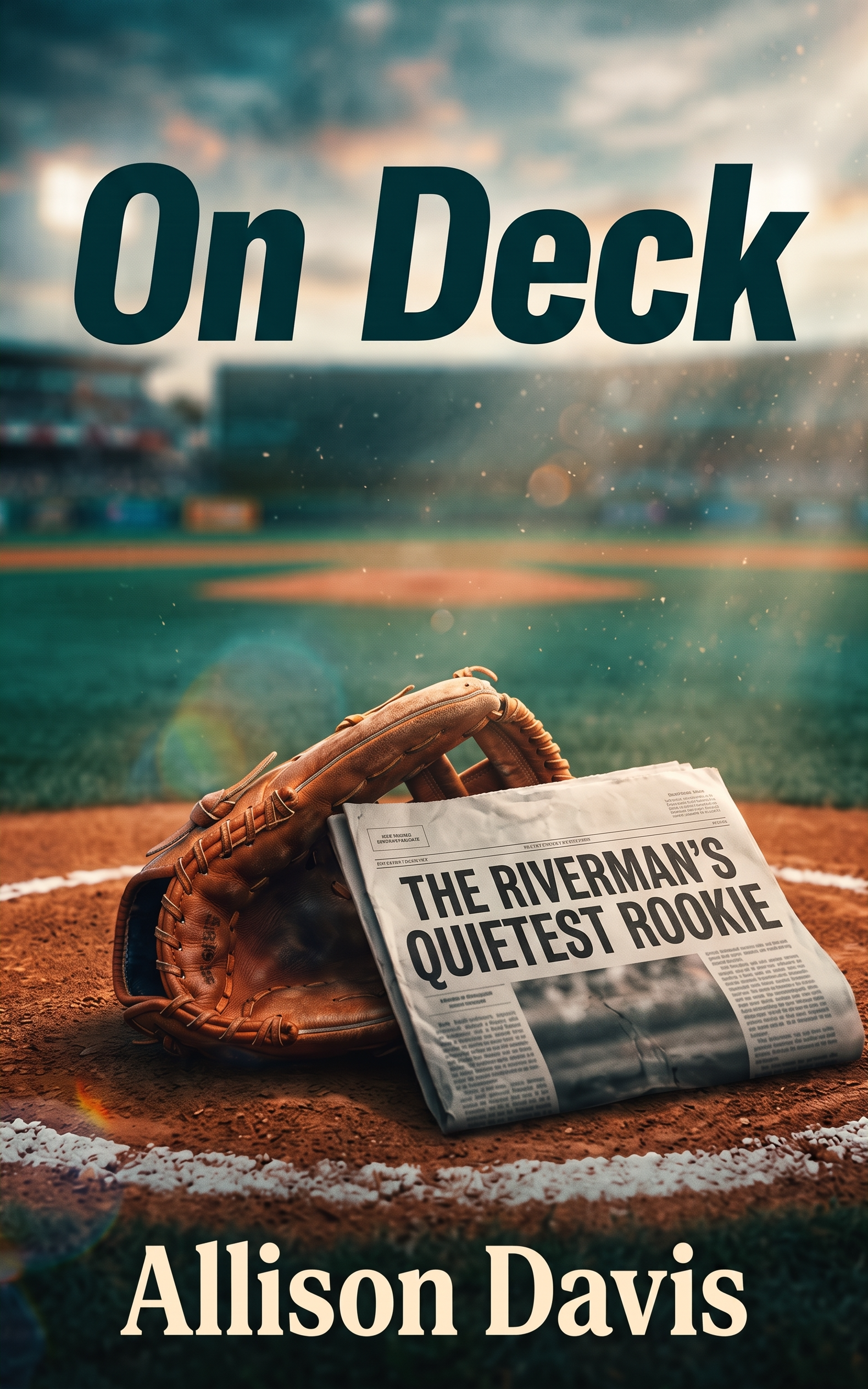
On Deck
A broken rookie and the reporter who sees beyond his icy defensive walls
by Allison Davis
Chase Stone is the Nashville Rivermen's most volatile rookie—a powerhouse at the plate with a temper that keeps everyone at bay. To the public, he's an arrogant enigma. To Emma Collins, he's the only thing standing between her and the career-defining feature she desperately needs. Emma expected a challenge, but she didn't expect a man who communicates in glares and silence. When a chance encounter leaves Chase vulnerable and Emma choosing empathy over a headline, the icy walls between them begin to fracture. Beneath the reputation is a man haunted by a tragic past, one the media once exploited without mercy. Just as Chase begins to trust Emma, a catastrophic on-field injury shatters his confidence and his career. As he spirals into the physical and emotional trauma of rehabilitation, Emma becomes his secret anchor. But when a rival journalist threatens to expose their relationship and Chase's darkest secrets, Emma faces an impossible choice: the career she’s worked a lifetime for, or the man who has quietly become her home. In the high-stakes world of professional baseball, the hardest battles aren't won under stadium lights. They’re won in the moments when you finally let someone stand beside you.
- Romance
- Sports
Chapter 1
The sky over Cumberland Stadium was still the color of a bruise when I pulled into the employee lot, dark purple fading into gray at the edges, the sun not yet willing to commit to the day. Baseball looked romantic before the first pitch. Most people only ever saw the stadium loud and lit up, forty thousand voices layered on top of each other, but I had always preferred it like this — hushed, half-asleep, the kind of quiet that made you feel like you'd been let in on a secret.
I grew up three hundred miles from here, in a town in southeast Missouri small enough that the water tower was the tallest thing for twenty miles, and the Rivermen games came through my dad's truck radio on a signal that cut in and out depending on the weather. I used to lie across the bench seat with my knees against the door and listen to the announcers call balls and strikes like they mattered more than anything else in the world. By the time I left for college, I knew I wanted two things: a byline with my name on it, and a way back to that sound.
I'd landed in Nashville with a laptop bag, a decent camera, and exactly the kind of stubbornness it takes to convince an editor that a twenty-five-year-old with no big-city experience deserved a beat.
Frank was already at the employee gate when I walked up, dented thermos in one hand and a coffee stained crossword folded under his arm, looking like he hadn't moved from that stool since I'd left the night before.
"Morning, Ellie," he said, not even glancing up from the clue he was chewing on. "Early again."
"Early is on time. On time is late," I said, which was something my dad used to say about church, and which I had long since repurposed for baseball.
Frank huffed out something like a laugh and waved me through, and I climbed the stairwell toward the press box with my coffee already half gone and my bag digging a groove into my shoulder that I'd stopped noticing months ago.
The stadium at this hour belonged to nobody but the groundskeepers and the sprinklers, which hissed in long arcs across the outfield grass, and the birds that had figured out the netting behind home plate made for excellent perching. From the press box, I could see the field laid out in its early stages of perfection — the outfield mowed into stripes so straight they looked drawn with a ruler, the baselines chalked fresh and white, not yet scuffed by a single cleat. Somebody had been out here since before I arrived, dragging a hose across dirt that would be pristine for exactly one pitch before thirty players ran across it and ruined the whole effect. I found that oddly comforting. All that work for something that wouldn't last past the first inning. The perfection would be temporary.
I set my coffee down, opened my laptop, and pulled up yesterday's article — already frozen in the permanent, unchangeable ink of the morning edition and floating somewhere in the digital ether. I read it again anyway, cursor hovering over a sentence in the third paragraph that I still thought could be tighter. I changed a word. Changed it back. Changed it again.
"You know that's already out, right?"
Gunnar Miller's voice carried across the press box before he did, a breakfast burrito in one hand and a coffee in the other, his cleats still slung over his shoulder from whatever early routine he'd already finished.
"I'm aware," I said, not looking up.
"It's in print, Ellie. Ink's dry. You can't fix ink."
"I can fix the version in my head."
He dropped into the chair across from me with the easy familiarity of someone who'd done this exact thing a hundred times before, because he had. Gunnar was in his mid-thirties now, one of the last true veterans left on the roster, the kind of player who'd been so good for so long that the team had stopped worrying about when he'd retire and started worrying about what they'd do when he finally did.
"You do this every time," he said, unwrapping his burrito, salsa dripping down onto a stat sheet he had tucked away. "Write something good, then sit here picking it apart like it insulted you personally."
"It's not insulting me. I just think 'stood tall' is doing a lot of work in that sentence."
"It's baseball, not poetry."
"It should be both," I said, and he laughed, the kind of easy, full laugh that made the whole press box feel warmer.
We took our coffees down to the seats behind home plate for the interview I'd scheduled the week before, the same seats we always used because Gunnar said the acoustics were better there, though I suspected he just liked being close enough to the field to keep half an eye on it. I asked him the standard questions first, about his timing at the plate, about the bullpen's early-season struggles, and he gave me answers that were fine, usable, the kind of quotes that would fill space without saying much of anything.
"You're not like the guys from the national outlets," Gunnar said during a lull, adjusting his cleats over his shoulder. "Where'd you say you went to school?"
"Mizzou," I said. "Double majored in Journalism and Sports Management, mostly because I have never in my life done anything the easy way."
He grinned. "Explains the stubbornness. My agent has a degree in sports management and he can't even read a room this well." Then I asked him about his daughter, and something in his whole posture changed.
"She told me last week dinosaurs would make a better mascot than a tiger," he said, grinning around his coffee cup. "Said tigers are 'basically just big cats' and nobody's scared of a big cat. Wants a raptor. Full claws. The whole deal."
"She's not wrong," I said, laughing, already scribbling the quote down even though I knew it wouldn't make today's article. It didn't matter. Some things you keep because they're true, not because they're useful yet.
"She's seven and she's already smarter than half our front office."
"Low bar," I said, and he pointed his burrito at me like I'd made an excellent point.
This was the part of the job nobody told you about in journalism school — that the best material rarely came from the questions you planned. It came from the spaces in between, the moment a guy stopped performing for the recorder and started just talking. I had learned a long time ago that people were more interesting than their stats, that the story worth telling was almost never the one printed in a box score.
Gunnar glanced past me toward the infield, and something in his expression shifted into a kind of quiet respect. "Guy's been out there almost forty minutes already," he said, nodding toward shortstop.
I turned. Mason Callahan was out on the dirt, alone, fielding ground balls off a coach's fungo bat with the kind of unbothered rhythm that made it look less like practice and more like breathing. Field. Throw. Reset. Repeat. No one was watching him do it. No cameras, no crowd, not even most of his own teammates yet. He caught the ball, planted, threw a strike to first base where nobody stood to catch it, and reset his feet before the ball had even landed in the net.
"He does this every morning?" I asked.
"Every morning I've ever seen," Gunnar said. "Nobody makes him. He just shows up early and does the work nobody's gonna clap for."
We wrapped the interview a few minutes later, Gunnar heading off toward the clubhouse with his empty coffee cup and a promise to bring me one of his wife's peach muffins before I left for the day, and I was gathering my notebook and laptop when my phone buzzed against the plastic seats.
Ben Carter's name lit up the screen. My editor rarely called this early unless something had gone wrong or something new had landed on his desk, and given the tone of his voice when I picked up, I was betting on the second one.
"Hayes," he said, which was how Ben started every conversation regardless of whether we were standing three feet apart or on opposite ends of a phone line. "You at the park?"
"Behind home plate as we speak."
"Good. I need a feature. Full profile, twelve hundred words, maybe more if it's good enough."
"On who?"
"Chase Stone."
I sat back down in the seat I'd just stood up from. Everyone in the building had heard some version of the same story by now — the rookie with the swing scouts had been drooling over since he was nineteen, and the temperament that made every beat reporter in the city quietly grateful he wasn't their assignment. I'd watched him walk past a cluster of reporters after a game two weeks ago without so much as a glance, jaw tight, eyes forward, like the questions being lobbed at him were beneath acknowledgment.
"Ben, he doesn't talk to anybody. He walked out of a press conference last month because somebody asked him about his exit velocity."
"I'm aware."
"So why me?"
"Because you're good at this," Ben said, in the flat, unbothered tone he used when he'd already made up his mind and didn't feel like debating it. "And because everybody else who's tried has written the same eight hundred words about a kid with a bad attitude and a good bat. I don't want that story. Anybody can write that story."
"Then what do you want?"
There was a pause on the line, just long enough that I could hear the newsroom noise behind him, phones ringing, someone laughing too loud near the coffee machine.
"Don't interview the prospect," Ben said. "Interview the person."
He hung up before I could ask him what that was supposed to mean in practical terms, how exactly I was meant to get a man who wouldn't give a two-word answer about his batting stance to open up about anything resembling a life outside the lines. I sat there for a moment with the phone still warm against my ear, the field in front of me now filling in slowly, more players trickling out for stretches and soft toss, the stadium shaking off its quiet the way it did every morning around this time.
I flipped my notebook to a fresh page, uncapped my pen, and wrote his name at the top in careful letters.
Chase Stone.
I stared at the blank space beneath it for a long moment, waiting for an angle, a question, anything, and came up with absolutely nothing at all.
Chapter 2
We had a tough loss in St. Louis, a ballgame that slipped away in the eighth inning on a two-run double that should have been caught. I was down in the interview area when the clubhouse doors opened, notebook ready, digital recorder already blinking red in my hand, and I got my first real look at Chase Stone up close. He came through the tunnel lik…